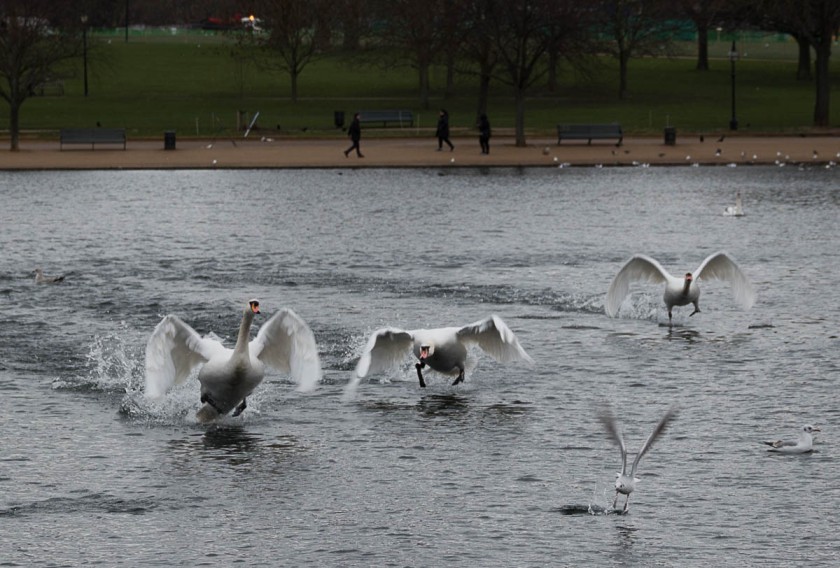
“The wild duck startles like a sudden thought… “

This photo reminded me of the line from John Clare (1793-1864) that I have used as my title:

P1090181.jpg

The Sherbrooke used to be home to many over-wintering waterfowl, but in recent years there has been less open water because of silting and aquatic plants. Some clearing this year has given us back more open water this winter:

P1170479

so I thought I would show you a couple of photos. One is a year-round resident, the coot, and at this time of year the males start jousting for territory:

Coot males territoial display

The other is a winter resident, the wigeon. There are only about 400 nesting pairs in the UK, where they nest up in the North of England and Scotland. But in the winter there are about 440,000 birds, most of whom return to breed in Iceland, Scandinavia and Russia. This photo shows a male and a female.

P1170504

They come in flocks, and feed both in the water and on grass:

P1170454

Because there are large numbers of winter birds at only a few sites, their UK conservation status is Amber, so it is terrific to have them in Sherborne.

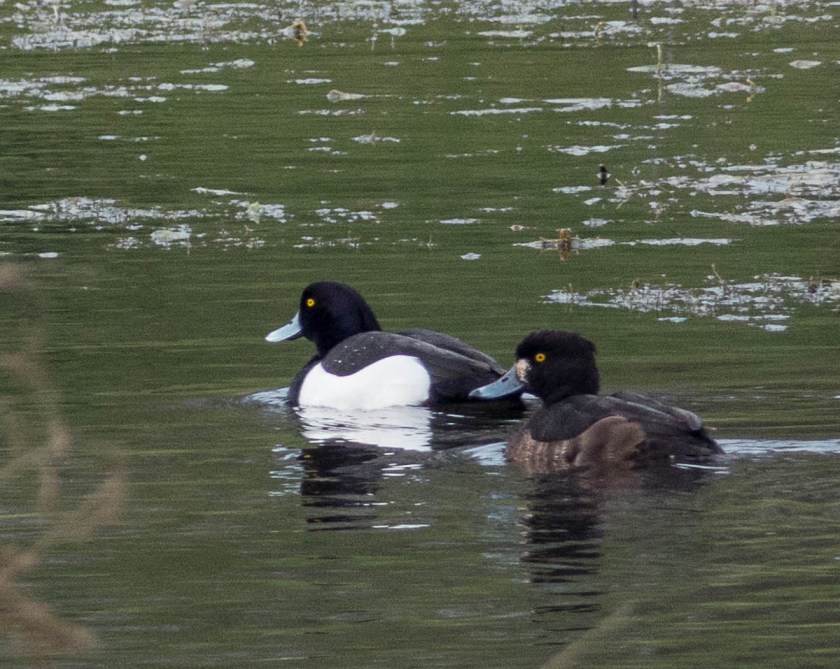
In past years we have also had tufted ducks, but this year I have only seen the odd pair.

Tufted duck pair

There is a reason children play with rubber ducks and not rubber geese: ducks just ooze charm.

Good neighbours

Trees do not waste their energy growing branches and twigs whose leaves will not reach the sunlight. In this little grove of trees, the two on the left and right edges have put all their efforts into growing branches on the exterior of the clump, and almost none in the middle. The trees in the middle have simply grown straight up, adding twigs and leaves at the top.  As a result, the entire copse has the same shape as a single tree growing all alone in the middle of a field, and each individual tree gets a decent share of the solar power.

P1170205

It somehow reminds me of Indian dancers with many arms:

Indian-dance-multiple-arms

[Photo credit: By Will Folsom [CC BY 2.0 (http://creativecommons.org/licenses/by/2.0)%5D, via Wikimedia Commons]

In writing this, it occurred to me that English has many names for a small group of trees: coppice, copse, spinney, stand, grove. I chose “grove”, “clump”, and “copse”, just for variety.  Unsurprisingly, we also have lots of names for rain: shower, drizzle, downpour, deluge, .. and indeed for coffee.


Landscape Ornaments

The Sherborne Estate includes farmland and parkland landscaped in the eighteenth  century, in the era of Capability Brown. The designer was Charles Bridgeman. No aristocratic landscape would be complete without the right sort of decorative wildlife.

A rainy weekend, but the weather eased enough for a misty walk, and there above us on the hill posed a herd of fallow deer, with a fine buck at their centre. The photo makes it look as though he still has velvet on his antlers, but that is a trick of the light. At this time of year the velvet has long gone. Fallow deer are the only deer in the UK with palmate antlers (like moose), and at 3-4 years the antlers can be 70cm long.

Some fallow deer are pale fawn and spotted  (at least in summer); but these are plain and darker. The male can measure up to 94cm at the shoulder, and weigh up to 94Kg. They were originally brought to England from the Western Mediterranean by the Romans.

Fallow deer

In the seventeenth century the Duttons (owners of Sherborne) built a deer-coursing lodge, Lodge Park (owned by the National Trust). Deer were chased by dogs, and killed in front of the lodge as a spectacle for honored guests. Luckily those days are gone, but Lodge Park is worth a visit..

Down by the brook there are currently five resident swans, three above the weir and two below it. The pair below the weir are older, and the cob (the male) defends his territory fiercely against the upstart youngsters further upstream. Here they are in the shallows, preparing for their pas de deux:

swansswansswans


Eminence grise

Here in the Cotswolds the local stone is golden when the sun strikes, but in winter both the buildings and the landscape can look grey. But then the evening sun gilds the water, and the grey heron patrols the edge of the brook, and grey seems not such a bad color after all.

P1170111

The grey stone walls offer rewards if you have an eye for detail: the snail is a white-lipped banded snail, (Cepaea hortensis), and the indomitable lichen (Caloplaca flavescens?) already has fruiting bodies preparing to disperse spores.

P1170141

In compensation for the greyness, spring comes early in England, with a flash of gold. These winter aconites (Eranthis hyemalis) are out on January 19th, ahead even of the snowdrops. They are native to Europe, but naturalized throughout the UK.

P1170095

PS. For copyright reasons, I decided against entitling this post Fifty Shades of …

Undocumented migrants

P1170031

The temperature is 2C as I write, and brightening up my very urban and fairly monochrome London backyard…

P1170040

… there be parrots.P1160959P1170054


Londoners may not be surprised, but the rest of you probably associate London with pigeons, not parrots. This pigeon-toed pigeon is looking down on these foreign arrivistes in quivering disbelief, if not affront:

P1170034

The bright green invading hordes are Ring-necked Parakeets (Psittacula krameri manillensis), and there are many theories as to how they arrived in England from India, but they are now very well established in London and the South East. They have been breeding in England since 1969, and the latest count had 8600 breeding pairs. Read this if you would like more background:

https://londonist.com/london/great-outdoors/london-s-parakeets-everything-you-need-to-know

They travel in noisy flocks, sometimes hundreds strong:

P1160994

and perch or preen on anything tall, including TV antennae.

P1170046

At this time of year they are pairing off:

P1170062P1170074


I photographed all these from our fourth-floor balcony, as they preened to fluff up their plumage for our Northern climes.


P1160965

PS: They are also called Rosy-necked Parakeets, here’s why:

P1170048

And I am thrilled they have come to live in my city.


In the deep midwinter..

In the last few days we have watched the pristine beauty of an icestorm on Christmas Eve, followed by six inches of fresh powdery snow on Christmas morning.

And through the deep deep freeze life goes on. Our new granddaughter Ellie arrived today, 8lbs 3oz and a lot of black hair!

IMG_0102
Japanese maple bud encased in ice after an ice storm on Christmas Eve in Carlisle, Mass


Red and white…

The scarlets and vermilions of these Ecuadorian cloud forest wildflowers eclipse any poinsettias in my local shops.

Or these:

Or these:

But our colder Christmas surroundings bring snow and frost, with a different whiter beauty.

IMG_1235


P1060535

IMG_1298

And so enjoy this time to remember old and true friends, and reach out to new ones.

IMG_1387

Have a wonderful Christmas and New Year.

Two toucans too..

Ecuador has five or six proper toucans: they are my kind of bird, being large and grand and brightly colored, so even I can see them.  Most are sub-tropical, but some are montane species living in the Andes cloud forests on the Western slopes, like my first one.

This male Plate-billed Mountain Toucan was perched on a branch near his nest, and inside the nest hole his mate was sitting on their eggs.  We thought he had brought food to sustain his lady-love, but eventually he selfishly ate this himself. The huge beak has serrated ‘teeth’, but despite this vicious-looking piece of machinery they are mainly fruit-eaters, supplemented by only occasional insects and lizards.

Plate-billed Toucan

The nest is in a perfectly round hole in a tree, and the female was not visible, although the guides said they had seen her.

P1130680

These are birds that really shouldn’t be able to fly: their bills are enormous, and they look ludicrously unbalanced. The mystery was solved for me a few years ago in Brazil, where my lodge had a toucan’s bill on display. It turns out they are extremely light, being made of bony struts filled with a spongy keratin-like material. The photo below shows off his fine wings, which must help manage that beak in flight.

Plate-billed Toucan

My other toucans were Black-mandibled Toucans, also known as Yellow-throated Toucans, living in the sub-tropical Sumaco area on the Eastern slopes, in a large fruiting tree near my lodge:

P1150180

They have bright blue feet, and flashes of red on the vent.

Yellow-throated Toucan

This one was part of a devoted pair, who spent long periods sidling up to each other, and taking turns grooming each other surprisingly delicately with those gigantic beaks.

Yellow-throated ToucanYellow-throated Toucan

A final check:

Yellow-throated Toucan

And time to pose for their portrait.


P1150243(In breeding season, pairs separate out from the larger flocks in which they mainly live.)


(Monty) Python

Spoiler alert:  Vegetarians should stop reading now!

Out one night with a flashlight, we came across this slender, elegant snake on a tree trunk, enjoying a late-night snack:

Common Blunthead eating lizard

From this angle, the poor lizard has a disconcertingly human sacrificial appearance.

More dramatically, we were on the Napo River in a small boat watching flocks of parrots on a clay-lick, when the guides suddenly became very excited, pointing at the trees in the top right-hand corner of this photo:

Salt lick where parrots come.  In top right hand corner we also saw a boa.

None of us could see anything, but after some considerable time they calmed down enough to explain that a very large python was draped among the creepers, and it had caught a parrot. So, here are two photos taken twenty minutes apart, at a considerable distance, and from a rocking skiff,  of the cruel constrictor.

In the first one, the poor parrot is being slowly asphyxiated.

Boa constrictor strangling and eating a parrot

And in this second one, it is halfway down (actually, up) the snake’s gullet, beak first (which you would have thought might be rather painful, but then feet first wouldn’t be great either).

Boa constrictor strangling and eating a parrot

A genuine ex-parrot. (Credit: Monty Python).

A Red-tailed Boa, by the way, can get big enough to eat a deer, so a mere parrot doesn’t have much chance.

To cheer you up, here are the ones that got away.

Blue-headed parrots and Dusky-headed paraqueets
Blue-headed parrots and Dusky-headed paraqeets
Yellow-crowned parrots and Mealy Amazon Parrots

Yellow-crowned parrots and Mealy Amazon Parrots