A secret pool: 2

“What’s in a name?” 

As I was sitting quietly on a log watching the muskrats, a male Wood Duck, Aix sponsa, flew in right over my head and landed in front of me. In the 20 seconds or so before he noticed me and took off in hurry, I managed a photo: he is in full breeding plumage, very splendid: *
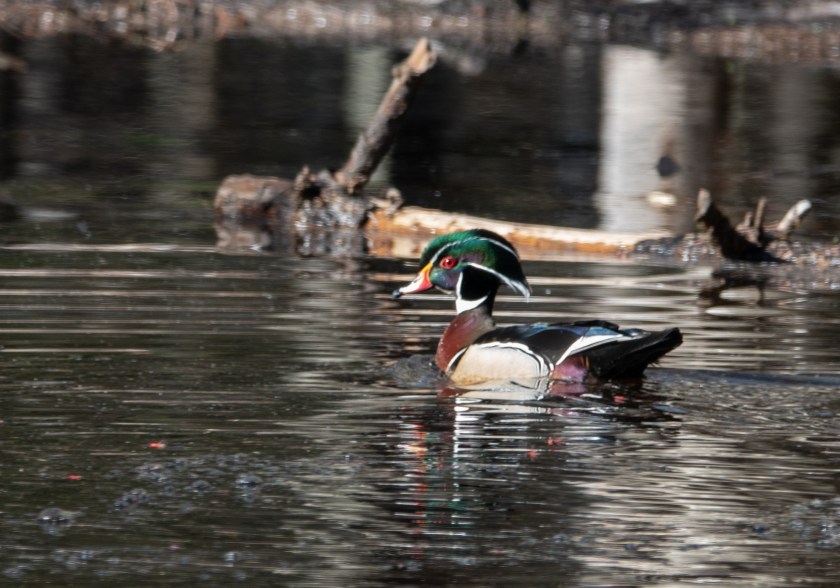
Male wood duck in breeding plumage

The second half of the scientific name, sponsa,  alludes to his resplendent turnout, in the hopeful expectation of being the groom at a wedding.  His intended spouse,  however, was nowhere to be seen.

The next morning, more water birds.  These are Hooded Mergansers, Lophodytes cucullatus.
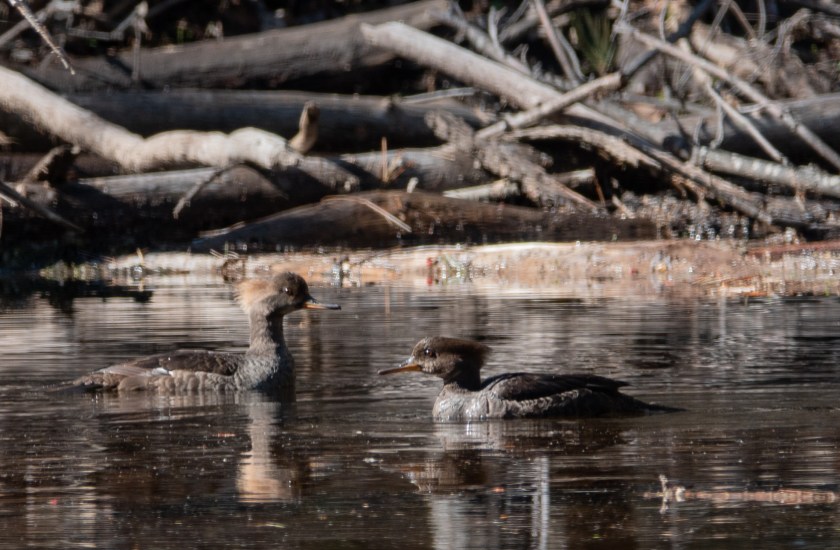
Hooded mergansers, females or juveniles

Another apt name: cucullatus is related to the word cowl, as in a monk’s hood. It even has a tonsure!
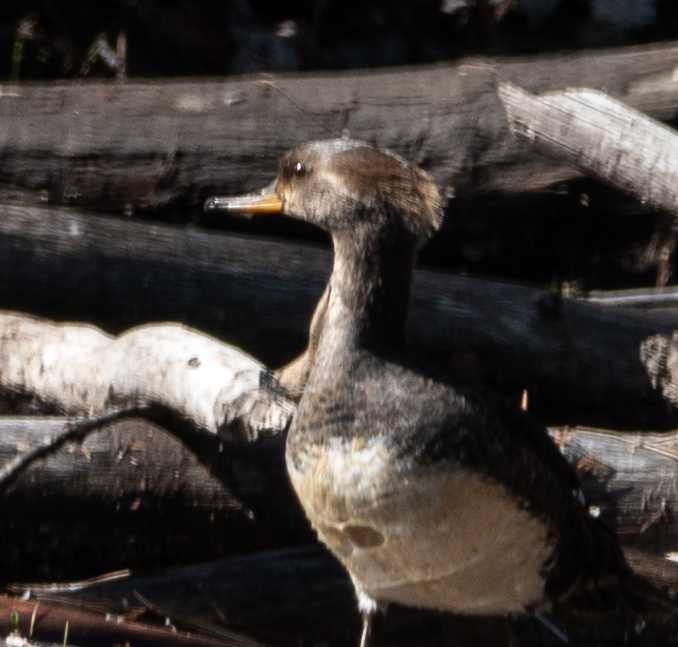
Hooded mergansers, females or juveniles

These two seem to be either both females or juveniles because the male would be more spectacular.

The next evening, a male Northern Flicker, Colaptes auratus,  flew in to the very top of one of the tallest dead trees.
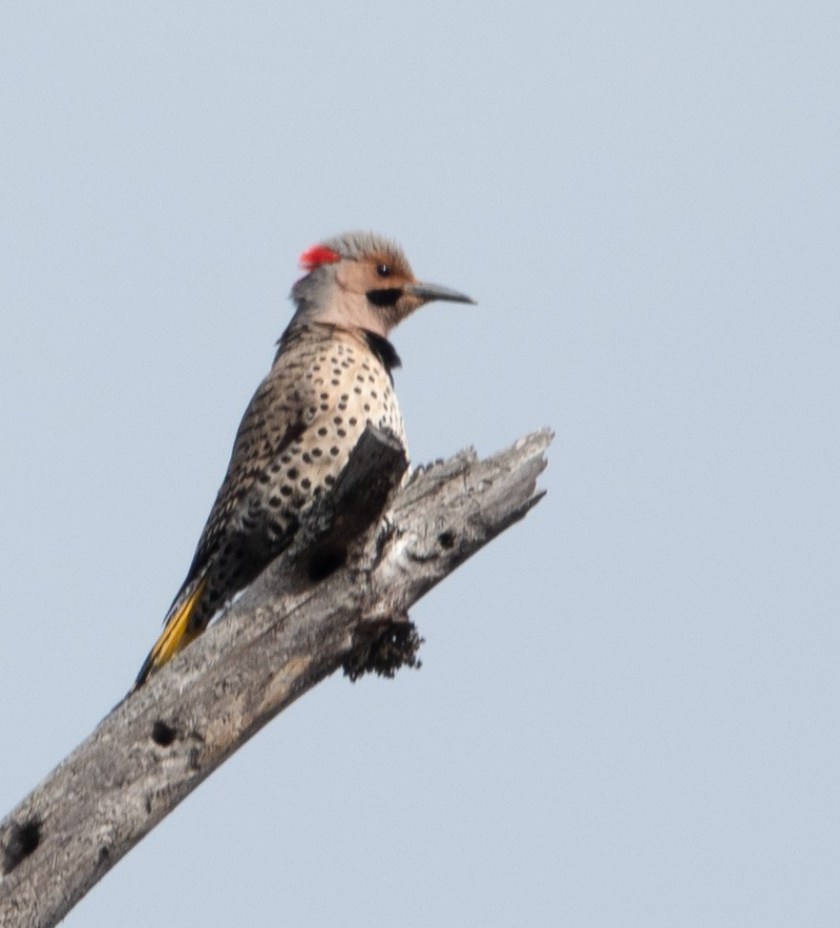
DSC09259

Notice the bright yellow (auratus) underside of his tail, found only in the Yellow-shafted subspecies of the Eastern US. They have a varied diet of insects and fruit, nuts and berries, but 45% of their diet is ants.

This one was not feeding; he was on a different mission. He alternately called and then drummed on the very end of the branch, typical territorial display for the springtime. Unlike most woodpeckers, they largely feed on the ground, so the drumming is unlikely to be foraging. Here is a short video:


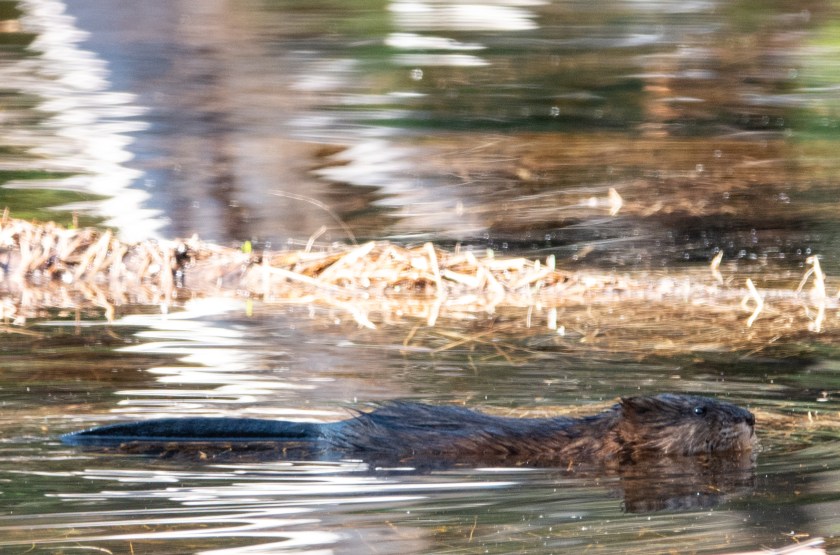
And then the icing on the cake, for me. This beaver pond and all the others on my land were bereft of beavers last summer, and I didn’t see a single one. But as I was walking away, standing right out in the open, I saw a giant muskrat…… no, a beaver, the creator of this magical place! Happy days.
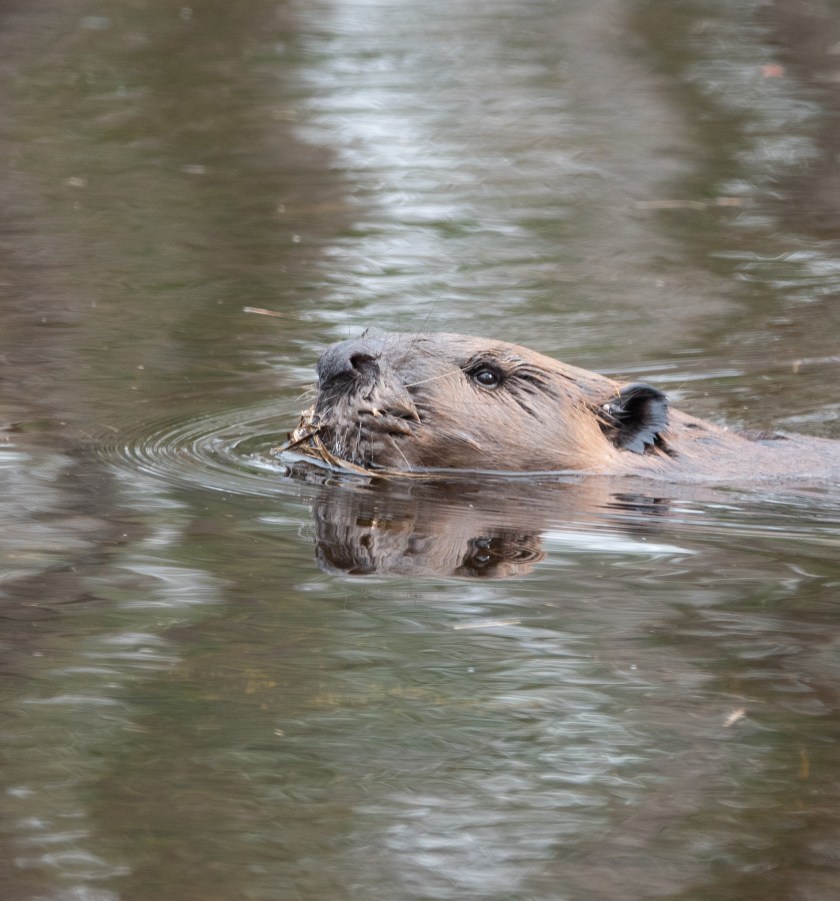
Beaver

(I am slightly worried that the poor beaver has a porcupine quill stuck in his upper lip? But maybe it’s just part of his mouthful of vegetation.)

* PS: In Florida three weeks ago I saw this pair of wood ducks, high in a tree. They will nest up to 65 feet up. As you can see the closer female is relatively drab:

P1040749

They breed all along the East coast of the US, but in winter the northerners all move southwards, rather like Canadian retirees.

A secret pool: 1

Back to the present, and the less exotic. Behind my house in Maine there is a small beaver pond, currently seemingly abandoned since the dam is not being maintained.  These ponds are scruffy places, full of dead trees, but they create openings in the dark forest that are home to all sorts of wildlife. All the photos in this and the next posting were taken last week on my pond. The small teepee-like pile of sticks, background, left of centre, is the old beaver lodge, and as you can see I had to take my photos from some distance.

DSC00170

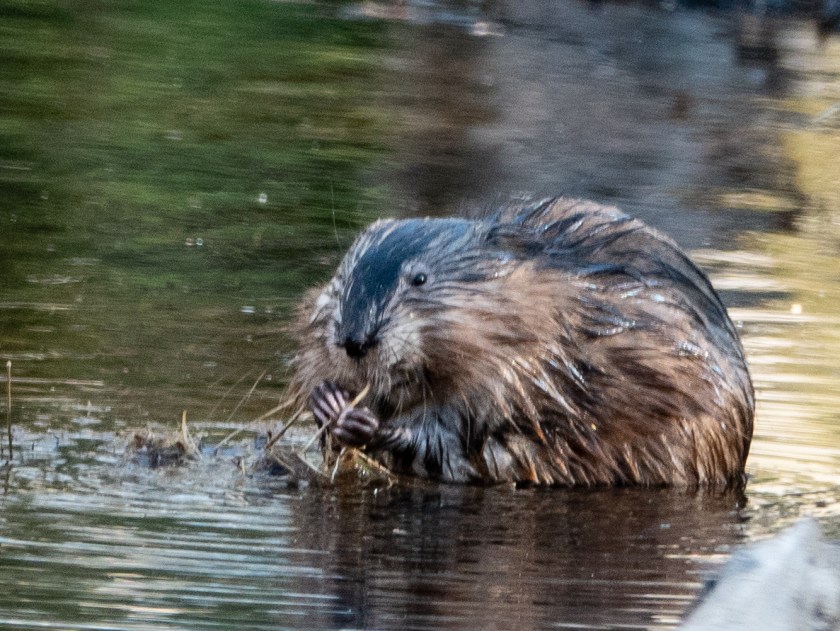
There are two muskrats living in the pond this spring.


Muskrats, Ondatra zibethicus, are about a foot long, with another 10 inches of bare black tail.

DSC08952

At first glance they could be very tiny beavers, but the tail is quite different, round at the base and then flattened vertically:

DSC00286

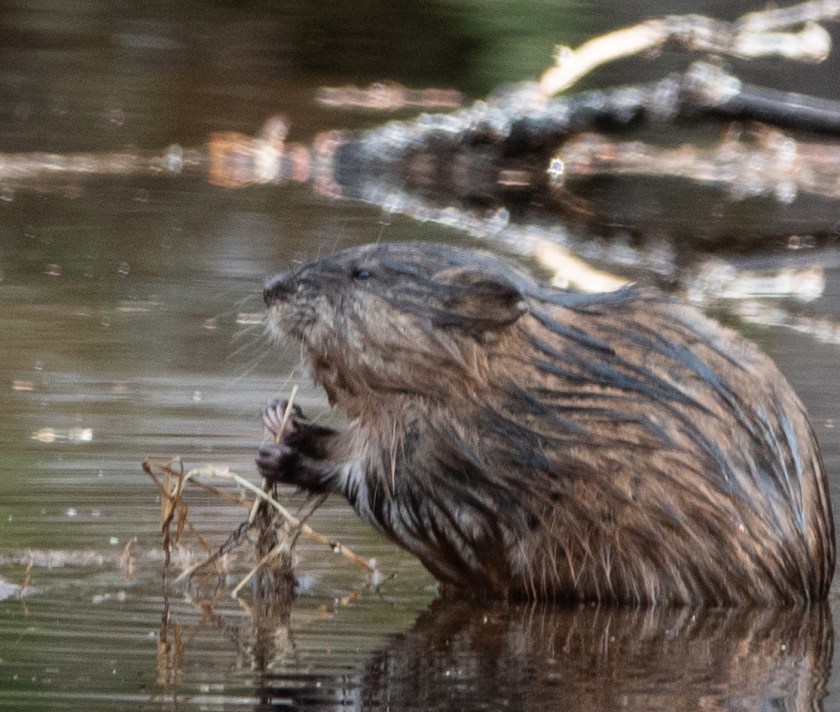
They are living in the old beaver lodge, and they emerge to eat roots, rhizomes, shoots and leaves, which they wash obsessively first, before eating them delicately:

DSC09068

This video shows one eating, washing,  and eating its lunch, in their typical frenetic fashion:


They are feeding from a feeding station in the middle of the pond, exactly at water level, so that they can reach to wash their food easily, and are also safe from predators. If the water level goes up or down, they choose a new feeding station. They slide off to get more food, and return to the same spot for the next course. Their front feet are able to manipulate the food with great precision:

DSC09537

Their hind feet are much larger:

DSC09518

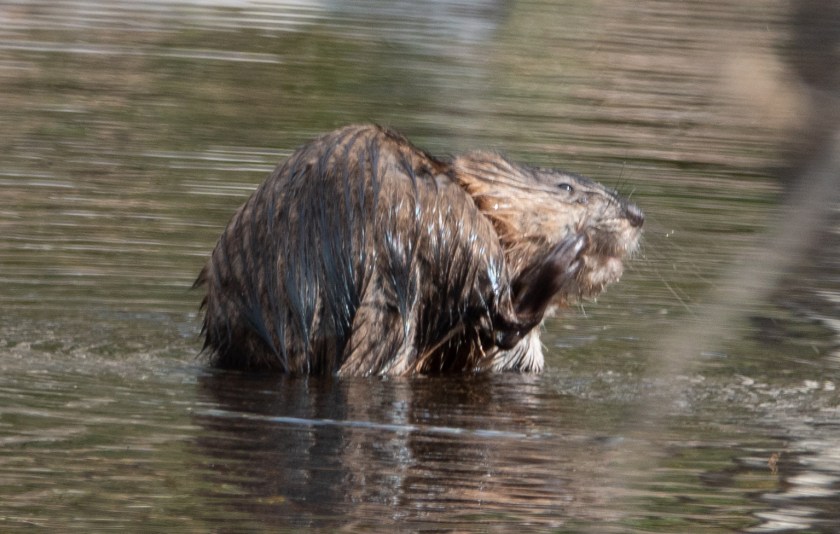
I suspect they have young in their lodge, because the next morning they were busily diving for vegetation, then taking it straight back to the lodge, instead of eating themselves:

DSC09492

A litter will have 4-6 kits, and they are born naked. When the mother leaves to feed, she covers them with shredded vegetation to keep them warm, so this may be bedding, not food, that she is carrying back. They are ready to live on their own by 4 weeks, and she may have 3 litters a year.

In the winter, muskrats gather in groups in larger lodges for warmth, and move around under the ice, making occasional holes through which to breathe and feed..

PS In its native North America the muskrat is doing fine, although it used to be heavily hunted for its long thick fur.

DSC09186

It was introduced into Europe for its pelt, but has now become a serious pest in some countries, where among other things it burrows through Dutch dykes, presumably creating jobs for little Dutch boys who use their fingers to plug the holes ….

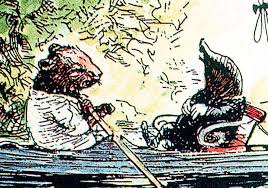
PPS Ratty in Wind in the Willows, is actually a water vole. He is on the left below. He is about 2/3 of the length of a muskrat.

images-3

Kenneth Grahame describes Ratty thus:

“Dependable and thoroughly decent, with a fondness for impromptu picnics and impeccable taste in clothes, this twinkly-eyed country gentleman would take you out for a glorious day on the river before asking you, as the sun began to set and he draped his jacket over your shoulders, whether you’d care to have dinner with him next week.”

In 2011 readers of Country Life ranked Ratty second only to the gamekeeper Mellors in Lady Chatterley’s Lover as their favorite “lusty literary hero”.

Go figure.


The mother, the jewel and the clown

[The first photo is honor of US Mother’s Day tomorrow!]

Maternal love is not to be explained. This warthog and her baby are clearly struggling in this harsh arid environment, but their mutual gaze is every bit as loving as that of  Mrs. Bennett and her offspring.

Note the Red-billed Oxpecker looking on, oblivious

dsc08898.jpg

Beautiful the warthog is not, but Ethiopia has bejeweled wonders for the taking, like this Northern Carmine Bee-eater:

Northern Carmine Bee-eater

Other birds are almost comical:

Double-toothed Barbet

This is the Double-toothed Barbet, named after its unusual beak, seen here in close-up:

Double-toothed Barbet

The notches help it hold onto live and kicking uncooperative prey, like scorpions or frogs.

My last photo is blurry, because the camera insisted on focussing on the branches not the bird,  but this male Nile Valley Sunbird in his breeding plumage is so fine I thought I’d include him anyway.

Nile Valley Sunbird, male in full breeding plumage

The Fish Market: strictly for the birds

[If you only want to see the birds, they are mostly near the end of this post!]

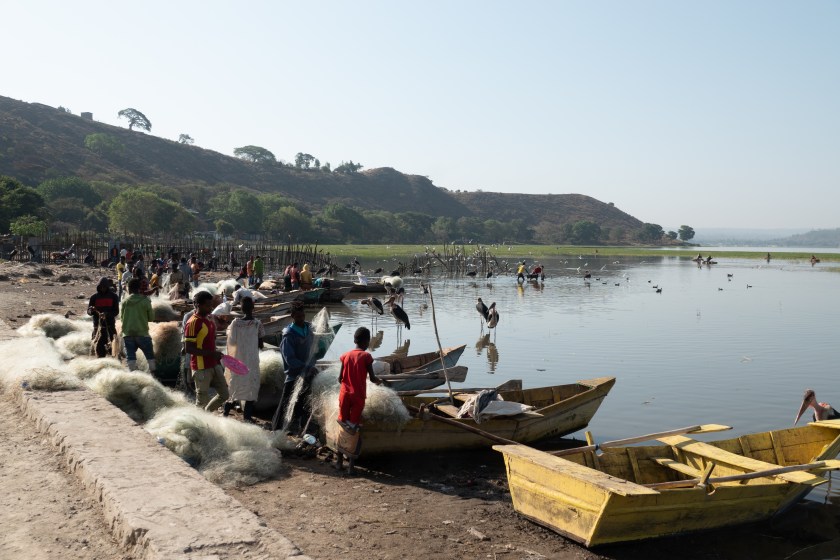
There are two fish markets on Lake Awasa in Ethiopia, and they attract a rich melange of human life and wildlife, in a symbiotic balance that has probably changed little for centuries. The boats are skiffs:

DSC07542

And there are dozens of them:

DSC07398

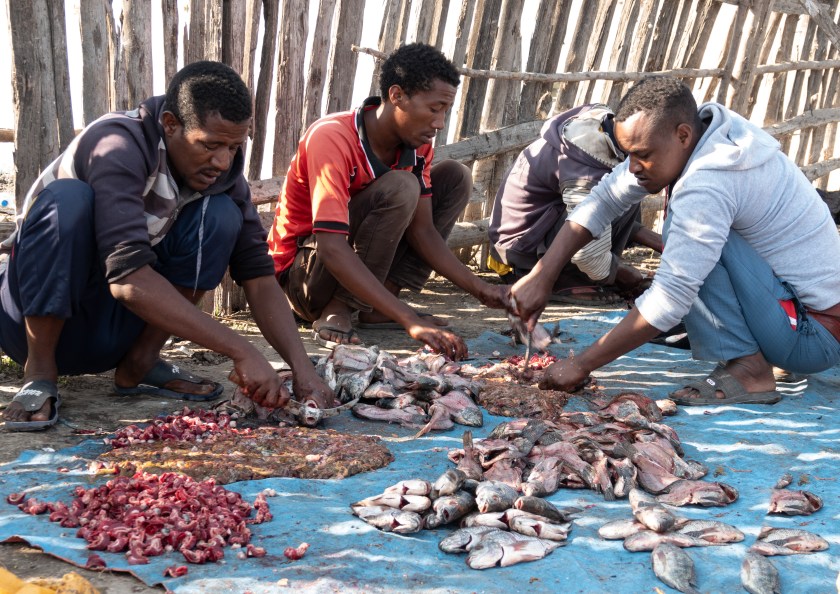
The fishermen clean the fish with ferocious mini-scimitars and sell them to middlemen:

DSC07440

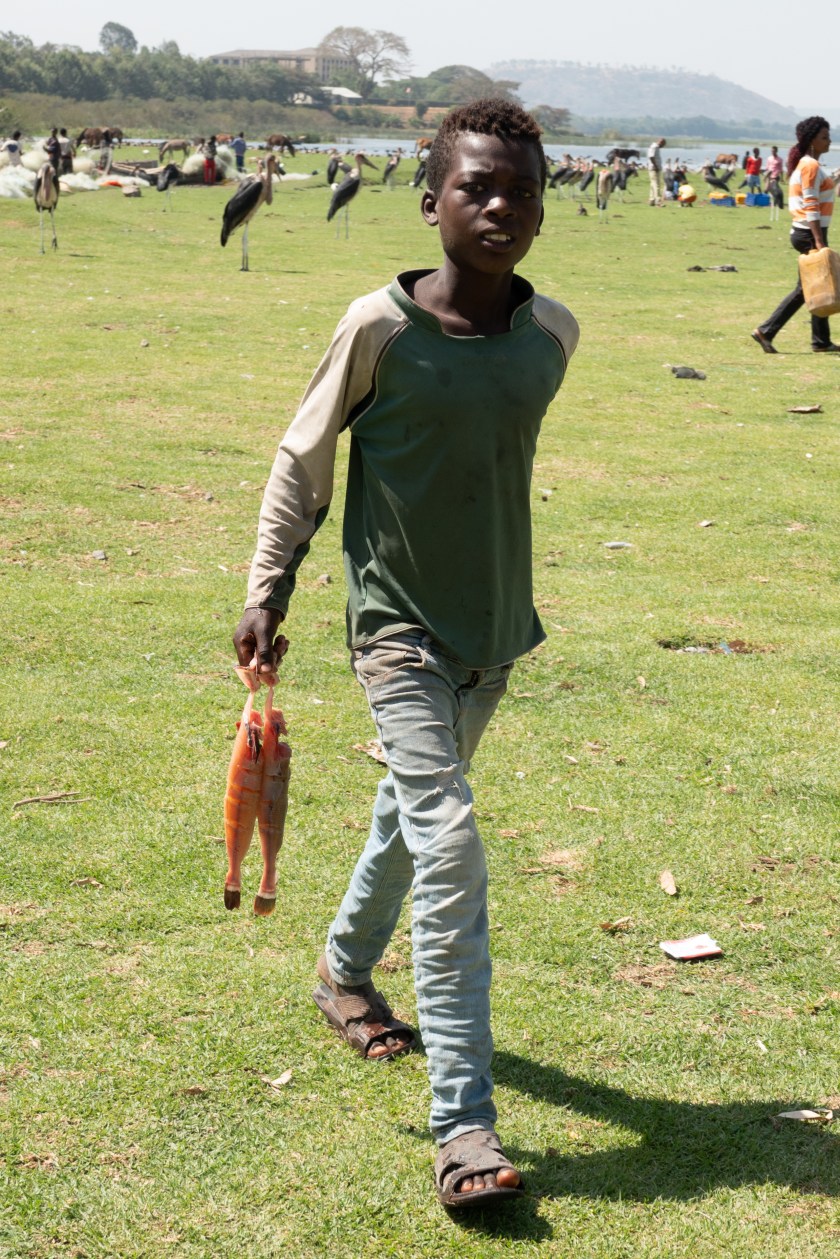
Who in turn sell to local buyers:

DSC07584The pelicans hang around hoping for discards:
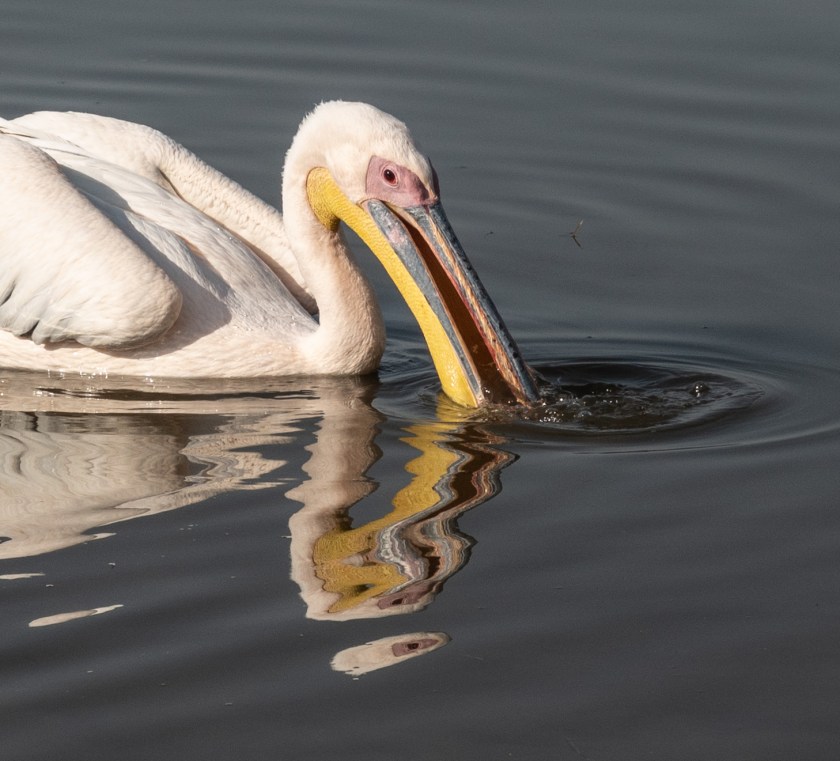
Great White Pelican

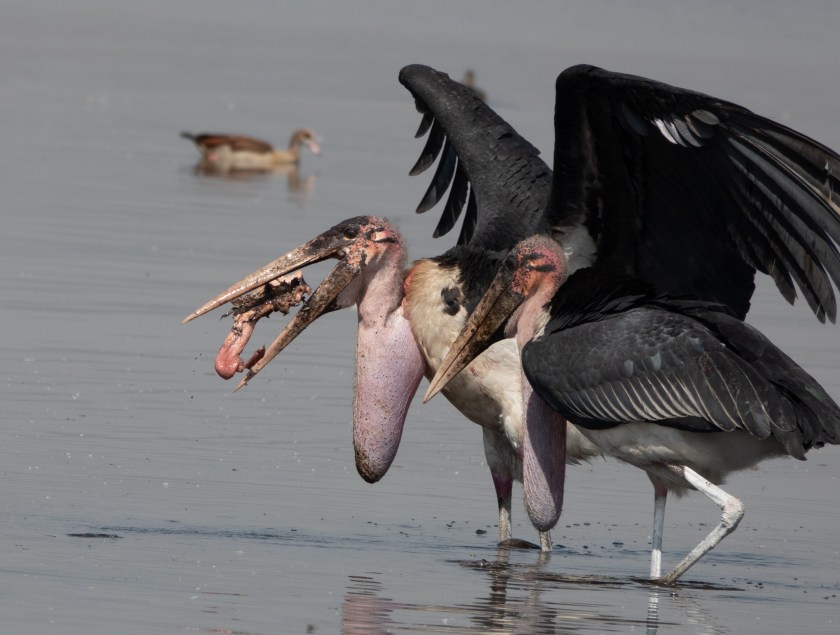
The entrails are sold for “rich man’s dogs” to eat, but there are plenty left over that are cleaned up by the marabou storks:

Marabou Stork.

though this stork has clearly scavenged from something much larger:

DSC07491

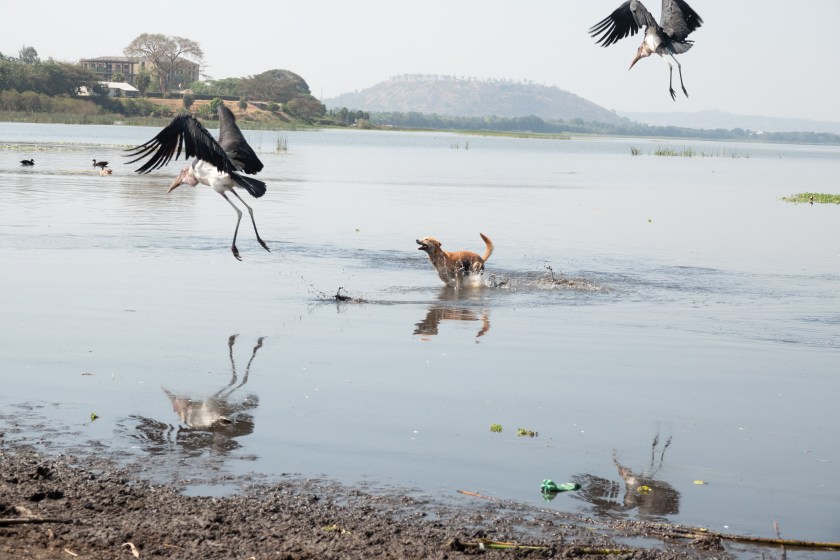
The  half-wild village dogs chase the storks (unsuccessfully, and the storks are much larger than them anyway, their 12 foot wingspan is the largest of any living bird):

DSC07507

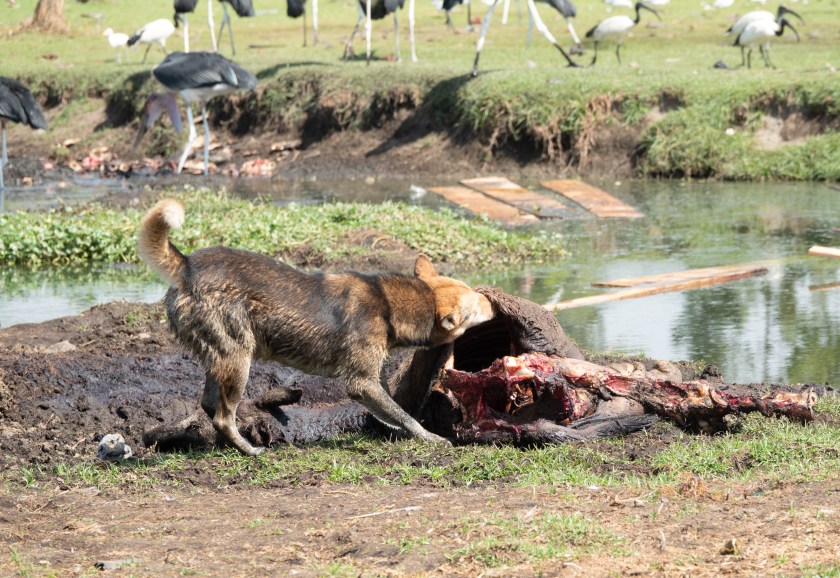
And they also scavenge the carcasses dotted around the shoreline:

DSC07576

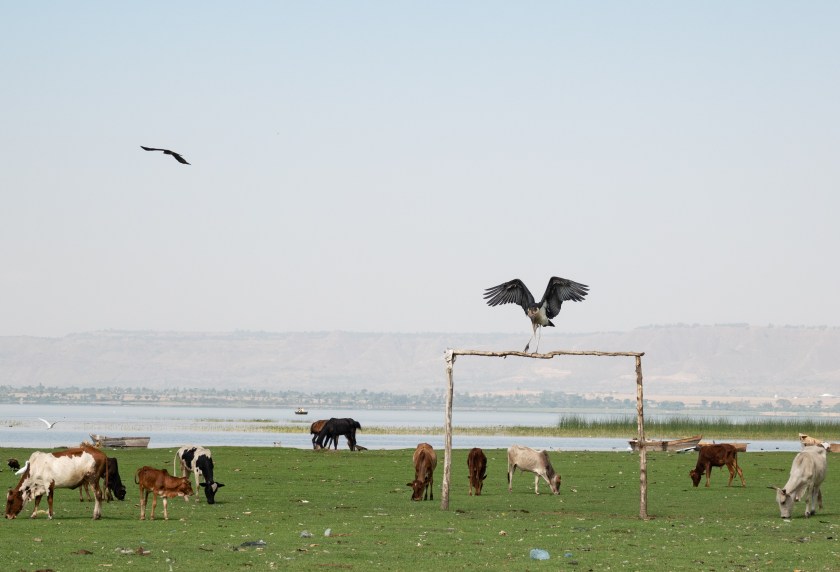
On land there is a party atmosphere. Kids play soccer, though this goalie is rather unorthodox:

Marabou Stork. Goal.

At the back, stalls sell fish soup:

DSC07465

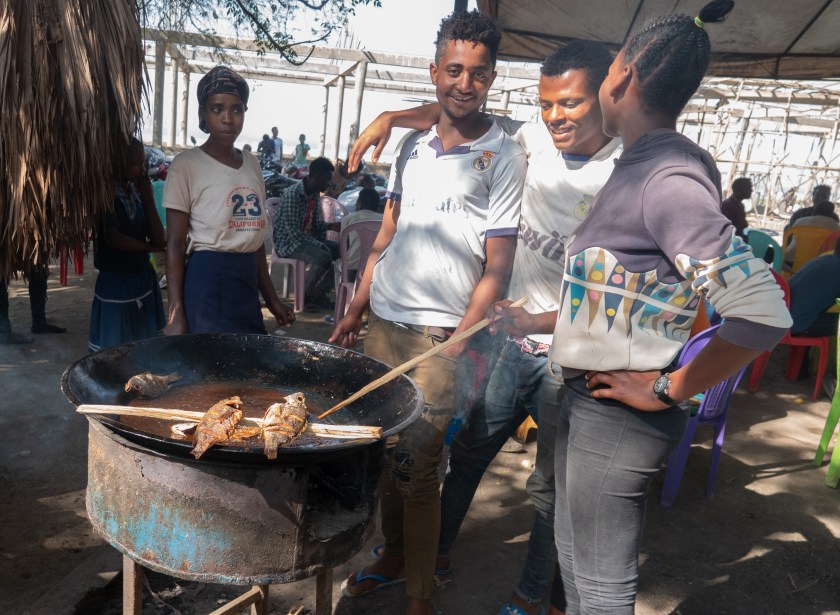
Barbecued fish:

DSC07461

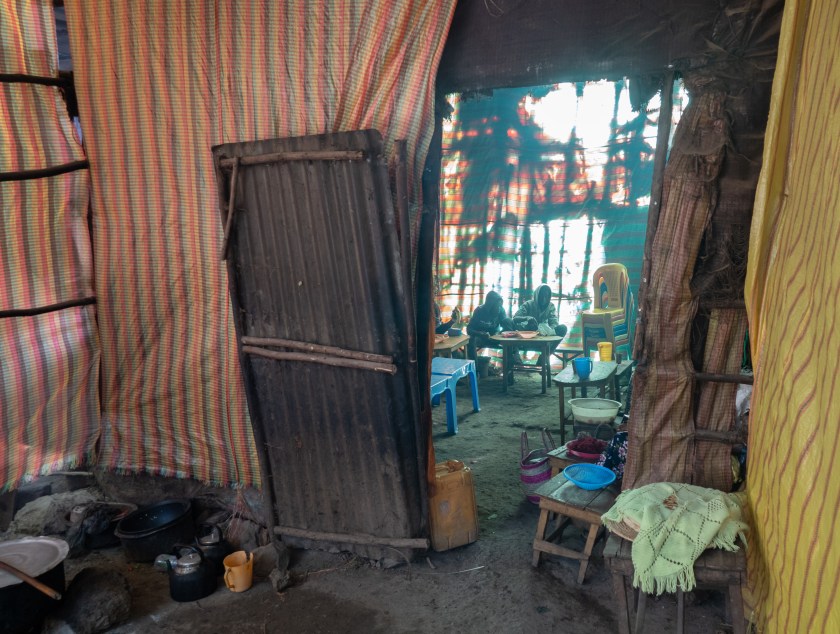
And in the back rooms , something else:

DSC07467

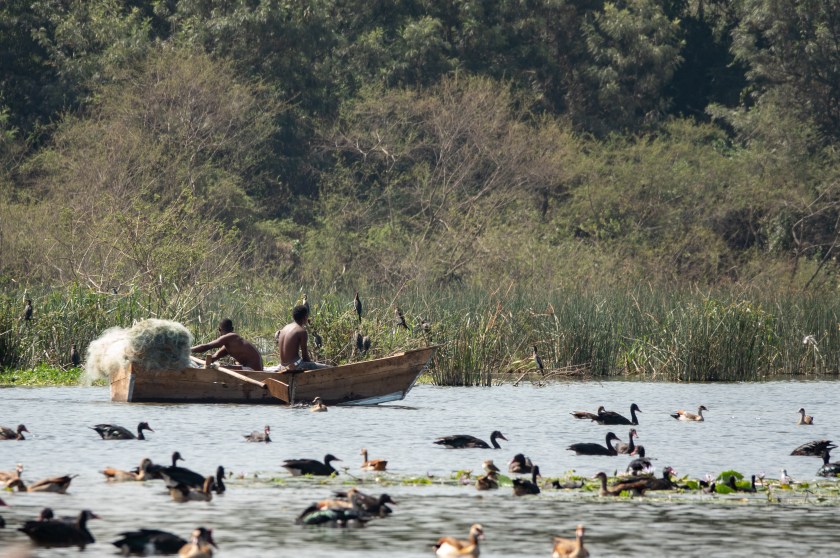
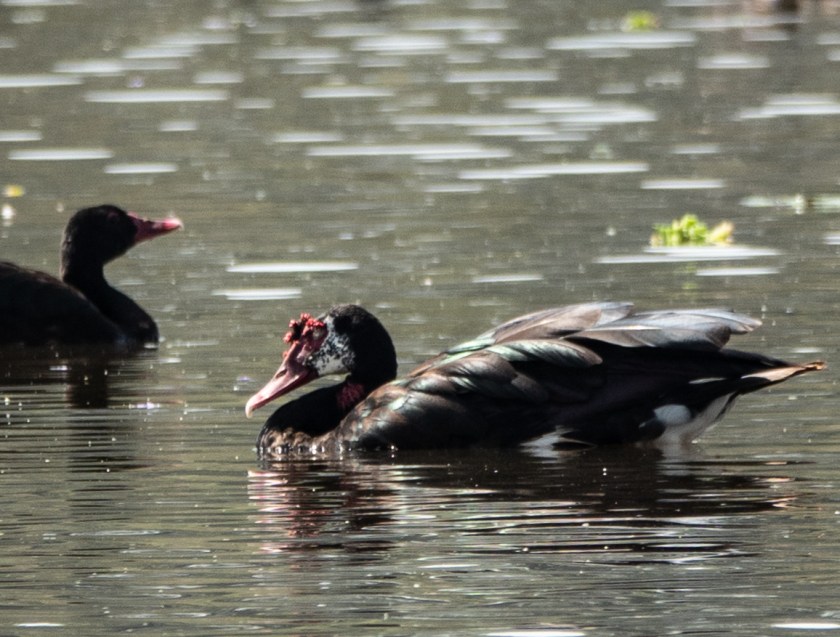
In the water, birds abound. A spur-winged goose:

Spur-winged Goose

An African jacana male, with its blue forehead  shield :

African Jacana, male

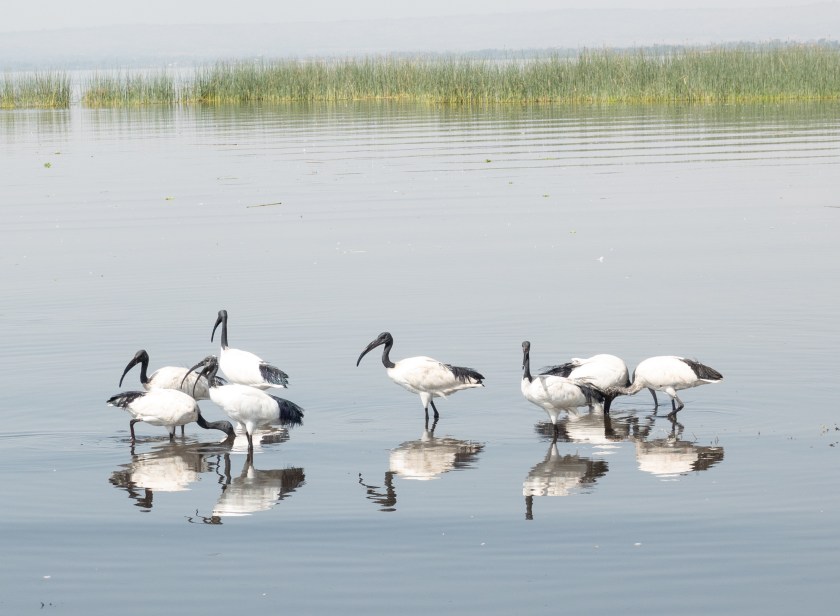
Sacred Ibis:

DSC07534

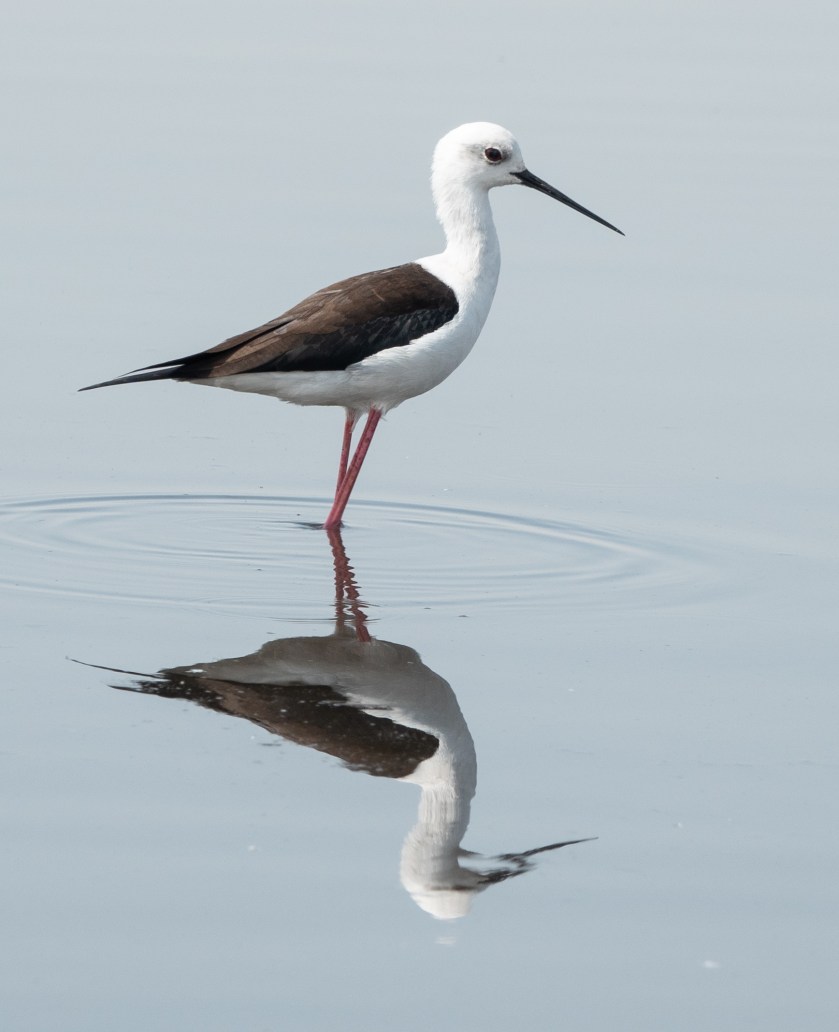
A Black-winged Stilt:

Black-winged Stilt

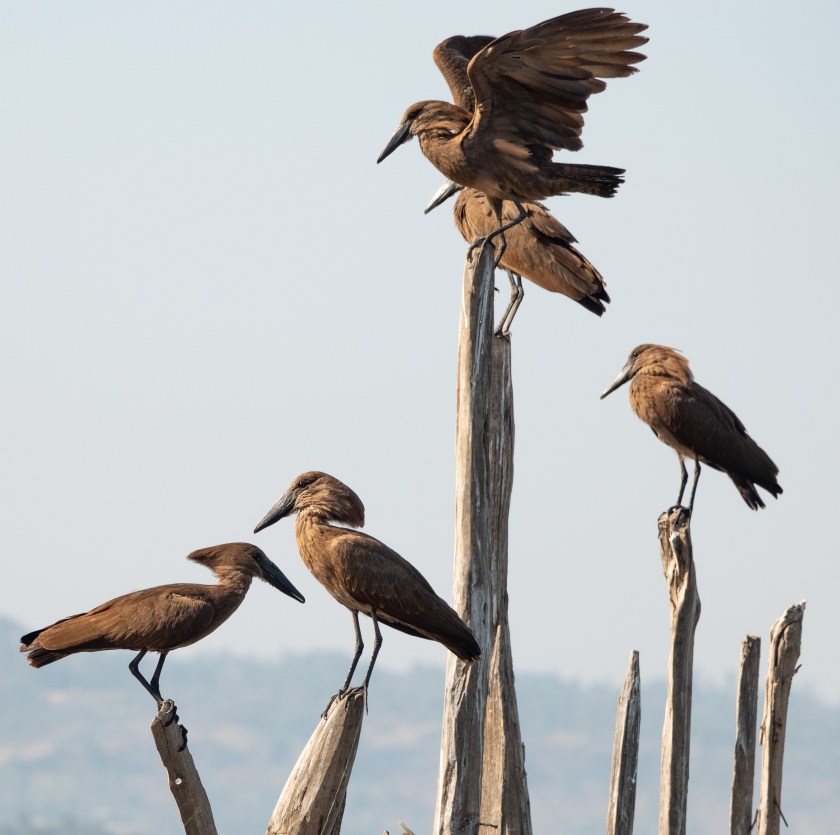
And Hammerkopfs:

DSC07434

Everyone wins except the fish. As the population (both local and tourist) increases, overfishing is apparently taking its toll, and the catch is steadily shrinking,

P.S. Lake Awasa is part of the Great Rift Valley, It is an endorheic basin, meaning it is fresh water, but has no outlet (except perhaps an underground one), and instead it peters out into shallows and swamps.

P.P.S. Most of these photos were taken at the smaller and less official market. The high-end hotels buy from the other one, which is slightly (just) more hygienic!

Mountain Nyala: Shy giants

My final Ethiopian antelope weighs about 100 times more than my first, and is much rarer.

The Mountain Nyala, Tragelaphus buxtoni, my last and largest antelope from the Ethiopia trip, is found only in Ethiopia. Our first glimpse was a big male browsing in the distance: they can weigh up to 300Kg, and be up to 53″ tall at the shoulder, Their horns always have creamy tips:

DSC09648

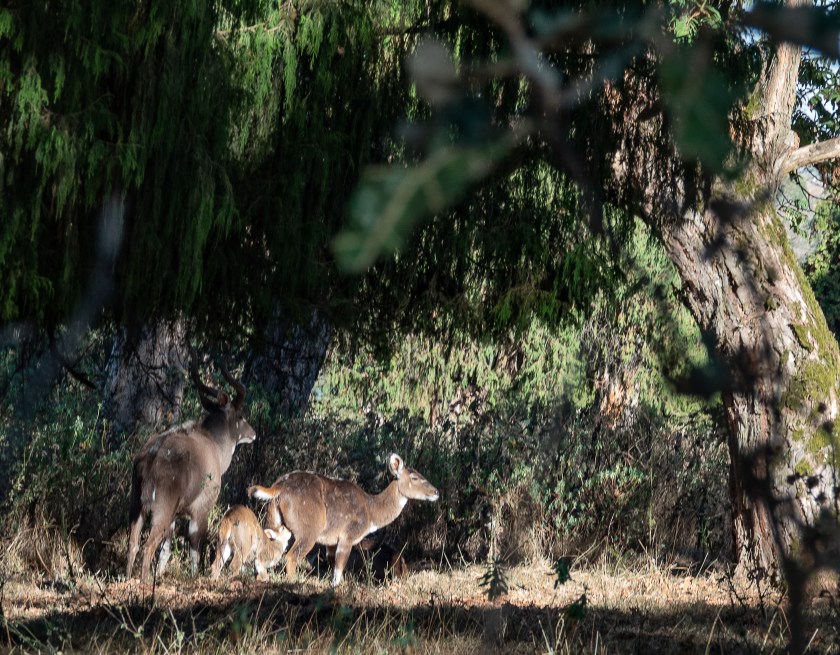
The Bale Mountains have a montane woodland ecozone at around 10-11,000 feet, and that is where the shy, elusive nyala are most often found. As we walked, they were all around us, but dissolved into the trees when we got too close. So we had only tantalizing glimpses:

Mountain Nyala, endemic to Ethiopia

Until this closer encounter:

Mountain Nyala, endemic to Ethiopia

They are endemic to the Ethiopian highlands, with half the total population in the Bale Mountains National Park. They are considered endangered, and there are thought to be only about 2500 adults left in the wild.

They might well remind you of the kudu or the bushbuck with their grayish coloring and white markings, and you would be right, they are related to both.

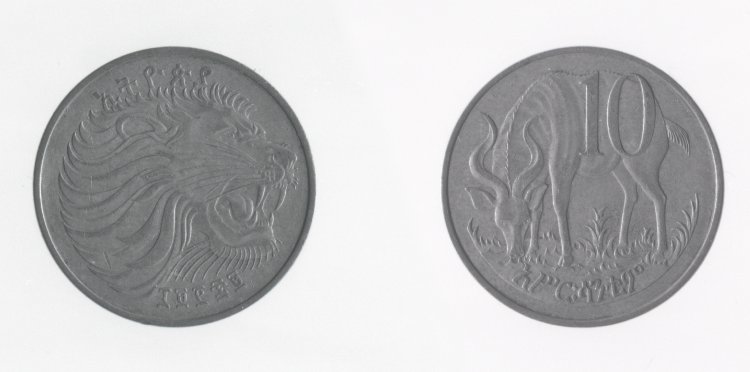
PS The Ethiopian 10 Birr coin has a nyala on the back, demonstrating their significance to Ethiopians.

AN00378757_001_l

That dreadful Hartebeest

After a break from antelope, back to Ethiopia and a couple more, larger than the last batch …..

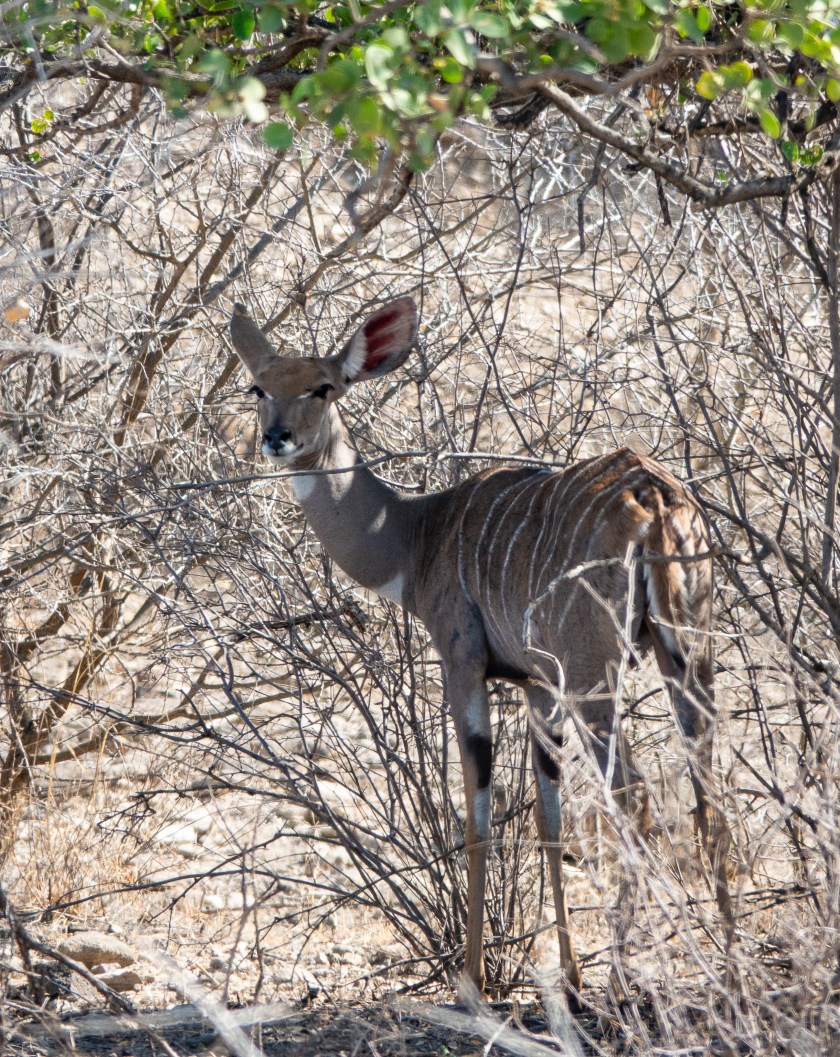
This elegant beast is a female Lesser Kudu, Tragelaphus imberbis. She will hide in thick brush most of the day and feed mainly at night. Males can be 41″ at the shoulder and weigh 108Kg, with spectacular spiral horns.

Lesser Kudu

For comparison, these are male Greater Kudu, Tragelaphus strepsiceros, in Zambia last spring. These males are much larger, 63″ at the shoulder and at 270Kg weighing more than twice as much as their Lesser brethren.

Kudu. "The Grey Ghosts".

There are only around 700 mature Swayne’s Hartebeest, Alcelaphus buselaphus swaynei, left in the world, and one of the remaining populations is in Senkele sanctuary, not far from Lake Awassa. The sanctuary is reached via a dirt road through a tiny village, and the village kids climbed precariously on the back of the bus for a fun but dangerous ride. Our worried guide tied thorny acacia branches to the back, which successfully dislodged them.

The rangers had burnt the dry grass to encourage new growth, and the herd had headed straight there for the tiny invisible green shoots.

Swayne's Hartebeest, endemic to Ethiopia

This mother spent maybe ten minutes cleaning her baby’s bottom. A mother’s love knows no bounds, but I prefer baby wipes.

PS Hartebeest were given their name because they look rather deer-like, ‘hart’ being an archaic word for deer, and the obsolete Afrikaans hertebeest means ‘deer-beast’. Males can weigh up to 200Kg, much larger than the Lesser Kudu.

PPS My title comes, yet again, from the Flanders and Swann song about the Gnu, since poems about hartebeest are hard to come by…

“G-nor am I in the least
Like that dreadful hartebeest”

PPPS You will be relieved to know that after today there is only one last antelope post still to come!

Strutting Tom

It is definitely spring. Outside my study window, in the mist,  a tom (male) turkey is displaying to his lady hen, who continues to preen, unimpressed by his splendor.

P1040208

Seen advancing from the front he is quite a sight, like a galleon under full sail. He has an enormous blue snood hanging down over his beak, a darker blue face, …. and bright red wattles. He puffs himself up, and drags his wings,  strutting his stuff, the Arnold Schwarzenegger of the turkey world.

P1040176

Meanwhile, she grazes on,  oblivious.

In 1784, Benjamin Franklin wrote to his daughter in support of the Turkey as national bird: “For my own part I wish the Bald Eagle had not been chosen the Representative of our Country. He is a Bird of bad moral Character. He does not get his Living honestly. You may have seen him perched on some dead Tree near the River, where, too lazy to fish for himself, he watches the Labour of the Fishing Hawk; and when that diligent Bird has at length taken a Fish, and is bearing it to his Nest for the Support of his Mate and young Ones, the Bald Eagle pursues him and takes it from him.

…For the Truth the Turkey is in Comparison a much more respectable Bird, and withal a true original Native of America . . . He is besides, though a little vain & silly, a Bird of Courage, and would not hesitate to attack a Grenadier of the British Guards who should presume to invade his Farm Yard with a red Coat on.”


A Spate and a Spadix

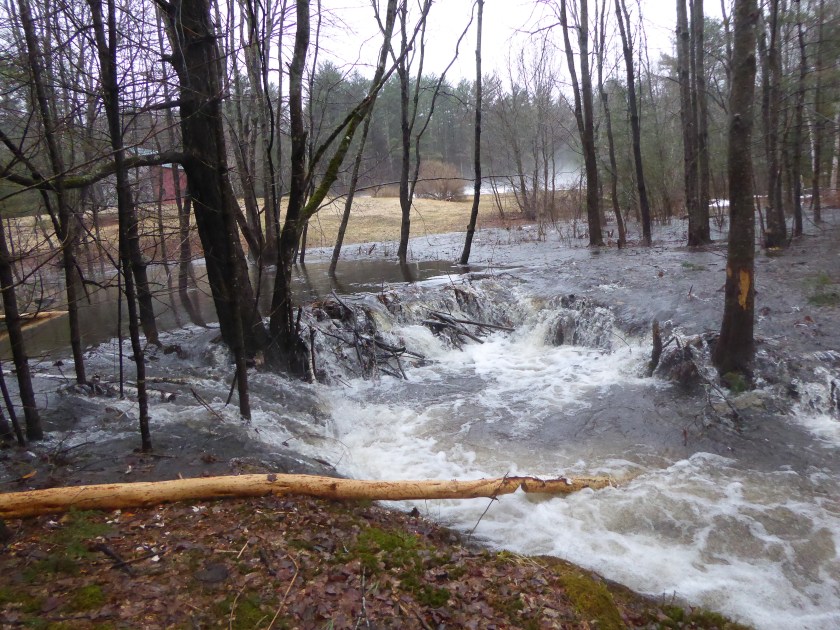
Let’s take an Easter break from antelopes. I am in Maine for a few days. The thaw is happening, and the streams are in spate. This is a usually dry woodland area below my red barn; the de-barked tree is beaver work.

P1040138

My bridge may not be there in the morning:

P1040139

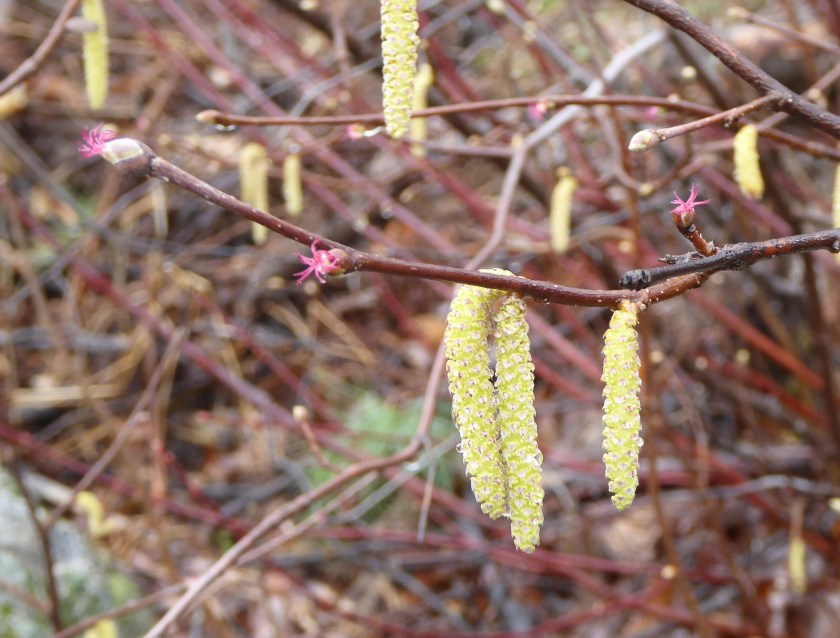
The Beaked Hazelnut, Corylus cornuta, is flowering, with its golden male catkins and tiny red female flowers:

P1040119

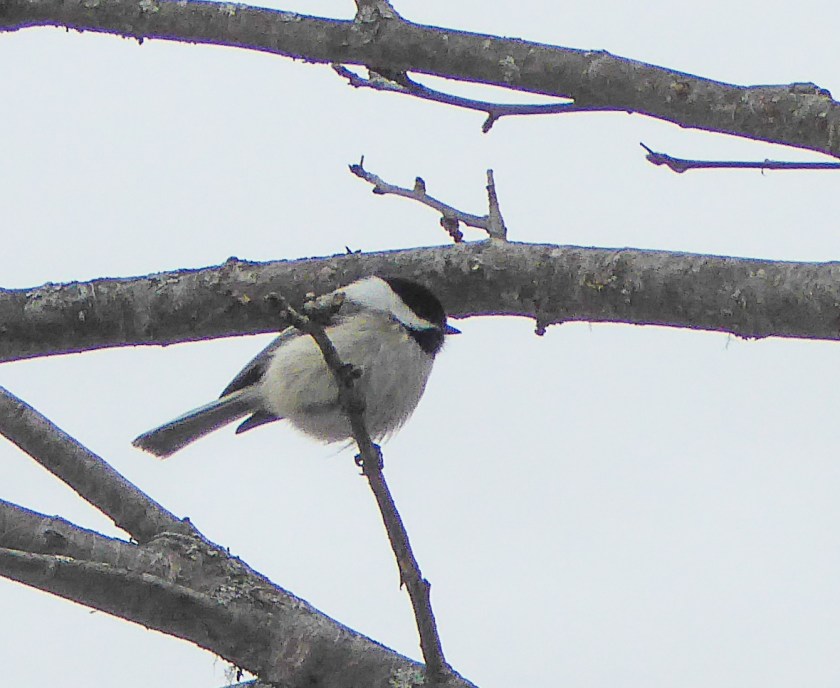
The Maine State bird, the Black-capped Chickadee, Poecile atricapillus, is here, a member of the tit family.

Chickadee

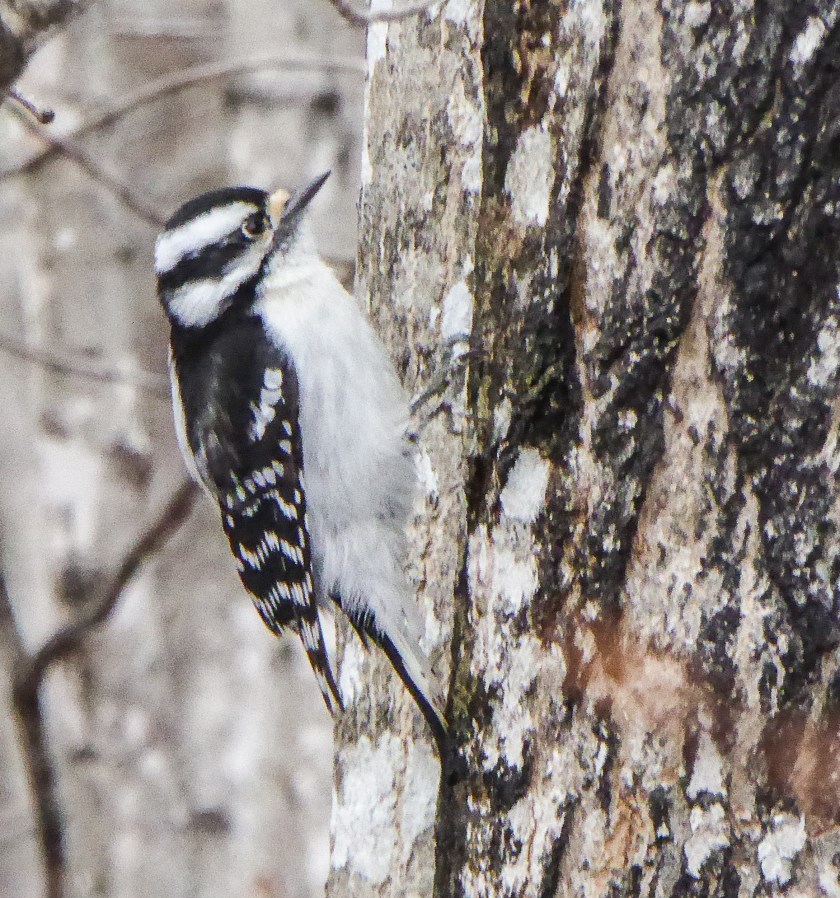
A female downy woodpecker was busy:

Female Downy Woodpecker

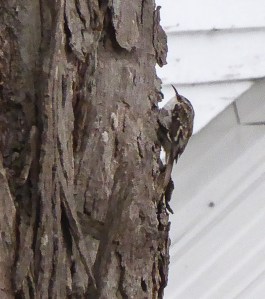
And I saw my first ever Brown Creeper, Certhia americana, a relative of the UK’s Treecreeper. They are not rare, but they are very shy, and well-camouflaged. It moved much like a nuthatch, but working its way up the tree, instead of head down like a nuthatch. Notice the lovely curved beak.

Brown Creeper

Finally, I mentioned skunk cabbage a week or two ago, but now in Massachusetts it is in flower.  Symplocarpus foetidus is a member of the Arum family.  It comes up so early in spring that the heat of its cellular respiration melts the snow or ice around it,

Skunk Cabbage

It has a strong odor, especially if bruised, like decaying meat, and this draws insects to pollinate the tiny flowers on the knobby spadix. Later, a roll of large green leaves unfurls.


Buck up

Moving up the antelope size ranks, here are a couple of handsome bucks, both females despite their names.

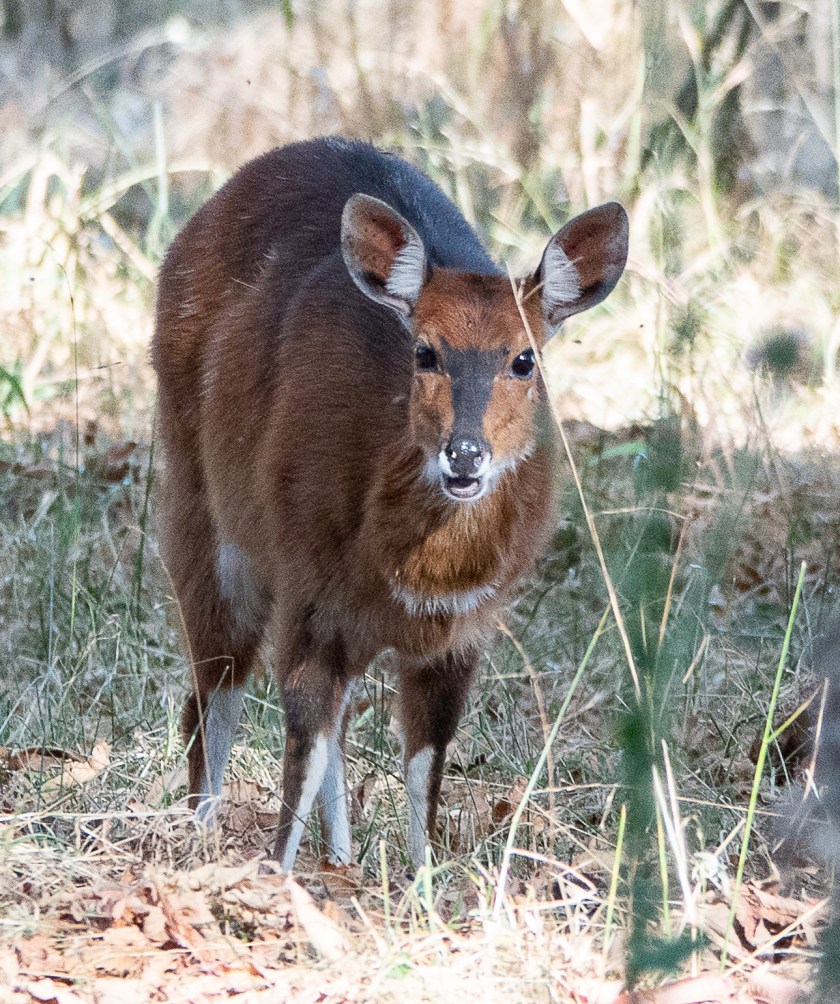
I rather warm to the charming Bushbuck, Tragelaphus scripts meneleki. Males are up to 30″ at the shoulder, and up to 80Kg in weight. They are largely nocturnal, frequenting the forest edges and browsing on bushes, leaves and twigs. They are shy and hard to see; this one was emerging from safe cover in late afternoon to feed. The thick coat keeps them cosy up here at 4000 meters (13,000 feet) in the Bale mountains.

Menelik's Bushbuck, endemic to Ethiopia

Good looking though she is, like most bushbucks she is largely solitary.  Females are bright chestnut, males are almost black. The white markings are very variable geographically, as shown in this illustration from the excellent The Kingdon Field Guide to African Mammals, by Johnathan Kingdon.

Screen Shot 2019-04-15 at 9.41.32 AM

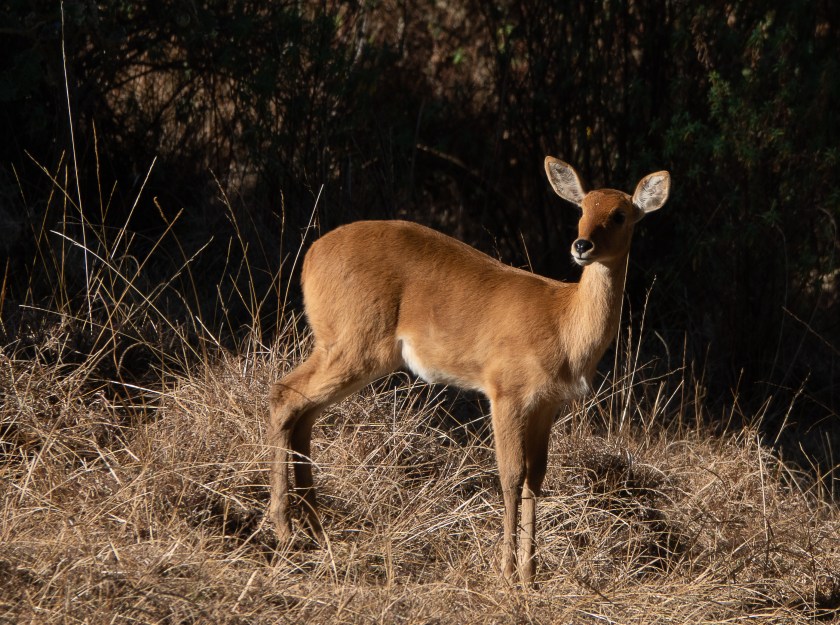
Just nearby, this Bohor Reedbuck, Redunca redunca, posed in a clearing.

Common Reedbuck

Males can be 35″ at the shoulder and weigh 65Kg.


Medaqqwa and Oribi

[Such a pleasure to discover an animal you have never even heard of before. For me, the mellifluously named Oribi is just such a new discovery.]

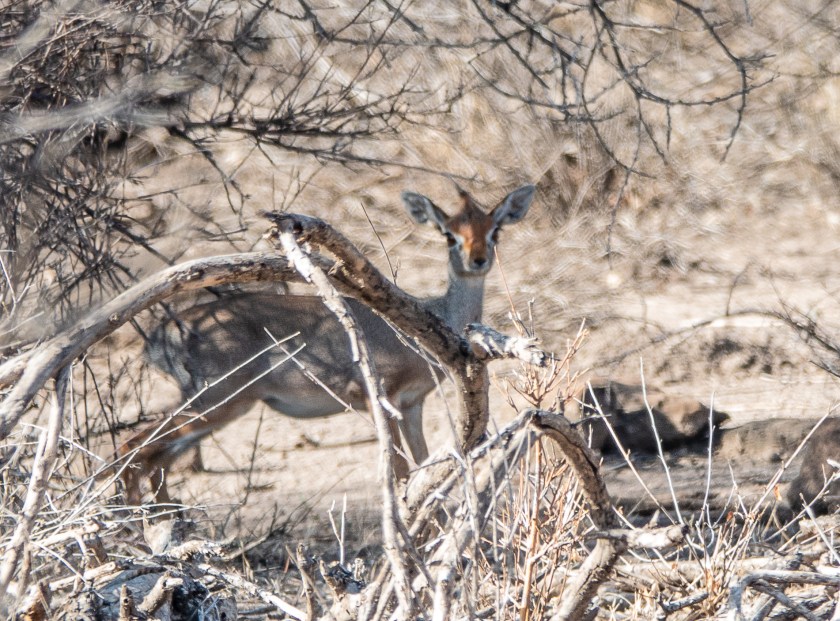
Today’s Ethiopian antelopes are not gazelles, and only the males have horns. Some are so tiny they can easily be mistaken for a hare: a small female Harar Dikdik may only weigh 2.5 Kg, and the Ethiopian Highland Hare can weigh 3.5 Kg! Their scientific name is Madoqua saltiana hararensis, supposedly named after the Amharic name for small antelope, medaqqwa. *

Harar Dikdik, sub species of Salt's Dik-dik

Not surprisingly, given their miniature stature (a maximum of 15″ shoulder height), they are extremely skittish, and this is my best photograph!

Moving up a notch, there are two species whose weight tops out around 22 – 25 Kg: the Oribi and the Bush Duiker. This charming family of Oribi, Ourebia ourebi, allowed us to get fairly close, but they can run at 50Km an hour if startled. The males are about 26″ at the shoulder, about the size and build of a Dalmatian.

Oribi

They are strictly grass eaters, and their social lives sound interesting, since they are described as sometimes polygynous, sometimes polyandrous, and sometimes polygynandrous depending on food resources and population density. Yet these three, who were not part of a larger herd,  look monogamous to me!

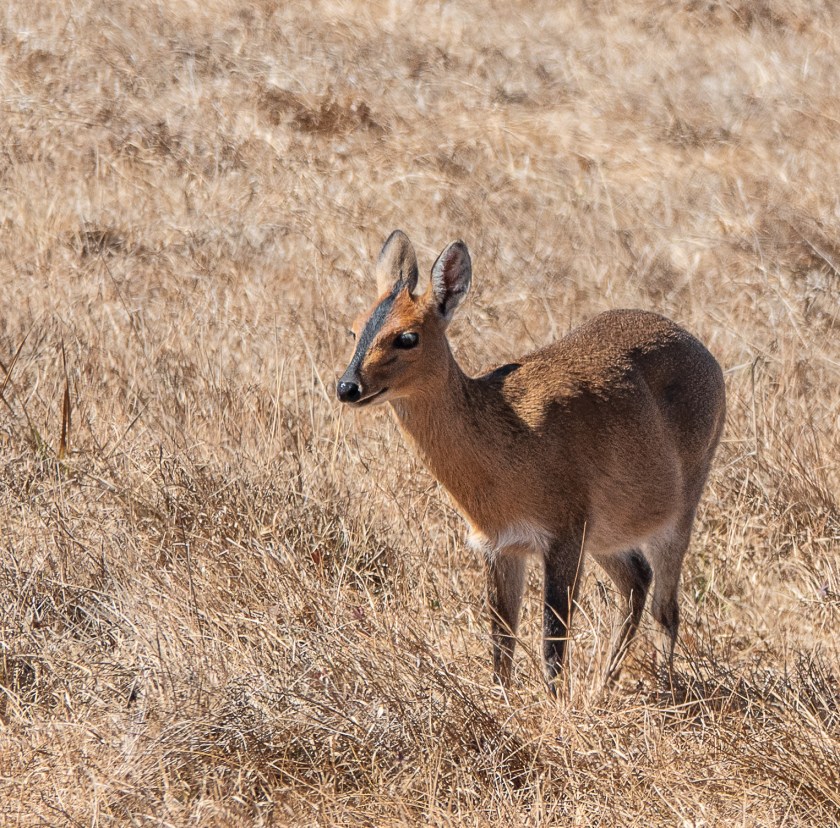
The similarly-sized Bush Duiker, Sylvicapra grimmia, is the ungulate that lives at the highest altitudes, and it is monogamous. Their Latin name means “wood goat”, perhaps because they eat all sorts of things, including not only grass but also insects, frogs, and even carrion.  They can get nearly all their water from their food, and may not drink at all in the rainy season.

Bush Duicker

They are not endangered, possibly because no-one could call them picky eaters.

* I can’t confirm this origin for the Latin name Madoqua. My attempts to translate “small antelope” or “dikdik” into Amharic online turn up different words, like yenishu, የንሹ

P.S. For my UK readers, the 2.5 – 6 Kg dikdik is far smaller than the muntjacs that plague us in the UK, and which can weigh up to 18Kg..