Rapture

The Bald Eagle, Haliaeetus leucocephalus, is America’s iconic bird. They are not bald, but white-headed.
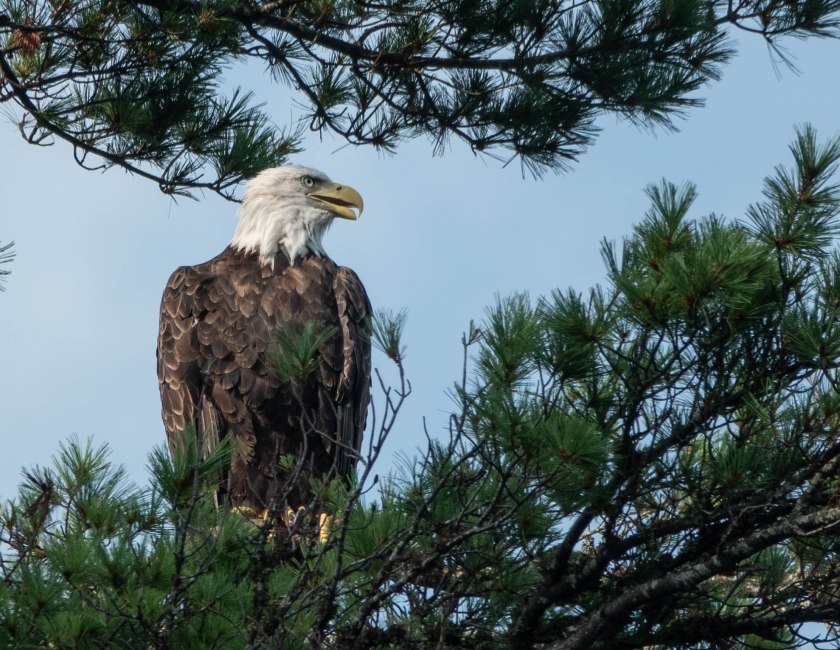
DSC05490

In the 1970’s there were only 39 nesting pairs left in Maine, but they are now recovering, and by 2013 there were 634 nesting pairs. A pair breed every year on our lake. I took the photo of one of the adults from a small boat (thanks, Kevin). This year they raised two chicks (now fledged).

Their nest is a messy collection of branches and twigs, high off the ground:

DSC05501

They have powerful feet, and prey mainly on fish, which is why they are more common on the coast.
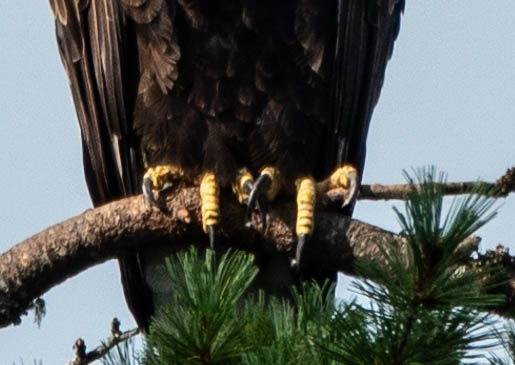
DSC05481-2

They also snatch fish from ospreys. Round us, ospreys are rare, but one flew over yesterday:
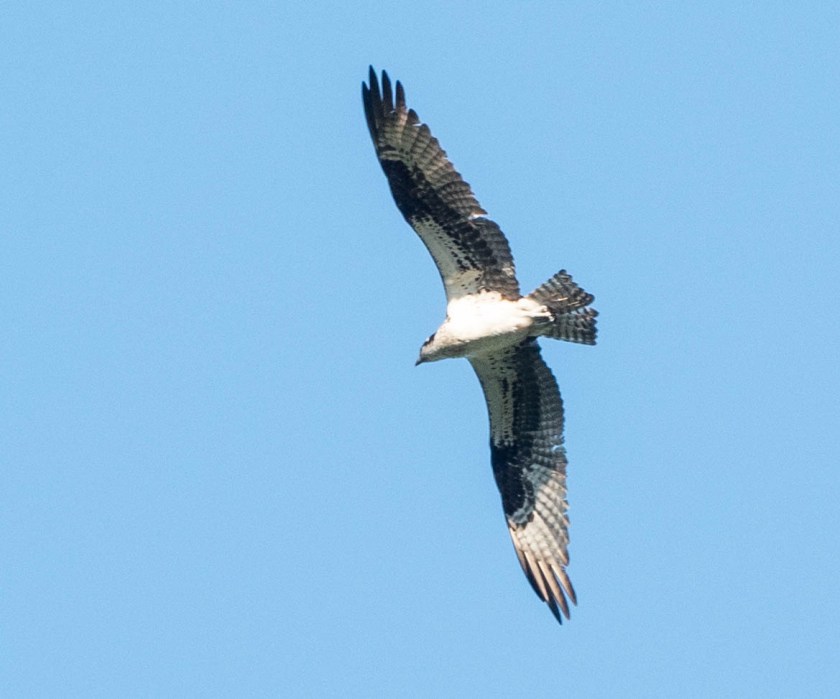
Osprey

An adult female bald eagle has a wingspan of up to 7 1/2 feet, or 2.3 meters, and can weigh up to 14 lbs, or 6.3 Kg.  Their vision is astonishing; one comparison suggests that they can see unaided as well as we see with powerful binoculars. The oldest verified eagle in Maine was 32 years and 11 months old!

Seeing their numbers recover is inspiring, but I have mixed emotions: the heron colony on my land has been abandoned, most probably because of the threat to the nests, eggs and young from the circling eagles.

PS: Many countries have chosen eagles as their national symbol, including Albania, Austria, Mexico, Montenegro, Philippines, Poland, Romania and the USA. I think the Mexican Golden Eagle is my personal favorite, partly because of the charming prickly pear cactus it is perching on.

 

500px-Seal_of_the_Government_of_Mexico.svg


PPS My friend Mary Pearce has explained the story behind the Mexican seal. Apparently the Aztecs, guided by the prophecies of Huitzilopochtli (the god of the sun and war), ended their migration from farther north by building Tenochtitlan (now Mexico City), on an island in a lake where an eagle held a snake perched on a flowering nopal (prickly pear) cactus.

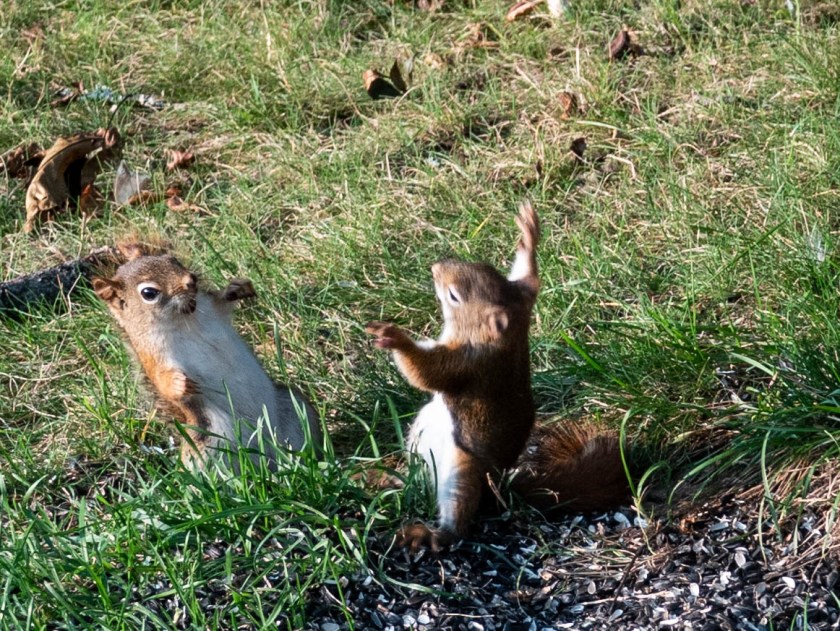
Squirrel martial arts

Warning:  Some of these photos might be upsetting, read on at your own risk.

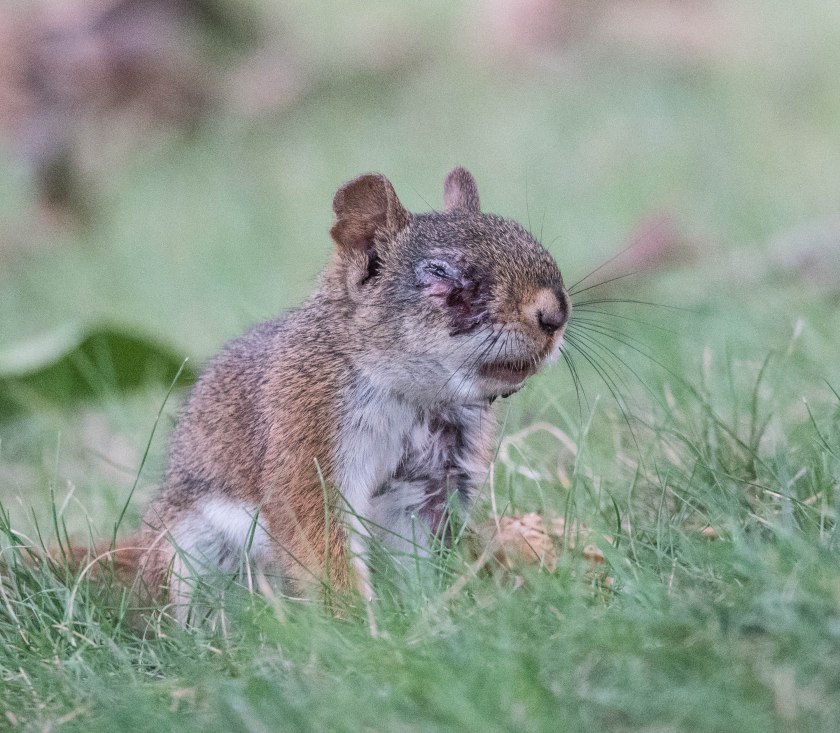
From time to time I see badly injured red squirrels, like this one, which actually seemed to be carrying on as usual despite the loss of one eye:

DSC04655

I have no way of knowing what did it, and I have tended to assume it was a fox.

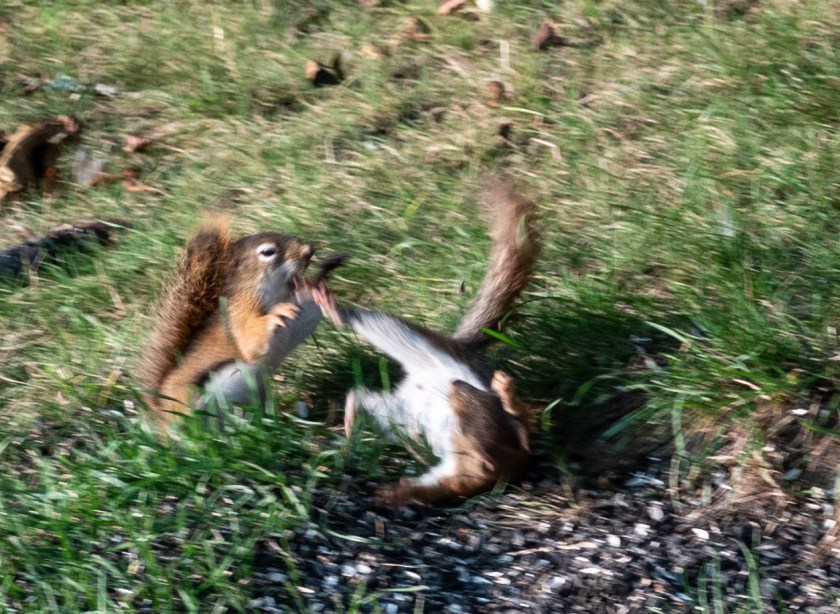
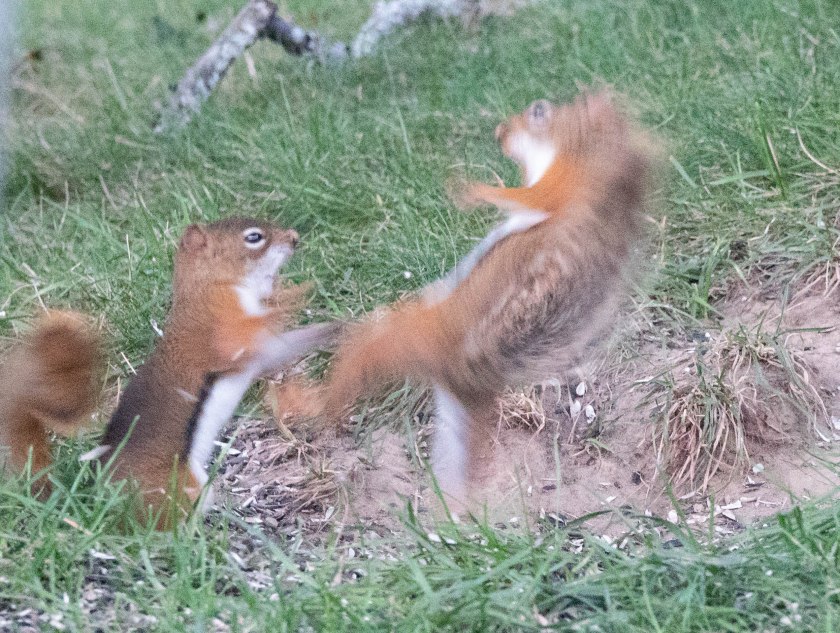
But if you watch the squirrels closely their squabbles can get pretty aggressive. They are very short sharp encounters, over in a second or so, and very hard to photograph. Look at these two squaring off:

DSC05092

And then admire this karate kick, exactly one second later:

DSC05091

It is not hard to imagine a kick like that taking out an eye, especially given those claws:

DSC04670

Or a good kick could take out an ear: this squirrel has the equivalent of a boxer’s cauliflower ear from some old injury:

DSC04590

This one has injured a finger in a fight:

DSC05596

The squirrel with the eye injury has now been attacked again and has what look like even worse injuries, although it was running around and eating as if it were unscathed.

DSC05377

Defending yourself with only one eye must put you at a significant disadvantage against a predator, or indeed in fights like these.

DSC05362

DSC05622

“Red in tooth and claw” does seem pretty appropriate.  And just so you know, I googled the source of this phrase,  and it comes not from Shakespeare, but from Alfred Lord Tennyson’s In Memoriam A. H. H., 1850.

Sidebar! I once had a run-in with my son’s third grade teacher, who sent him home with a poem to memorize,  written by a certain Alfred Lloyd Tennyson ……


Comparing bills

I’ve been pondering this question: The kingfisher and the bluejay have quite different diets, and yet their beaks are not dissimilar. Why??

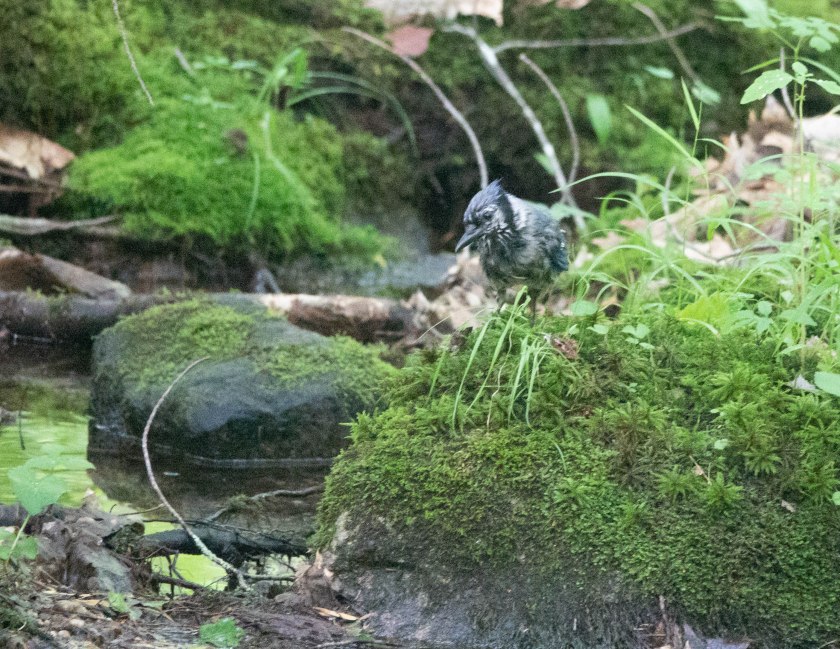
It started when I was deep in the woods, and saw some movement in a tiny stream. It was a bluejay having a bath (bad photo, sorry!):

DSC03760

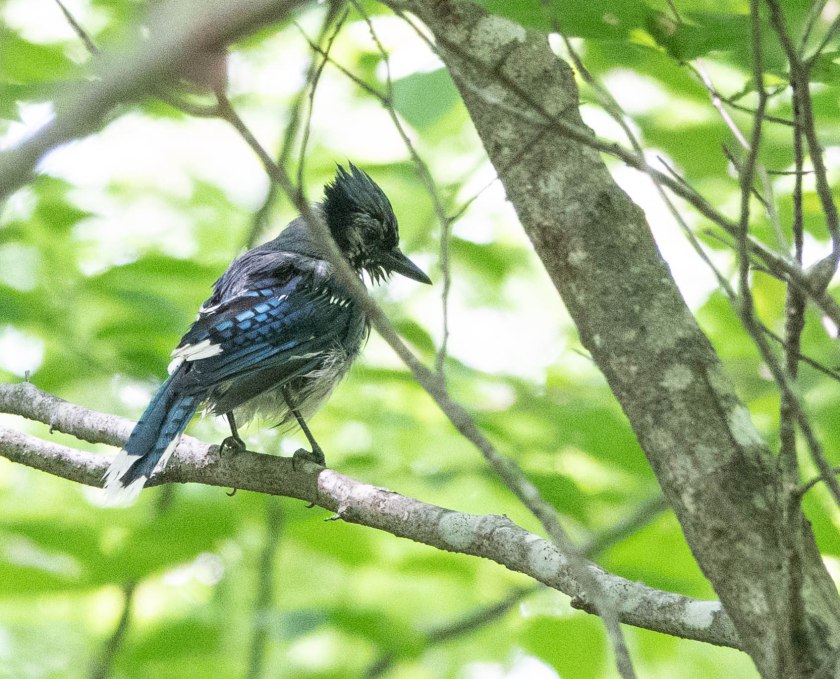
It flew up to recover its dignity and its plumage:

DSC03757

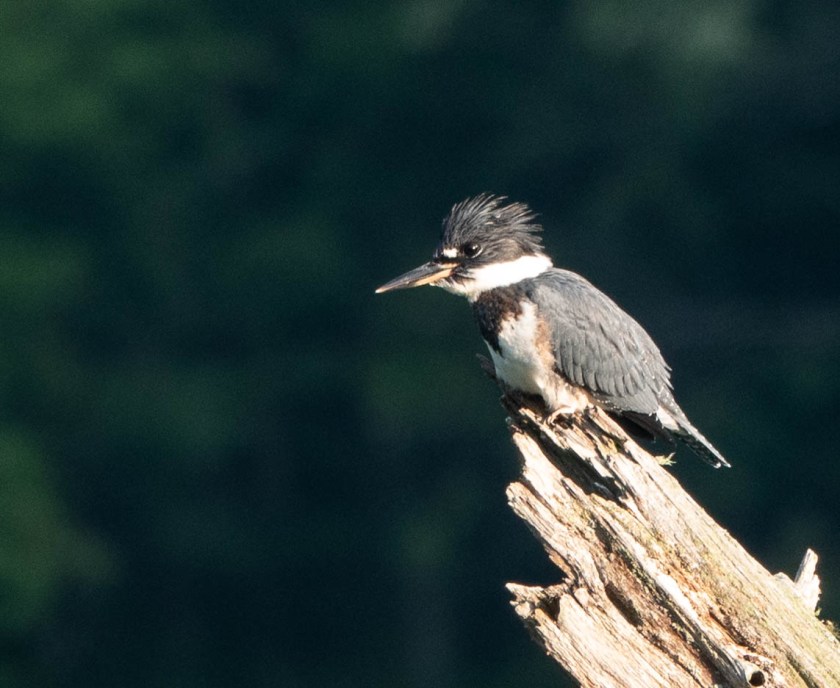
The day before I had seen a Belted Kingfisher:

DSC03888

So now I had two photos, of pretty similar beaks:

The kingfisher of course eats fish, and this beak is well adapted for grabbing (or if necessary spearing) a slippery fish. But bluejays eat mainly seeds, so why is their beak this shape? The cardinal, a true seed-eater, has a beak like this, designed for crushing seeds:

DSC03560

I think the answer lies in the fact that the bluejay is in fact an omnivore.  It also eats insects (about 20% of its diet), and even occasionally small dead or injured vertebrates like baby birds. A favorite food is acorns, and they hold them in their feet while pecking them open, so the beak has to be sharp and strong enough to penetrate an acorn.  Here is a good video showing how they do it:


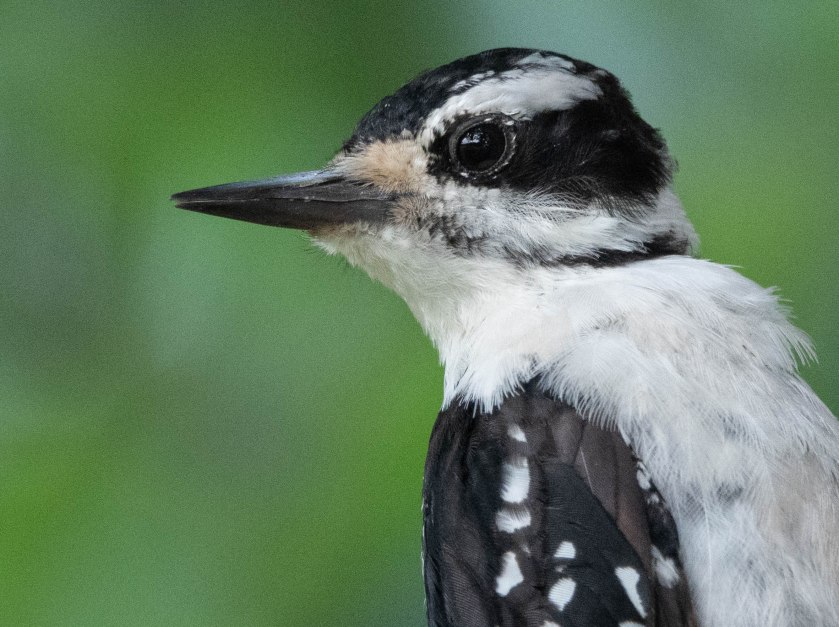
To do this, the bill has to be pretty sturdy, and the bluejay’s bill is definitely sturdier than the kingfisher’s, which would be unlikely to stand up to this kind of demand. In fact, it is not so different from a woodpecker’s, as you can see here:

DSC05124After all, hammering at acorns is a mini-version of hammering at trees.
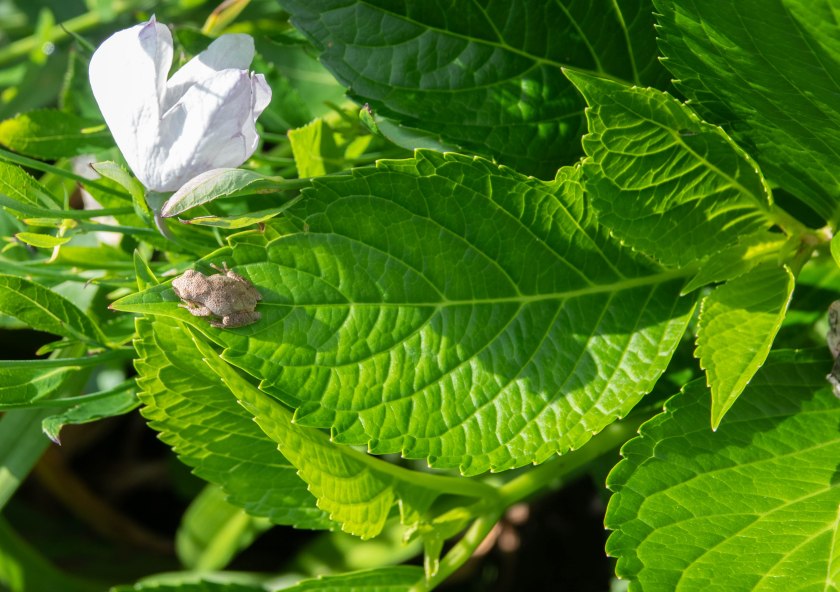
Small but feisty frogs

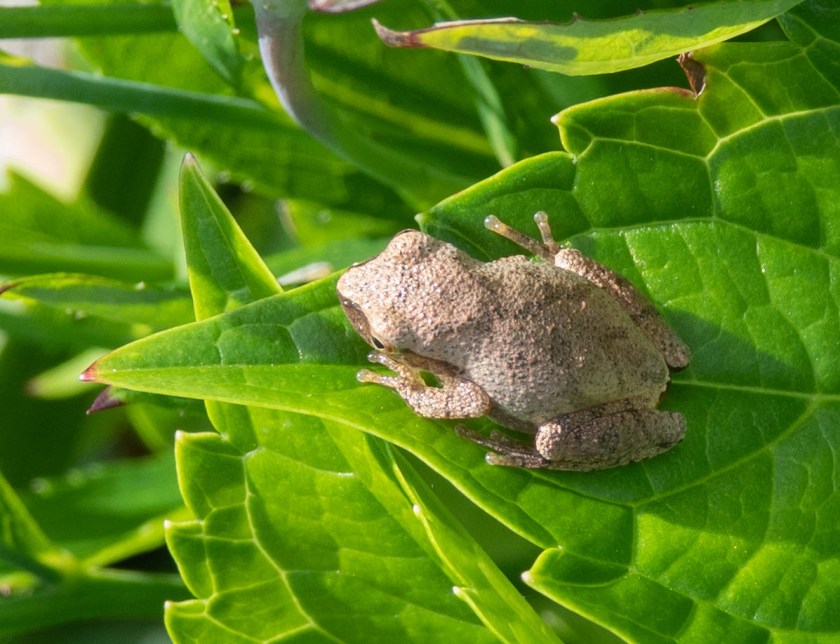
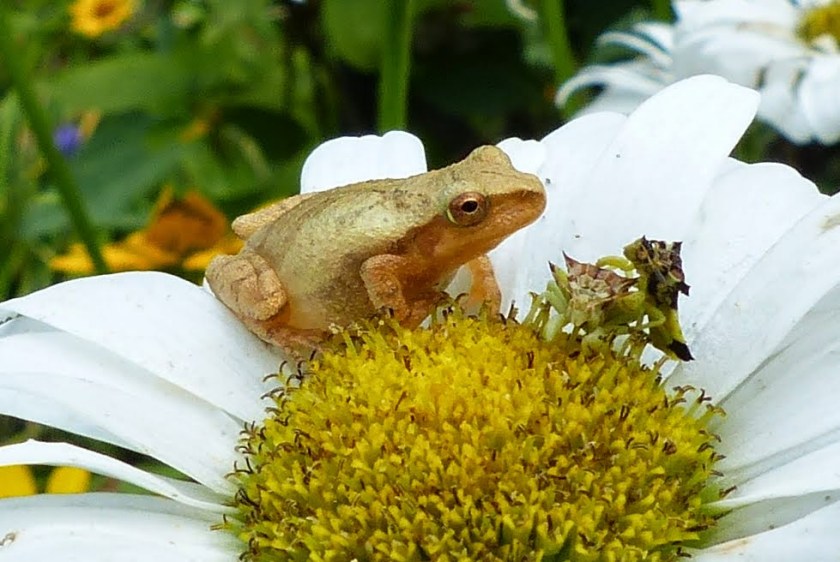
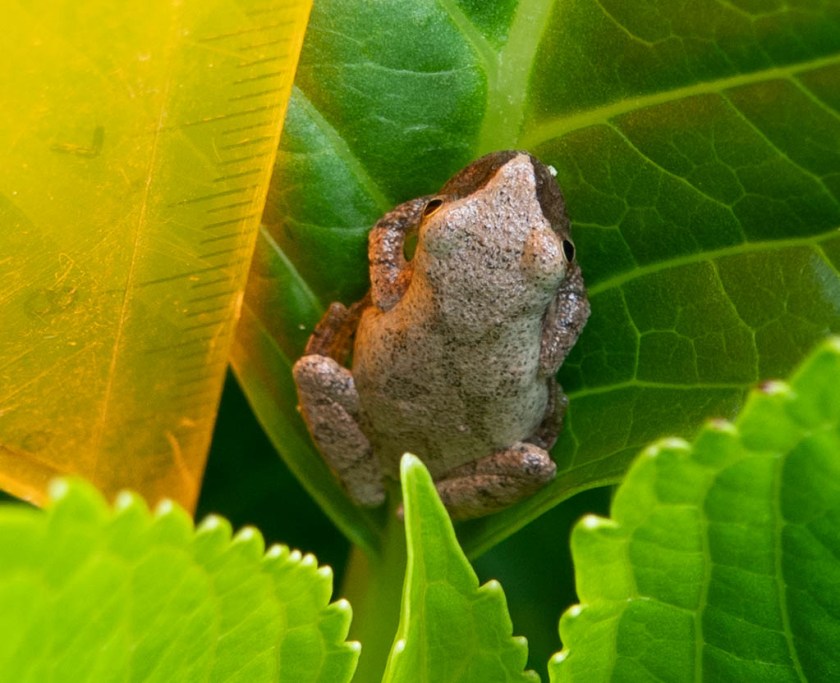
The fully-grown spring peeper below, sitting on a hydrangea leaf, is 25mm long. It is nowhere near being the smallest frog in the world, which is Paedophryne amanuensis, which at 8 mm long is only about 1/3 of the size of this peeper..

DSC04394

Here it is closer up, with a centimeter measure to show you its size, about 2.5cm.

DSC04413

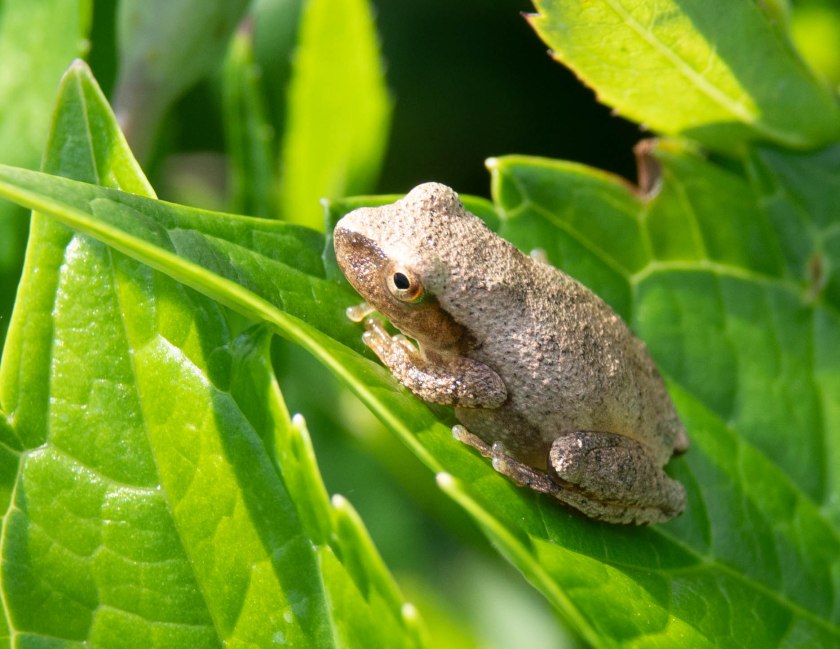
DSC04396And even closer
DSC04401

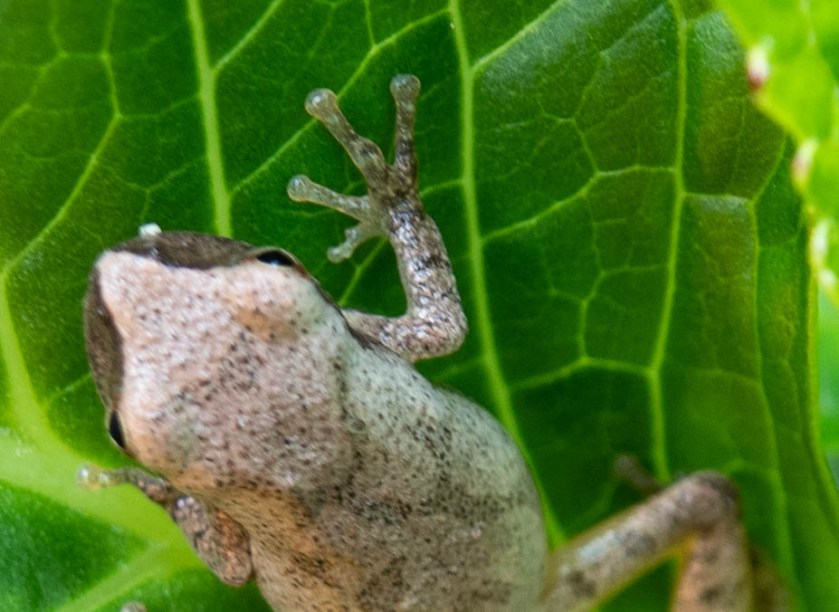
Its Latin name Pseudacris crucifer comes from the cross-shaped marking on its back, rather broken up on this particular individual. Its tiny fingers are translucent, and large toe pads help it grip while climbing.

DSC04417

It is a tree frog, but goes to the water to breed in the spring. It has a deafeningly loud chorus, amplified by a large throat pouch, which makes sleeping in our guest bedroom overlooking the pond quite difficult.

They are insectivores, though this one seems rather intimidated by this amorous pair of large Ambush Bugs.

P1030185-2

In the winter they hibernate under tree bark or leaf mould, and can tolerate the freezing  of their body fluids down to -8C. I’m not quite sure how they survive a Maine winter, since it routinely goes well below that!

Hail, Caesar

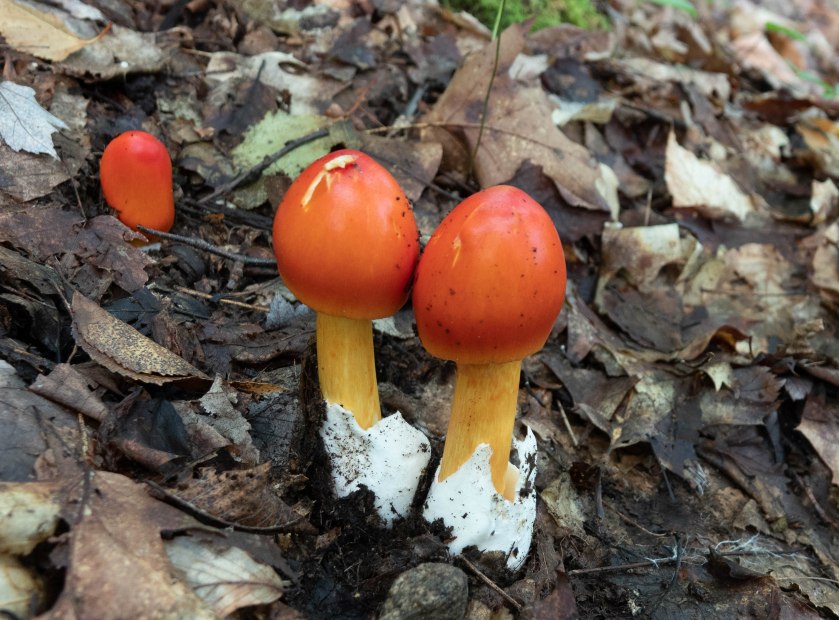
This mushroom well deserves its name as the imperator of the fungus world.

DSC04371

Amanita caesarea blazes in the forest, six inches tall and imposing. It starts like a tiny scarlet Easter egg: this one has been dined on delicately by a rodent, who has eaten it exactly as I was taught to eat a soft-boiled egg:

DSC04129

It pushes skywards and begins to open out:

DSC04386

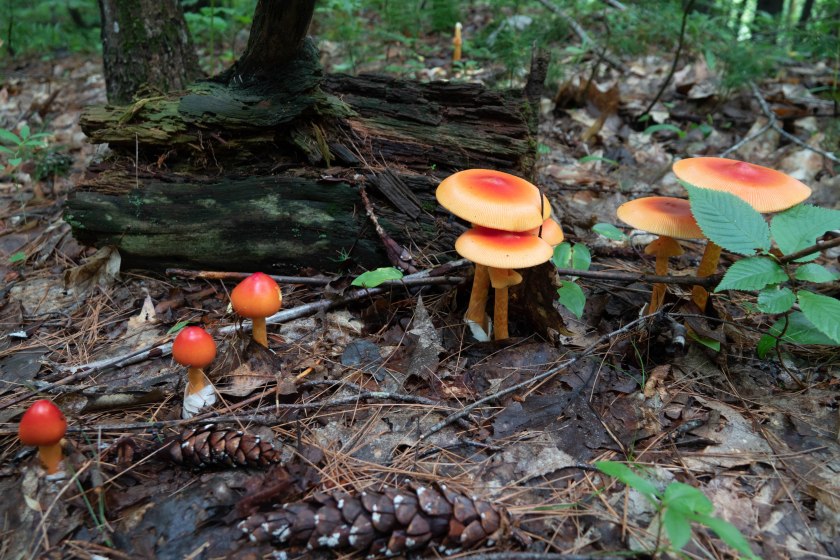
And then it reaches its parasol-like final stage:

DSC03967

Its decline is often brutal (“Et tu, Brute?”). Either it is eaten:

DSC04372

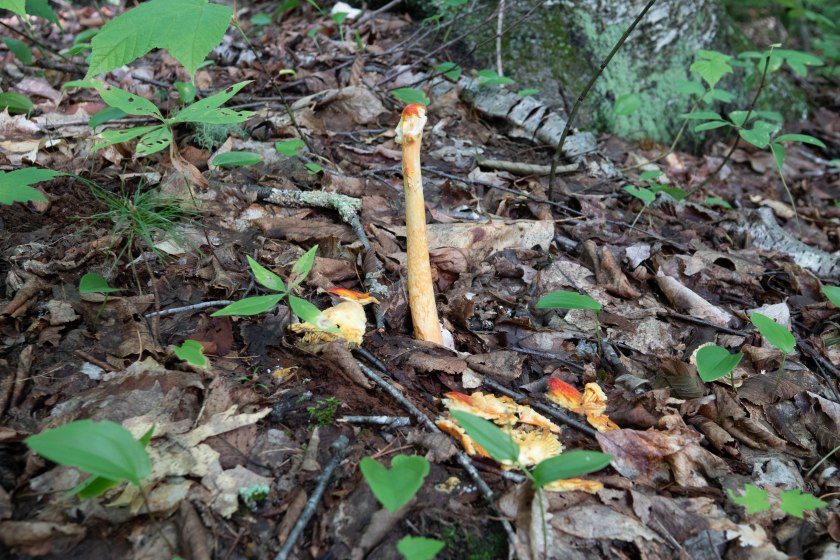
Or a secondary fungus, Syzygies megalocarpus*,  colonizes it and creates a sort of mad Einsteinium Groucho Marx hairdo:

DSC04381

Although it comes from the Amanita family, many of which are highly poisonous, Caesar’s mushrooms are supposed to be delicious, but I have never plucked up the nerve to eat a mushroom this color (though I’m not sure why it scares me, since I happily eat all sorts of orange food, from carrots to tangerines to lobsters. )

PS Some technical stuff: the skirt-like frill round the stalk is the remnant of the partial veil that used to cover the gills when the mushroom was young.  The white cup at the base is called the volva, from which the young mushroom emerges. Sometime it is under the ground and can only be seen by digging down. In most amanitas, pieces of this get stuck to the cap, creating small white patches, but in Caesar’s mushroom that usually doesn’t happen, though in the big photo at the very top of this post there is in fact a piece left.

  • Thanks to Parker Veitch for the ID.

The sad savage beauty of the Barred Owl

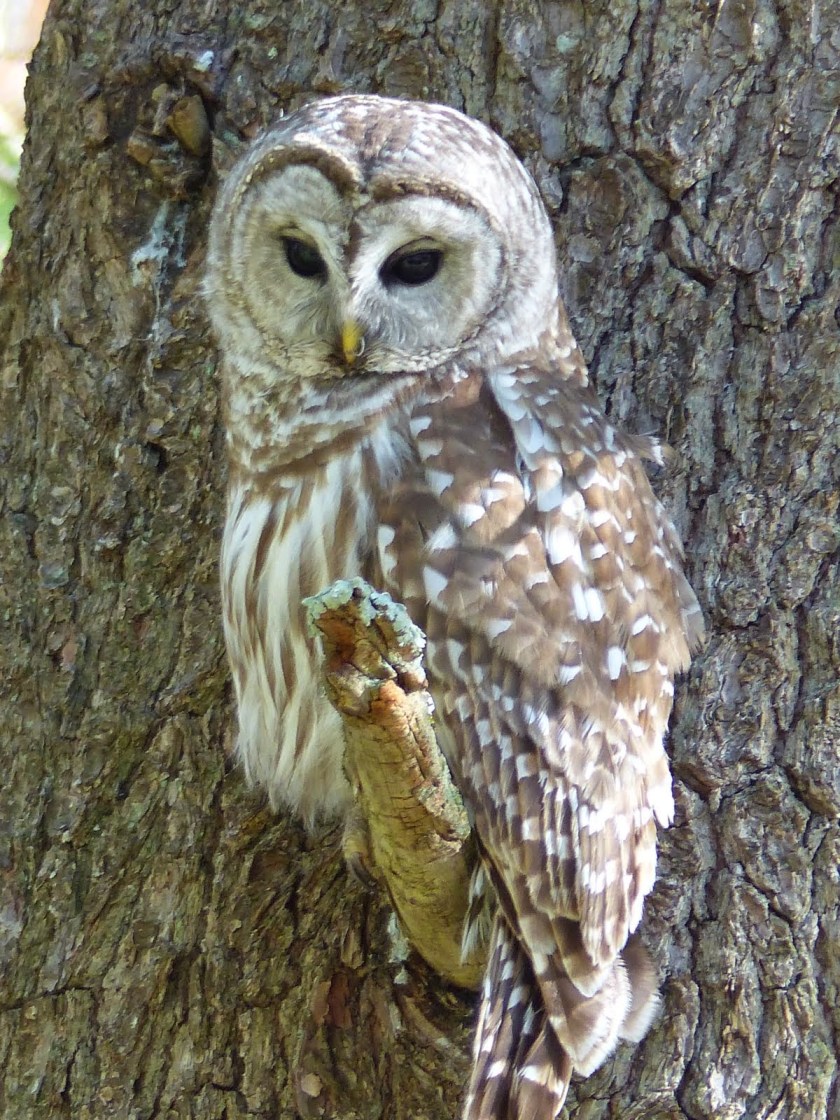
Barred Owls, Strix varia, are fairly common here, but since I am diurnal I rarely see them. I have a camera trap on my big hickory tree, and one came several nights in a row, probably hoping to catch one of the flying squirrels that live in my tree. Here he or she is:

Owls

The wings are barred, but the name actually comes from the vertical bars on the chest, which will see in some later photos.

Owls

One night, I got a movie:


Occasionally they can be seen in the daytime.  This one perched on a pine tree next to my son’s house near Boston a couple of years ago. It is the only American owl with brown (as opposed to yellow) eyes.

P1000286

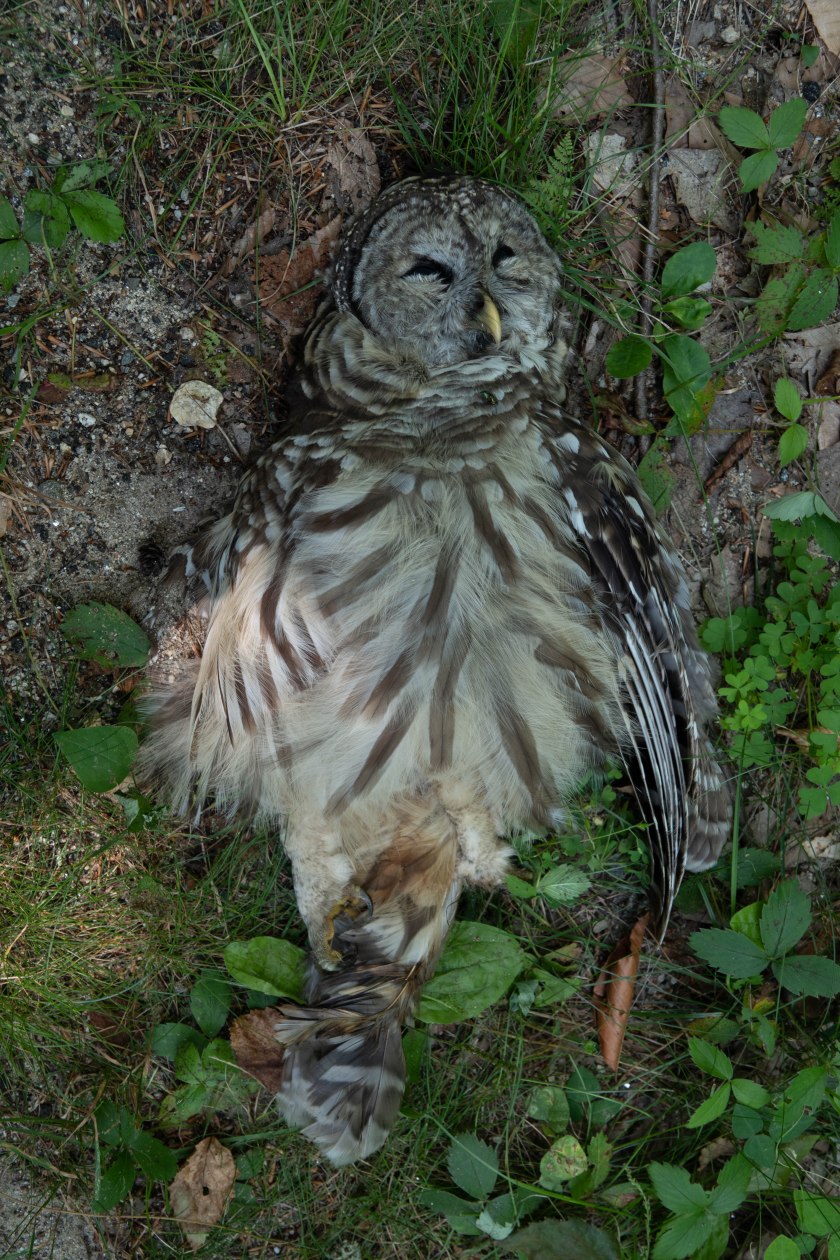
They hunt in wooded areas, and if a road runs through woodland they are sometimes hit by cars.  Sadly, we found this one last week on a small lane overhung by trees near the lake.

DSC03914

It had no apparent injuries , but when we moved it off the road it was clear its neck was broken.

DSC03915

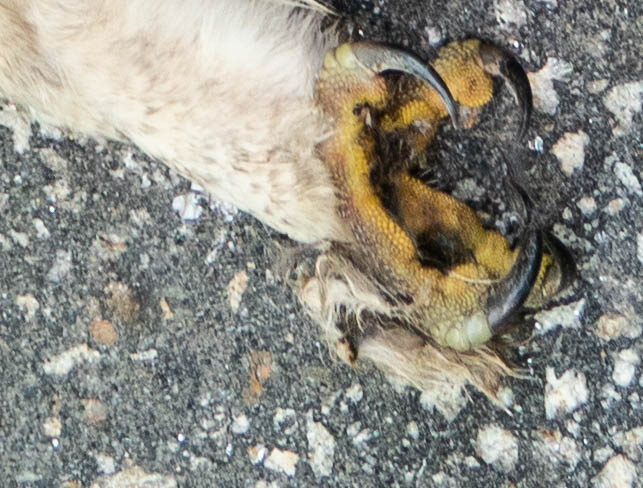
It had fully feathered legs, and the most fearsome talons and rough leathery feet to help it grip.:

DSC03914

Such savage beauty, like all raptors.

PS Don’t confuse the Barred Owl with the Barn Owl! The US Barred Owl weighs from 0.5Kg – 1Kg. By comparison, the UK Barn owl, Tyto alba, is smaller, weighing 0.2 – 0.7Kg, and of course much whiter!


Adjidaumo, the velveteen squirrel

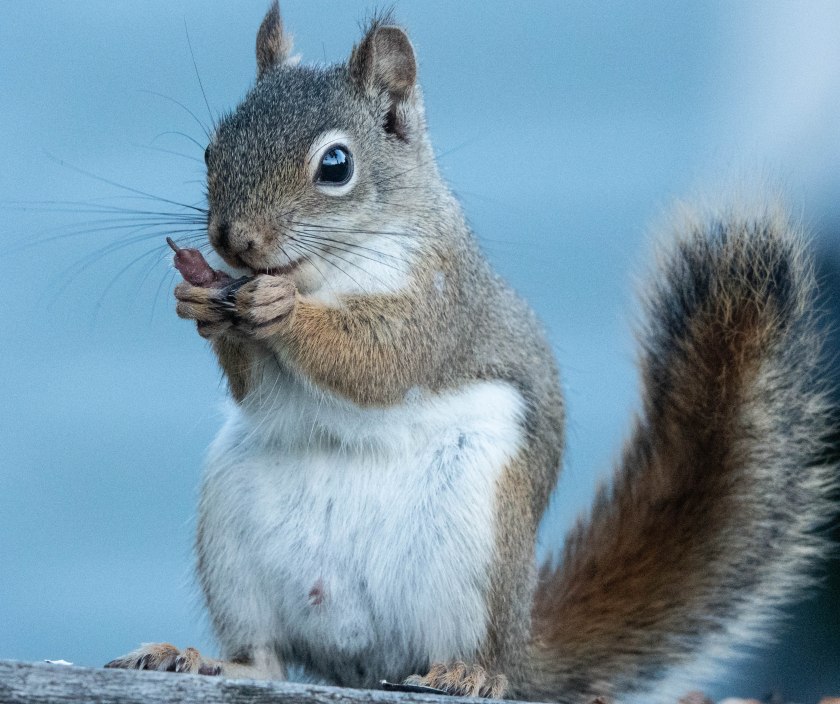
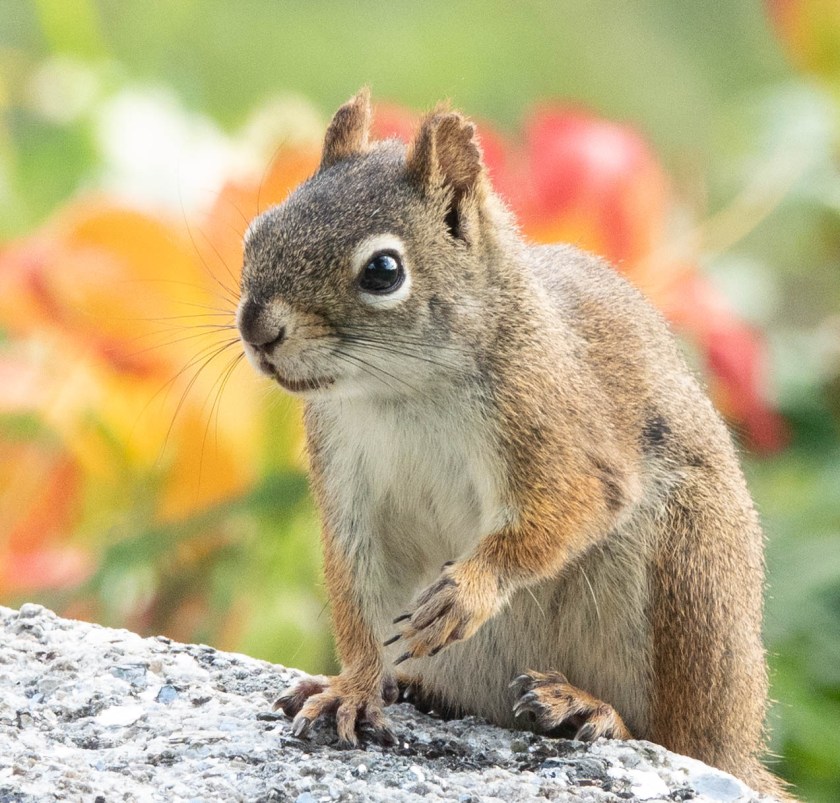
American red squirrels, Tamiasciurus hudsonicus, look like russet velveteen plush toys:

DSC03099

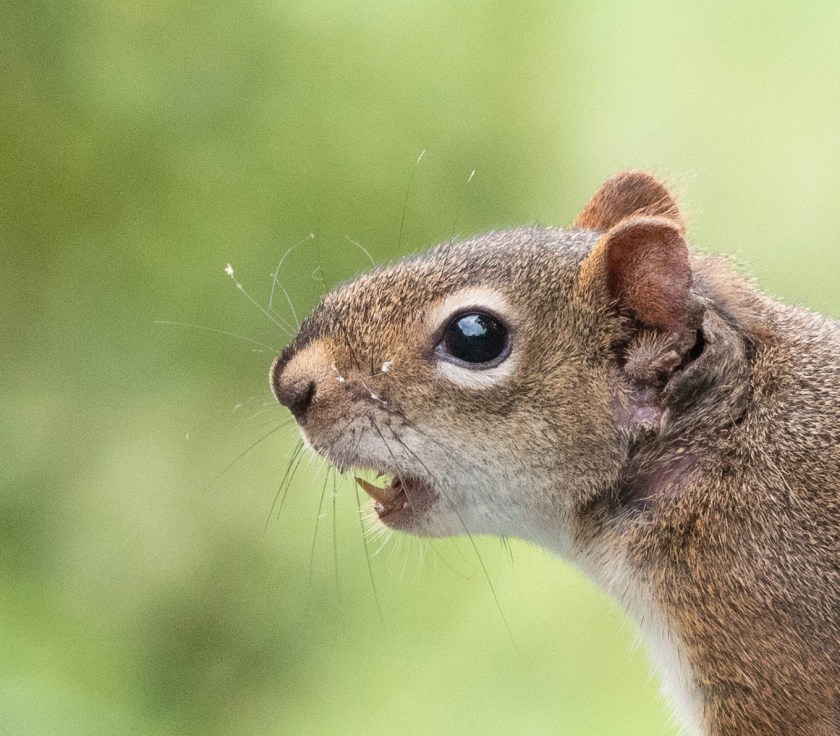
But in fact they are very aggressive. They have formidable teeth and claws:

Red squirrelDSC03227

Their feet are interesting too, with thick calloused pads on the palm as well as the fingers:

Red squirrel

Sometimes you can see a wounded squirrel like the one below. It had identical wounds on both sides of its muzzle. I do not know if another squirrel did it, or whether it was chased by the fox that is hanging around my garden. The second photo shows the same squirrel, with the wound healed:

Red squirrelRed squirrel

The video below shows typical squirrels squabbling over territory and food; as you will hear they are extremely noisy :

In Longfellow's Song of Hiawatha, the squirrel is called Adjidaumo. 
This is an Ojibwa word literally meaning "mouth-foremost", because 
squirrels descend trees head first. Here is a short excerpt from the 
poem:

At the stern sat Hiawatha, 
With his fishing-line of cedar; 
In his plumes the breeze of morning 
Played as in the hemlock branches ; 
On the bows, with tail erected, 
Sat the squirrel, Adjidaumo ; 
In his fur the breeze of morning 
Played as in the prairie grasses. 

....

And the squirrel, Adjidaumo, 
Frisked and chattered very gayly, 
Toiled and tugged with Hiawatha 
Till the labour was completed. 

Then said Hiawatha to him, 
" O my little friend, the squirrel, 
Bravely have you toiled to help me ; 
Take the thanks of Hiawatha, 
And the name which now he gives you ; 
For hereafter and for ever 
...
Boys shall call you Adjidaumo, 
Tail-in-air the boys shall call you !

“Will you walk into my parlour..” *

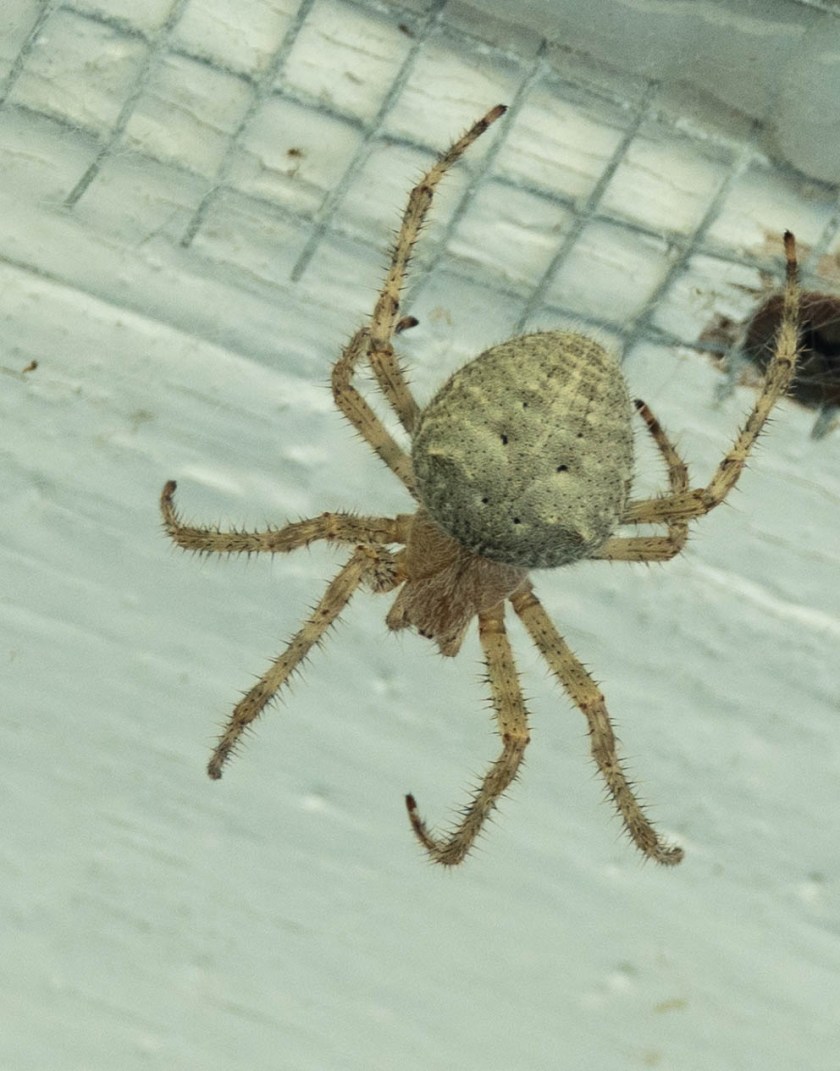
A follow-up on my last entry, and not for the arachnophobic among you. I promise to take a break from spiders after this.

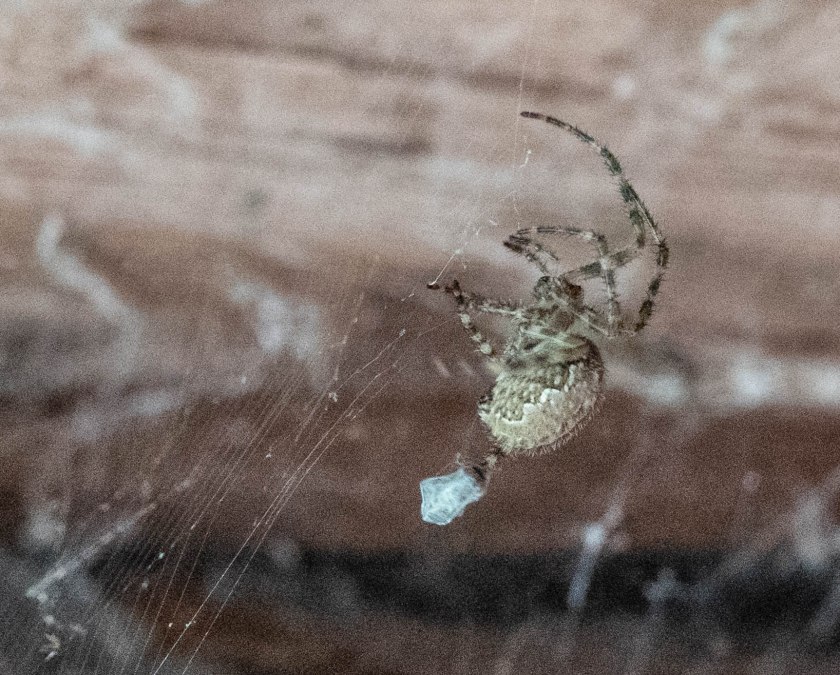
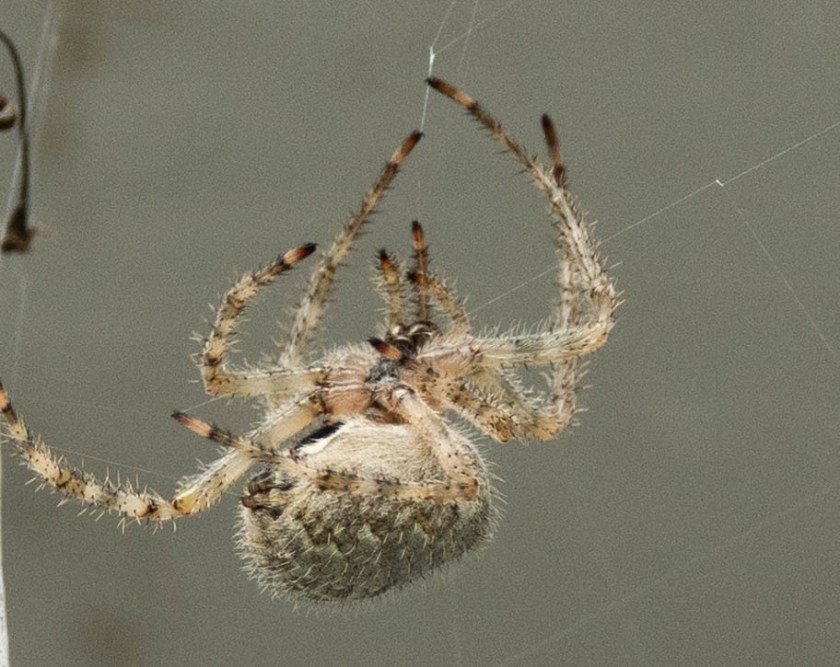
My dexterous orb-weaver spider caught a fly, and here it is all bundled up tidily:

DSC02960

Then she took it up into the eaves, and had supper:

C0007-4

And if you’d like to watch her dining techniques, here is an action video (like last time, watch in full frame if you can persuade it to do so).


* The Spider and the Fly  by Mary Howitt (1799–1888), was published in 1828. The first verse describes the content of my previous blog:

“Will you walk into my parlour?” said the Spider to the Fly,
‘Tis the prettiest little parlour that ever you did spy;
The way into my parlour is up a winding stair,
And I’ve a many curious things to show when you are there.”


Several verses later it ends like this, a good accompaniment to this blog entry!


“Up jumped the cunning Spider, and fiercely held her fast.
He dragged her up his winding stair, into his dismal den,
Within his little parlour — but she ne’er came out again!”

“A thin premeditated rig”

“Natural History” by E.B. White

The spider, dropping down from twig,
Unfolds a plan of her devising,
A thin premeditated rig
To use in rising.

E. B. White most famously wrote Charlotte’s Web, one of my children’s favorite books, about a very smart spider called Charlotte.

Orb-weaver Spider

This week I watched an orb-weaver spider weaving her web in close-up, and it was remarkable.

DSC02404

The spinnerets are at the back of her abdomen, underneath. You can just see a silk thread stretching out to the left from the spinnerets.


DSC02383

She uses her back legs to pull the silk out of the spinnerets, carefully holding it up with just the right tension and angling it towards where she wants it to go.

DSC02404

Each time she reaches a spoke in the web, she pauses and somehow ties it in, before continuing. The tiny toes on the end of each leg hold onto the spokes as she lays down yet another perfect section of her spiral. The spiral thread is sticky, and catches her prey: you can see the sticky beads in the photo just above this text.

DSC02373

Here is a short video, best watched fullscreen if you can. Watch how she carefully pays out the thread as she tightrope-walks across her growing web:


All that work, and then orb weavers usually eat their web for breakfast, and spin a new one every day.

PS: Arachne was a renowned weaver, and the Greek goddess of spiders. Hence the name Arachnids for the class that includes spiders, scorpions, and ticks…

Thanksgiving on legs

For readers in the US, wild turkeys, Meleagris gallopavo, are no longer exciting, in fact they have become a nuisance. But for readers elsewhere they still I think hold a certain fascination. If not, stop reading now!

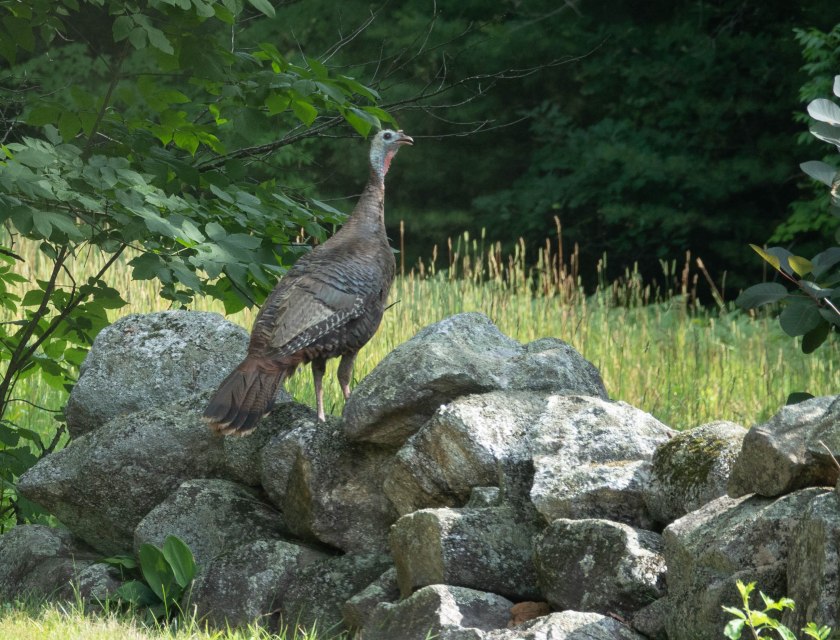
This solitary young female appears every day near our bird feeder, scratching around for what the birds have dropped. It is easy to see why they were hunted close to extinction for all that meat (up to 20lbs of it).

DSC01528

Their feathers are quite beautiful:

DSC01516

Their heads: well, that depends on the eye of the beholder:

DSC01546

If you look carefully you can see her ear, that circle below and to the right of her eye. And the conical spike on the top of her head is her snood. These are much much larger in males, and hang down right over the bill. They are highly erectile, getting larger and more brightly colored during courtship. The same is true of the lumpy red warts, called caruncles.

This time of year, the females are usually in groups with their young. They practice communal chick-rearing, a good role-model for human society.

DSC01598

They enjoy dustbaths in a small depression they have created by scratching for seed:

DSC01589

If I get too close, they scuttle off, or even make a stab at flying short distances with their vestigial flight feathers:

DSC01604

(The adults are powerful fliers. Yesterday I scared four adults, who then flew right across my 6-acre meadow into the tops of the distant trees.)

The whole group moved on to a new food source:

DSC01605

Leaving one adult standing guard on the stone wall:

DSC01613

Until they were all safe and she too moved on:

DSC01615


PS: Turkey populations are a notable conservation success story, having recovered from a low of 30,000 in 1930 to about 7 million today, a remarkable comeback spearheaded by early conservationists like Theodore Roosevelt.

PPS The males are much more dramatic in appearance, but I never see them on my land in the summer.  I am hoping to see one in the fall, in which case he will appear in this blog!