Plenty in the midst of drought

As fall approaches, we are in the midst of a drought. The beaver pond is down about three feet. The ground is iron hard, the leaves are curling and browning, the woods are devoid of mushrooms, but despite this, the defiant plants are producing seeds and nuts. Some are ingenious, like these Yellow Avens, Geum aleppicum, seedheads, each seed a tiny hook that detaches from the plant and attaches to a passing animal (or human).

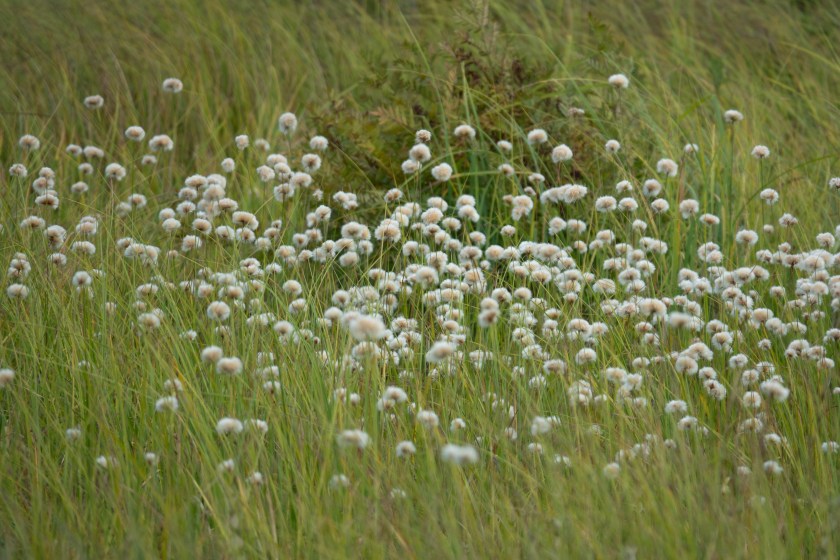
Some are hauntingly beautiful, like this ghostly Cottongrass, Eriophorum angustifolium, a sedge that likes open wetlands:

Many offer food to the birds and the animals. Some seeds have hard capsules, like these Witchhazel nuts, food for ruffed grouse, wild turkeys and squirrels:

Some are tucked into cones that attract seed-eating birds. These alder cones are hosting an American Alder Tongue Gall Fungus that creates that strange red tongue at lower left.

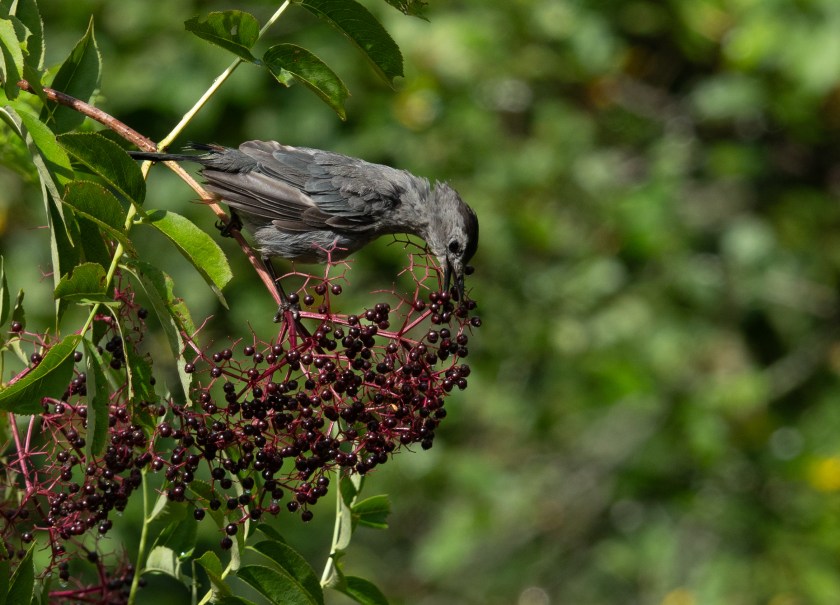
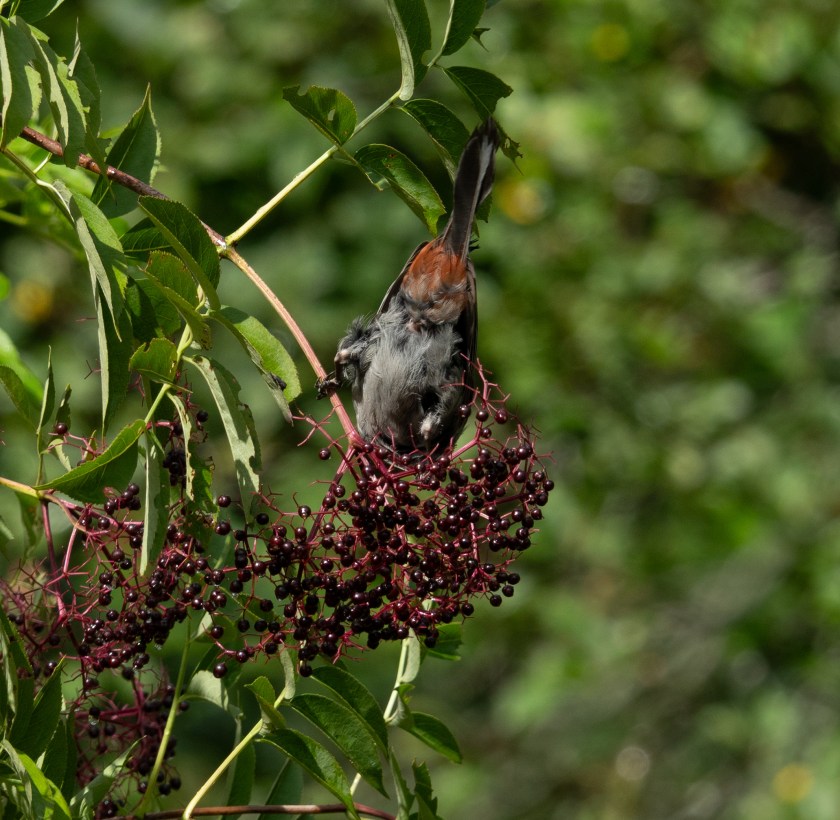
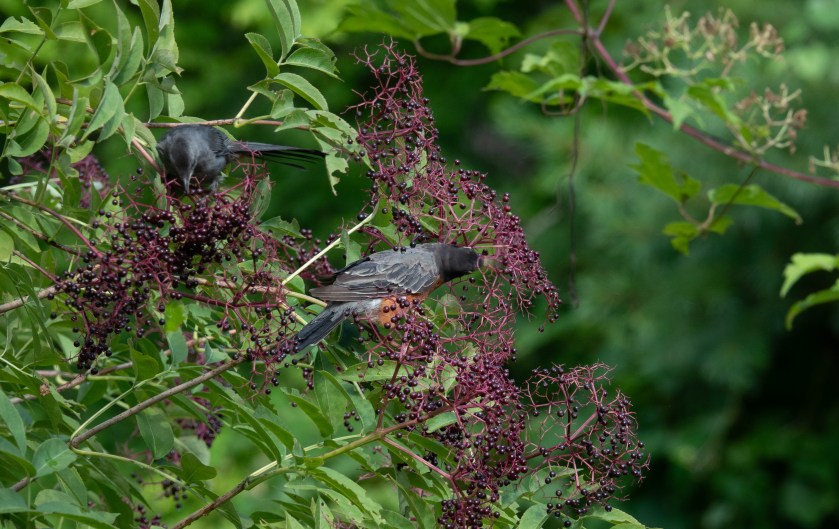
And of course some seeds are inside berries. The elderberries attract Gray Catbirds,

dull slate-grey birds

except for a brilliant chestnut under-tail:

They occasionally share with a passing American Robin:

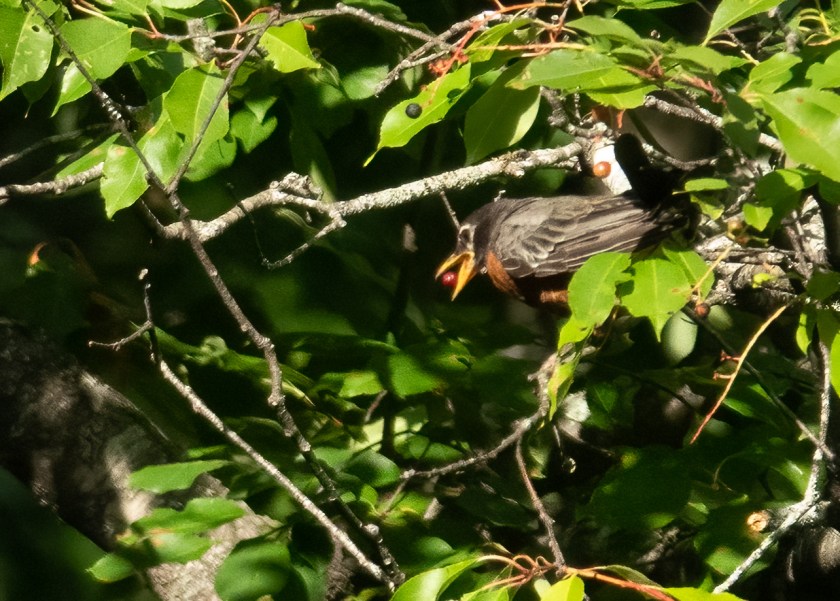
But the robins mostly seem to prefer the wild American Black Cherry, Prunus serotina, where they forage 40 feet up in the crown:

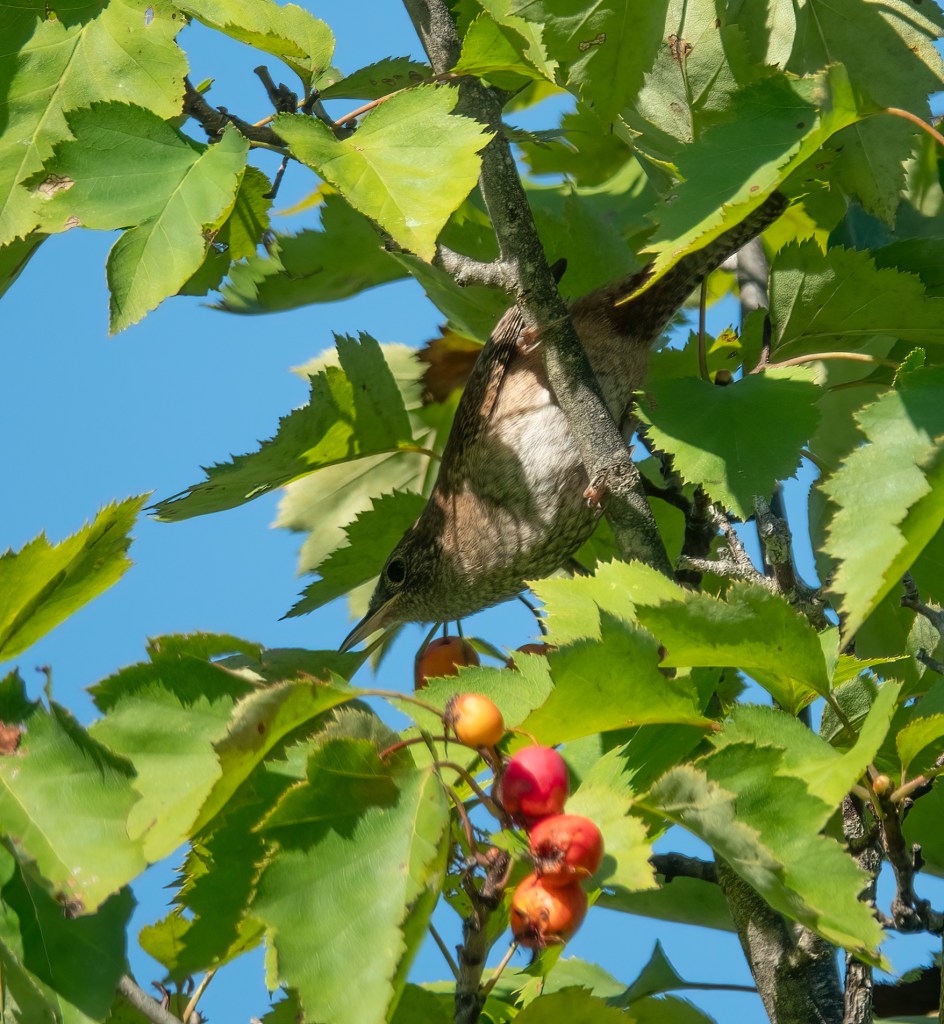
Finally, a wren on a hawthorn, feeding either on the fruit or, more likely, on tiny insects:

PS While I was writing this we had the first rain for over a month, sadly just a short shower, but that is why the catbird looks rather scruffy.

Wool-gathering

[I have blogged about these strange aphids before, so this is a sort of epilogue to my earlier post, which can find here: https://eyesonthewild.blog/2022/11/12/bugs-with-dreadlocks/ ]

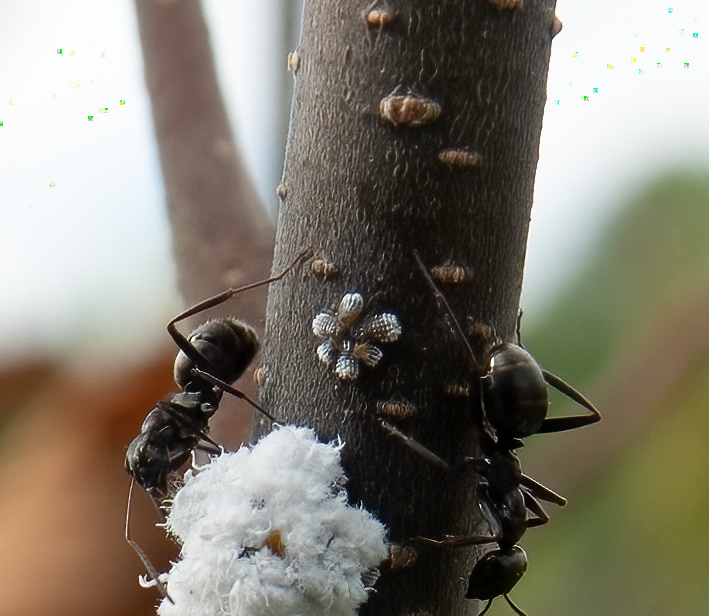
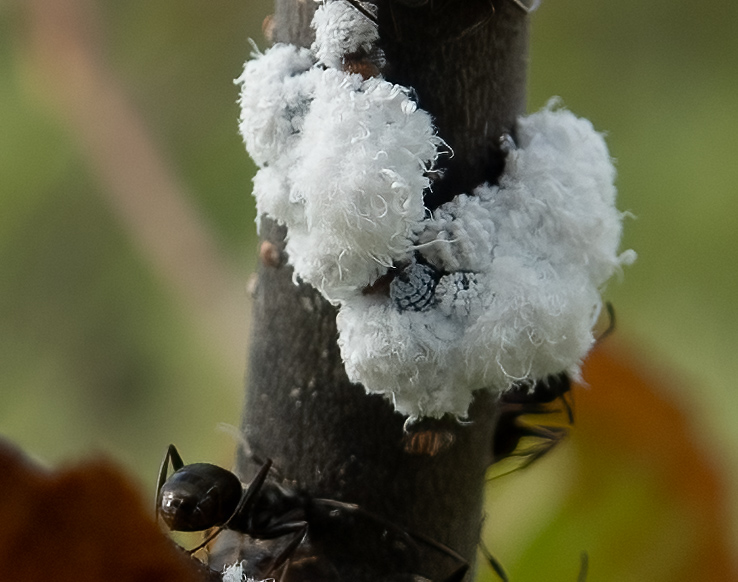
The Woolly Alder Aphid, Prociphilus tessellatus, gets its scientific name from the tessellated (tiled) pattern of wax-gland plates on its back . It is only 1/8″ long, and six of them are clustered in a little rosette in the centre of this photo:

The glands are composed of greatly enlarged epidermal cells underlying a modified cuticle that forms distinctive wax gland plates. Secreted wax in the form of threads passes out of the cuticle as filaments.. ” In the next photo you can see three aphids with differing amounts of white wax buildup, surrounded by many more entirely submerged beneath their shaggy coatings:

It is suggested that the primary role of the secreted wax is to prevent the aphids becoming contaminated by their own secreted honeydew and that of other members of the colony.” (both quotes from Smith, R.G. 1999 doi.org/10.1080/002229399300227)

In these photos they are being ‘farmed’ by ants, evidence that, just like other aphids, they too produce honeydew :

Think of the aphids as minute sheep, and the aphids as sheepdogs.

A Fluffy Lion

Yesterday morning I saw a small piece of fluff on an oak leaf.

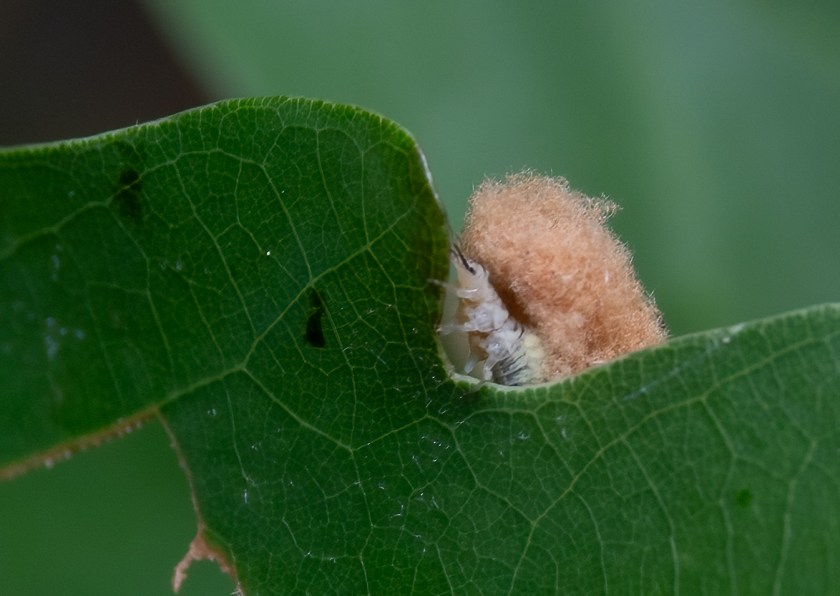
In nature, anomalies catch the eye, so I looked more closely. It moved! So I picked it up. A minute tail and a couple of legs poked out.

The whole thing was about 1/3″long. I tried to turn it over to see the bug underneath, but it righted itself in a microsecond. But when I put it on my thumb it tried to escape, walking steadily along my thumb looking for an off-ramp:

And when I put it back on the leaf, it beat a retreat over the edge of the leaf to safety:

Here is a video:

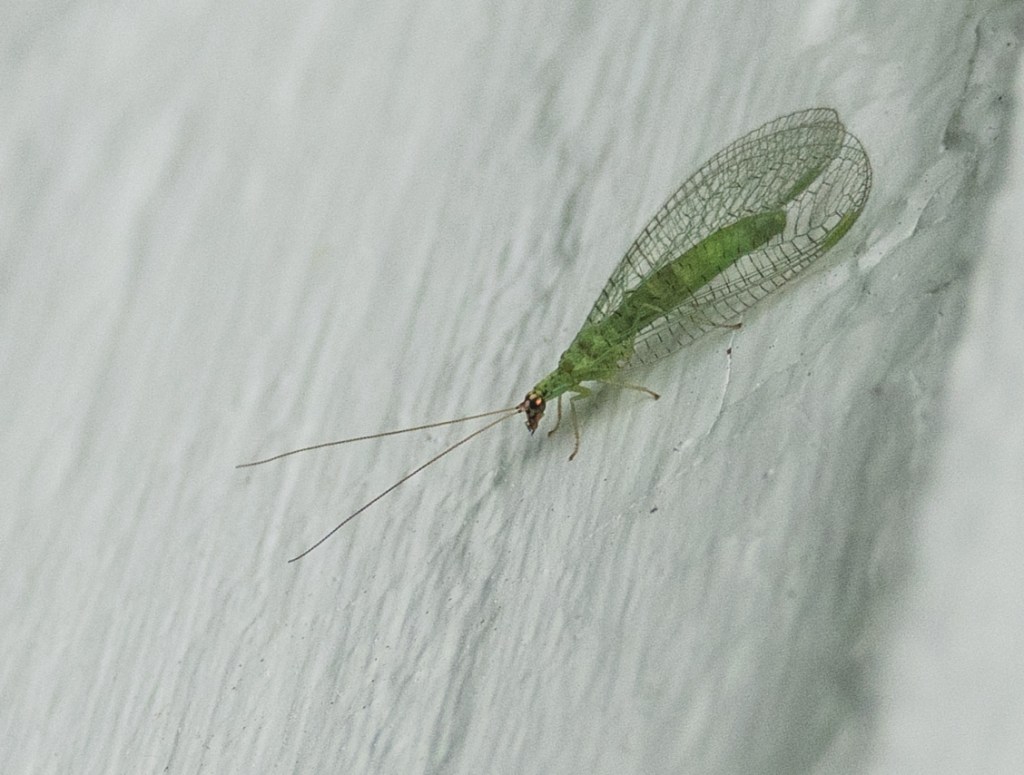
It is the larva of a Stripe-horned Lacewing. Here is a Golden-eyed Lacewing adult, a close relative:

Some species of lacewing larvae, like mine, load detritus on their backs as camouflage to fool birds, and very effective it probably is too, though it didn’t fool me for long.

They feed on aphids, and are sometimes described as alligator-like, both for their body shape and their bite: here is the larva of a Red-tipped Green Lacewing, showing those ferocious jaws:

The Missouri Department of Conservation has a graphic description: “The larvae, sometimes called ‘aphid lions’, are insatiable predators of other insects, especially aphids. A lacewing larva grasps the aphid with its grooved, caliper-shaped jaws, often lifts it up in the air, then drinks the fluids in the aphid’s body. A single lacewing larva can eat an aphid a minute, for hours, and not slow down. ” As a result they are sometimes sold as a natural form of aphid control.

Just shows you can be small but scary, more elegantly put by Shakespeare in Midsummer Night’s Dream “Though she be but little, she is fierce “

The Dangerous Phase

As summer reaches its peak, the nesting season is more or less over, but like teenagers the baby birds are not yet independent. They have mostly left their nests, and sit on branches cheeping urgently for food deliveries. Soon they will have to fend for themselves, and then migrate. Mortality is high in this interlude betwixt the parental home and true adulthood.

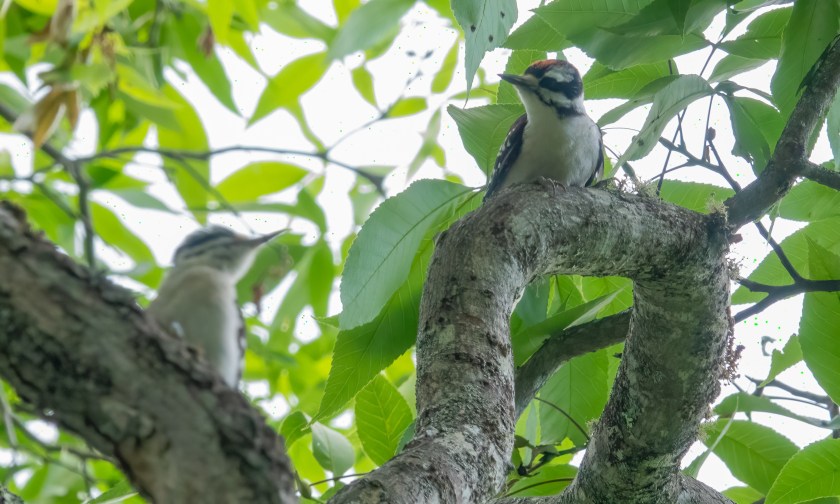
These are some I have seen in the last few weeks. In my big hickory tree, two Hairy Woodpecker chicks hopped around:

Two Hairy Woodpecker fledglings

The House Wren fledglings are still being fed, three days after leaving the nest, and several trees away:

Northern House Wren fledglings

A White-breasted Nuthatch seemed to have only a single chick:

White-breasted Nuthatch and fledgling.

A chickadee had ended up on the ground, but it clambered back up to a low branch shortly after I took the photo.

Black-capped Chickadee fledgling on ground by beaver pond.

The next shot is a food delivery by a Common Yellowthroat mother, right:

Common Yellowthroat fledgling, left, and mother, right

She then pokes it down the fledgling’s throat:

A hummingbird posing on my garden trellis:

Ruby-throated Hummingbird fledgling.

The scaly head feathers are distinctive for juveniles. At this age, you can’t reliably tell if it is male or female; the male’s ruby throat only develops later. However, male fledglings usually have streaks on the throat. so the pure white throat of this bird suggests it is female…

On the water, the ducklings are becoming more independent too. This Wood Duck duckling was nowhere near any adults, with just one sibling.

Wood Duck ducklings

This Hooded Merganser is further along:

Hooded Merganser duckling

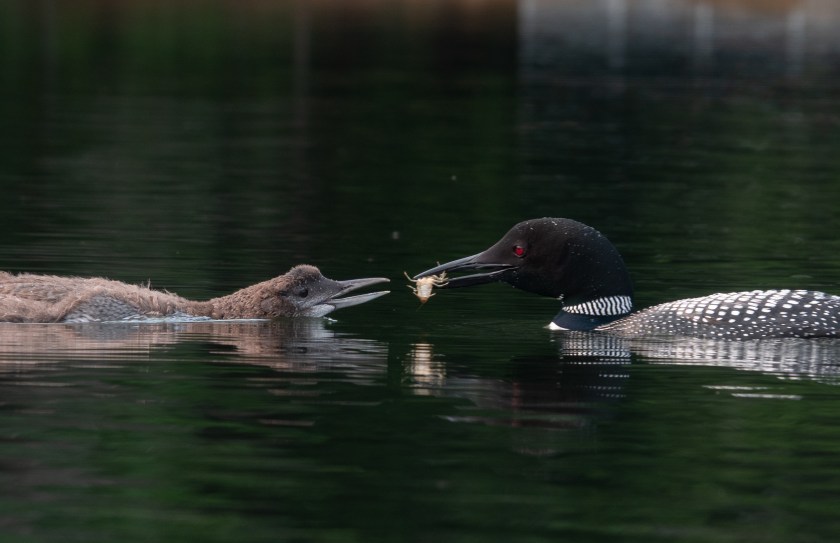
The loon chicks are still being fed, either with (quite large) fish:

Fish delivery
Lunch

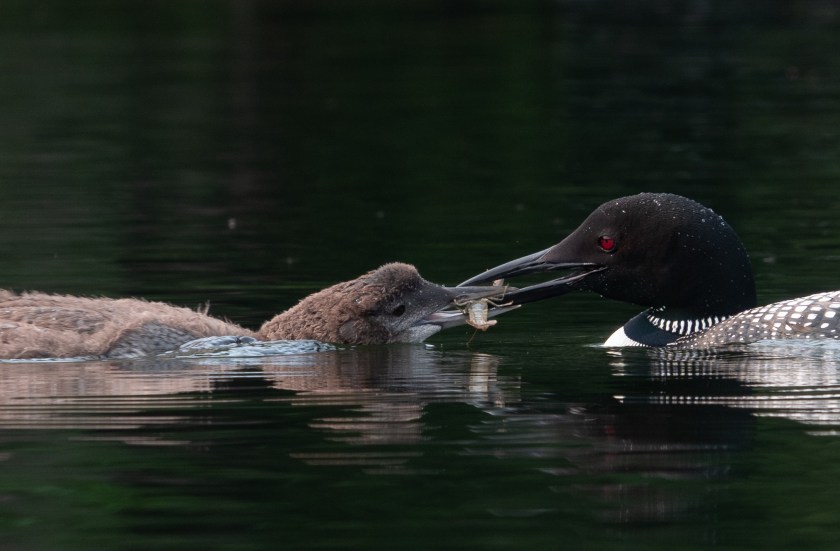
or crayfish:

Reaching for a crayfish appetizer
Handover
Complete

You can see that their downy plumage is being shed as the serious feathers underneath take their place.

Watching a new generation flutter out into the world is a special privilege. Cross your fingers and hope for the best.

The Sudden Demise of an American Chestnut

The American Chestnut disappeared in a few short years after the chestnut blight, imported from Asia, killed about 4 billion trees in the early 20th century.

But every now and again one decides to regrow, and lo and behold a few years ago I noticed a very healthy-looking sapling on the edge of my field. By last year it was maybe twenty feet tall, and in full flower:

I have read that very few trees reach the flowering stage before succumbing to the blight, but perhaps I had a winner?

This year, it flowered again. The long creamy fronds are the male flowers, full of pollen that the Common Eastern Bumblebee gorges on. The smaller round prickly ones are the female flowers, which will eventually become the fruit.

July 6 Round female flowers. Long thin male flowers.

July 6 American Chestnut close-up of female flowers
July 6 Common Eastern Bumblebee gathering pollen from male flowers

These photos were all taken on July 6th.

Five days later, on July 11th, the entire tree drooped:

Two days later, on July 13, it was moribund:

and three days after that, on July 16, it was dead.

The speed with which this fungus kills is horrifying. Ten days from healthy-looking flowers, to death.

The blight is a fungus that enters the tree through a small wound of some kind, creates a canker. Once it girdles the tree, it is doomed:

The trees send up suckers from the roots and the base of the trunk, and all of those below the canker were entirely healthy, but everything above it was brown and dead; the arrow points to the canker, and you can see healthy shoots in the foreground and to the left.

Most of my posts are (I hope) joyous, but this is a dispiriting tale of loss.

A Beetle Magical Mystery Tour

[This post is guaranteed to elicit from any under-10 year old an “Ew, gross!” response.]

There are at least two different beetles casually called the Milkweed Leaf Beetle. Both are red, and both do indeed eat milkweed leaves, but there the resemblance ends.

The Argus Tortoise Beetle, Chelymorpha cassidea, looks like a ladybug (aka ladybird!) but is a bit bigger at 9 to 12 mm (0.35 to 0.47 in) long compared to 5.5 to 8.5mm for the Harlequin Ladybug.

They have the most extraordinary larvae. Here is a trio:

Look at the rightmost one more closely. It has a pair of “horns” at the butt end, called the caudal furca.

Every time it poops, it deposits the output on these horns, building up a substantial lump.

This is called a fecal shield. It curves over the top of the larva like a sort of Roman helmet, and it can be moved or waved around, reminding me of the periscope of the (quite different) Beatles’ Yellow Submarine.

The purpose of this bizarre and rather disgusting construction, seems to be defense against predators (in this case my intrusive camera lens).

The previous photos were taken at midday on Monday. By 3.04pm on the following day the larva is beginning to form an oval golden pupa, though it is still soft:

At 5.25pm the bottom one has begun to darken, and meanwhile the top one has begun its transformation too:

And by 10.45am the next morning, both have completely changed their color, and hardened into their final pupal forms:

They will drop to the ground, and a new beetle will appear later this summer.

The unrelated Swamp Milkweed Leaf Beetle, Labidomera clivicollis, is also red on the outside:

When it wants to move to a new plant, it goes to a high place:

opens those wing cases (elytra):

and unfurls its wings. Lo and behold, they too are red.

An unexpected magical mystery delight.

PS The following one minute video is extremely boring, but shows you that the larvae with their fecal shields are perfectly mobile. For hard-core beetle people only.

Airborne

A few weeks ago I showed you the Northern House Wrens building their nest in an old gourd. After a summer storm, the gourd collapsed at a 45 degree angle, but the wren family was undeterred:

At first I thought there was only one chick:

But there were actually three, and by the time of these photos they could barely all fit into the mouth of the nest:

The parents were coming and going with food supplies. A grasshopper:

Next, a grub, delivered from below this time:

A large beetle for the lucky lefthand one, leaving the other one bereft:

My husband, and the solicitous father of our children, worried about the unfed chick: one can only hope that somehow they take turns.

It seemed to me that the chicks must venture out any day now, and sure enough the next morning one was sitting on a twig overhanging the nest:

Two were still inside, and the indefatigable parents continued to bring food:

They also removed endless numbers of fecal sacs; this short video shows a food delivery, followed by a cleanup:

At one point the pioneering fledgling chick returned to the gourd and tucked itself in under an overhang:

then flew competently off:

I thought if I watched for long enough perhaps I would see one of the last two taking its very first flight, so I settled in. Here is the resulting video. It starts with the one that had emerged the night before. Then all three chicks keep up a non-stop chatter, as they try to work out where the oldest one has gone. The climactic next section has been slowed down: the righthand chick almost falls out of the nest, flutters to get a grip on the lower rim, hangs there for a moment and then flaps up to clamber onto the top of the gourd. It surveys this new world, then takes its first real very short flight (more of a hop) to the next twig up. Success.

The final chick left a little while later. They stay nearby, and the parents will continue to feed them for a while until they are truly independent. Twenty-four hours and a rain squall later, they were calling for food from a tree about 200 yards away. It’s a cold hard world out there:

House wrens sometimes have more than one brood: we live in hope.

Great White Ghosts

[I never finished telling you about Florida, so here is a flashback.]

When I see a huge white wading bird, I think Great Egret, Ardea alba, but in southern Florida, I might well be wrong. True, there are plenty of these egrets around, but there are also decoys, designed to deceive. These impostors are in fact Great Blue Herons, Ardea herodias, but they’re a pure white subspecies Ardea herodias occidentalis, (and more helpfully sometimes called the Great White Heron, see more below.)

Great Egrets in breeding season have black legs,

bright green lores (the skin between beak and eyes),

and ethereally delicate plumes:

which they wield in flamboyant courtship displays:

stretching their necks to the sky:

to the bemusement of their pelican neighbors:

Great White Herons are much rarer. They have pale legs, a heavier yellow beak, and bluish lores:

with less delicate plumes:

Both of them are waders who stalk the shallows in search of prey. Which do you think this is, at sunrise in the Ten Thousand Islands?

It was, to my delight, a Great White Heron. So, don’t jump to conclusions next time you see a big white bird in south Florida, whether it is elegant:

or comical:.

PS As I was fact-checking this post, I discovered that in 2020 the Great White Heron was recognized as a separate species from the Great Blue Heron. It has been renamed Ardea occidentalis, and is considered by the IUCN to be Globally Endangered. There are less than 2500 left, and their shallow-water habitats are increasingly under threat. If you’re curious about how species decisions like this are made, read here: https://www.heronconservation.org/media/JHBC/vol07/07_01_Browning_and_Kushlan.pdf

In the thick of it

If you are trying to sell your house, the real estate agent will undoubtedly want the garden looking neat and tidy. But I leave some corners of my garden unkempt and tangled, because that is what nature likes. Here are some of the things that flourish in my thicket, about ten feet square, and composed of ancient lilacs, honeysuckle, a large hydrangea, old wild grapevines, and chokecherries. All of these are either native wild shrubs, or were planted by the early settlers when they built our house in 1810.

In early spring, the bloodroot flowers deep in the shade:

followed by the Red Trillium buds (complete with jumping spider):

The Northern House Wrens arrive, (and will eventually nest, as I blogged recently), and the male spends hours singing very loudly indeed from any available branch.

The chokecherry flowers:

A Northern Cardinal pokes around in the middle then chooses a lookout:

A male Ruby-throated Hummingbird finds the perfect perch to dry himself after pouring rain:

A Magnolia Warbler puts in a brief appearance:

A chipmunk rummages in the dead leaves then pauses on the wall to check the coast is clear:

A Chestnut-sided Warbler find nesting materials in the vines:

and rests amongst the chokecherry flowers:

And a female American Redstart just hangs out:

And all that is just what I both saw and photographed in spring 2025.

Jack and the Fungus Gnat

Jack-in-the-Pulpit, Arisaema triphyllum, is a striking, exotic, almost sci-fi looking wildflower. It has a single funnel-shaped stripy “petal” called a spathe, curled around an upright structure called a spadix.

I found myself wondering how on earth it is pollinated. If you look very closely at this photo, you can see pollen grains on the spadix, on the right hand-side:

Each plant is either male or female. The male flowers produce pollen, and the females have ovaries, and need the male pollen for fertilization. The female spadix apparently has tiny flowers, but I have never been able to see them. Finally, I found a more precise description. The tiny flowers are deep inside the spathe, at the base of the spadix, and to see them you have to cut away the front of the spathe, so I did:

What you are looking at is the inside of a female flower. These are the bright green ovaries, each topped by a tiny white fuzzy stigma waiting to receive the pollen.

But how does it get there?

Here is the best description I can find, from the New York Botanical Garden:

” Jack-in-the-pulpit is pollinated by fungus gnats, which are attracted into the hooded spathes by a slight fungal odor. The gnats visit to lay their eggs on what they are duped to believe is a fungus. … When the mistake is perceived the gnats are unable to crawl out of the spathe due to its slippery interior, nor can they fly straight up to escape in that way. However, if the plant is a male, they may eventually notice a small opening at the base of the spathe through which they can escape. By this time they are dusted with pollen.

The gnats, being of limited brain capacity, may be duped repeatedly until they eventually enter a female plant where the pollen that they are carrying brushes off on the fuzzy stigmas, thereby effecting pollination. This time there is no escape since the spathes of female plants have no opening in the base of their spathes, and the gnats die within the spathe.”

And here is what I think is a visiting gnat, on the stalk at lower left:

Successfully pollinated plants show brilliant berries in the fall:

PS The suggestive upright “Jack” is in fact a mere sterile appendix, but it does have one function: it produces the aromas that attract the gnats.

PPS There are many different species of Aristaema, Japan has five. It turns out each is mostly visited by a different species of fungus gnat, meaning that pollen is largely transferred amongst flowers of the same species, making hybridization unlikely. Read more here:

https://www.indefenseofplants.com/blog/2021/3/11/how-fungus-gnats-maintain-jack-in-the-pulpits