As a change from fungi and bugs, I thought you might like a few birds!
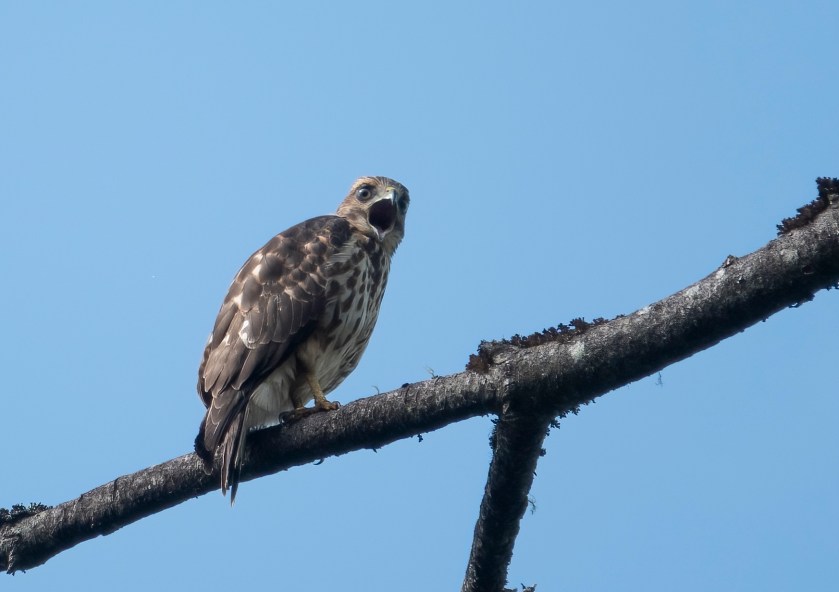
The Broad-winged Hawks were breeding by a small pond in our woods. This is a fledgling, still being fed by its parents, and it spent hours on a branch calling insistently for food:
I recorded its plaintive high-pitched call here:
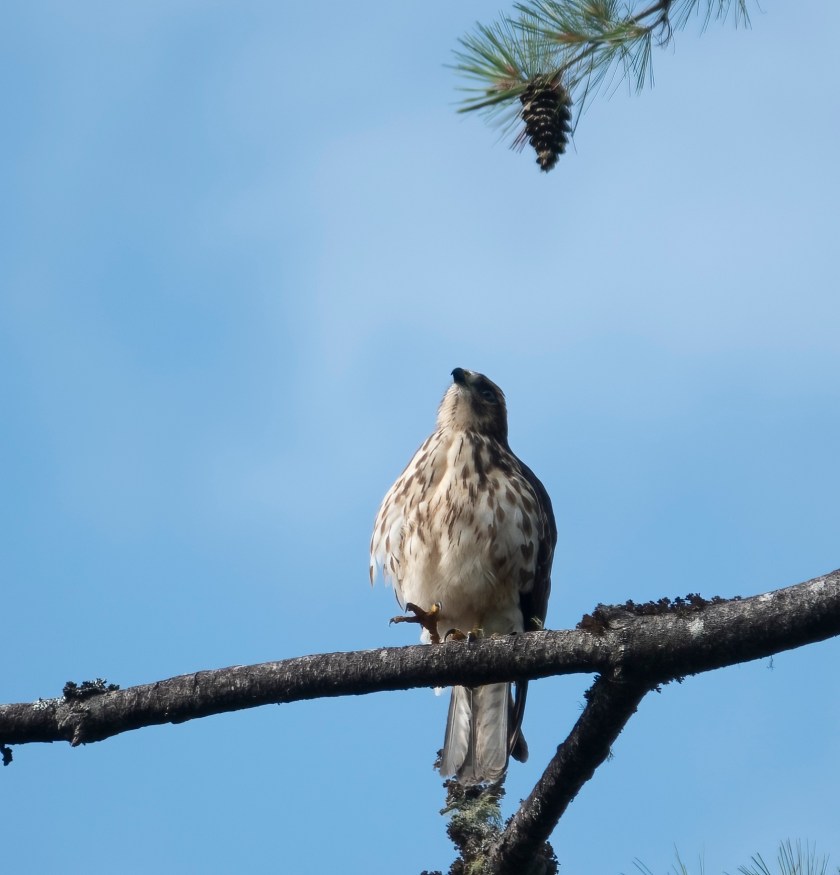
It hoped the pine cone might be edible, but it was out of reach:
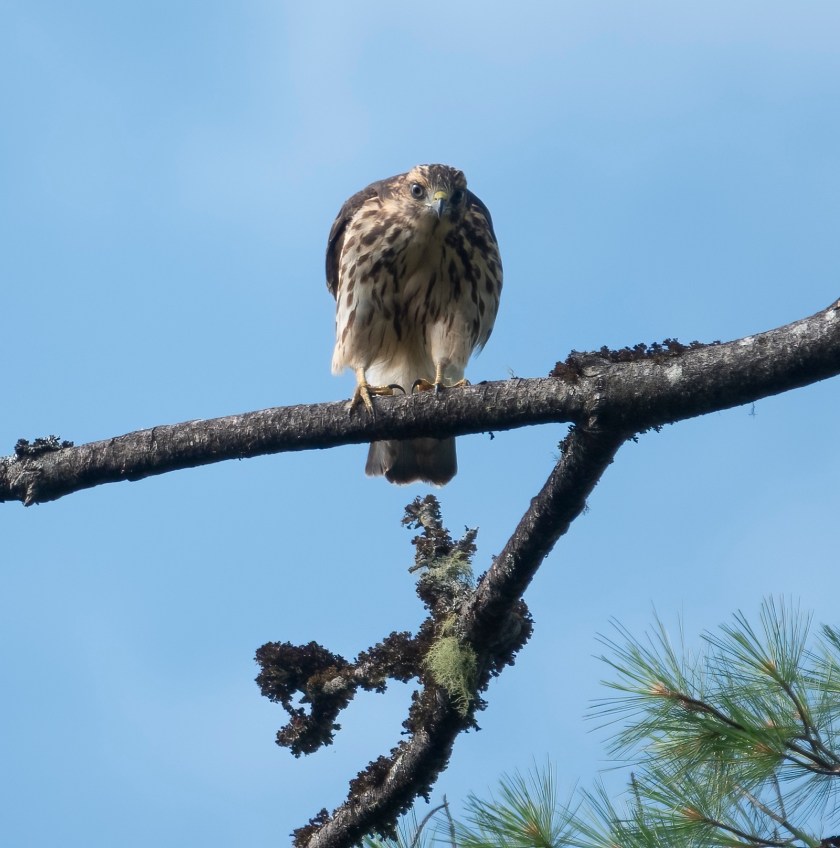
It knew I was there, but although it could fly short distances, but it stayed put:
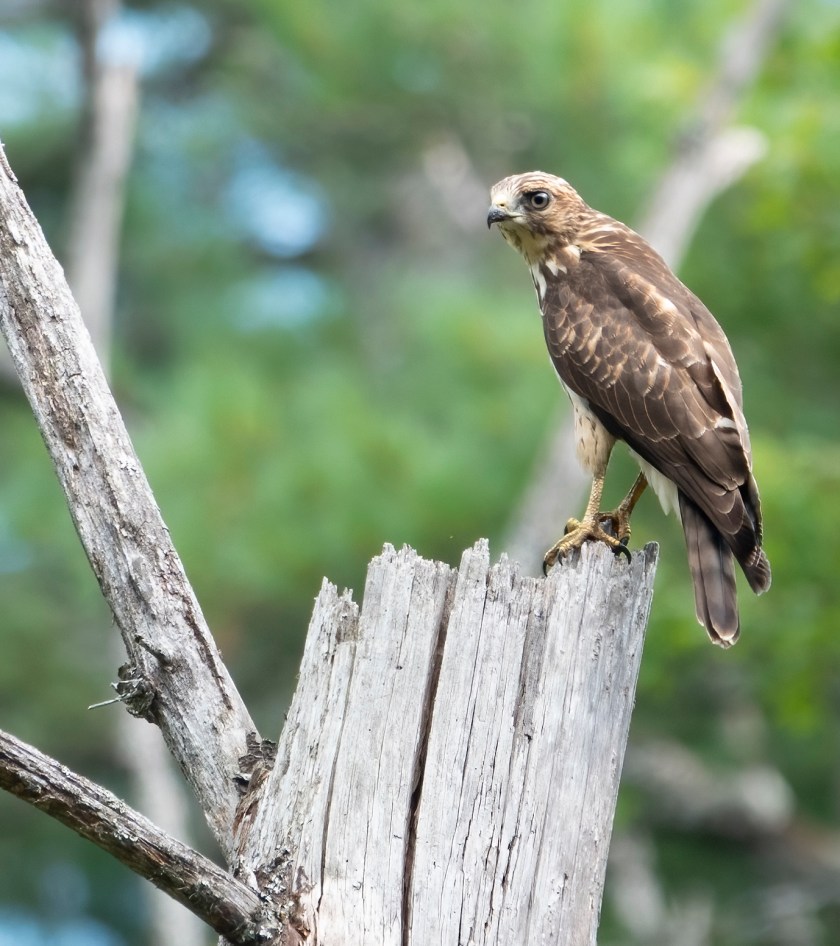
Two weeks later, it was still around, but most of the calling had stopped, and it flew much more:
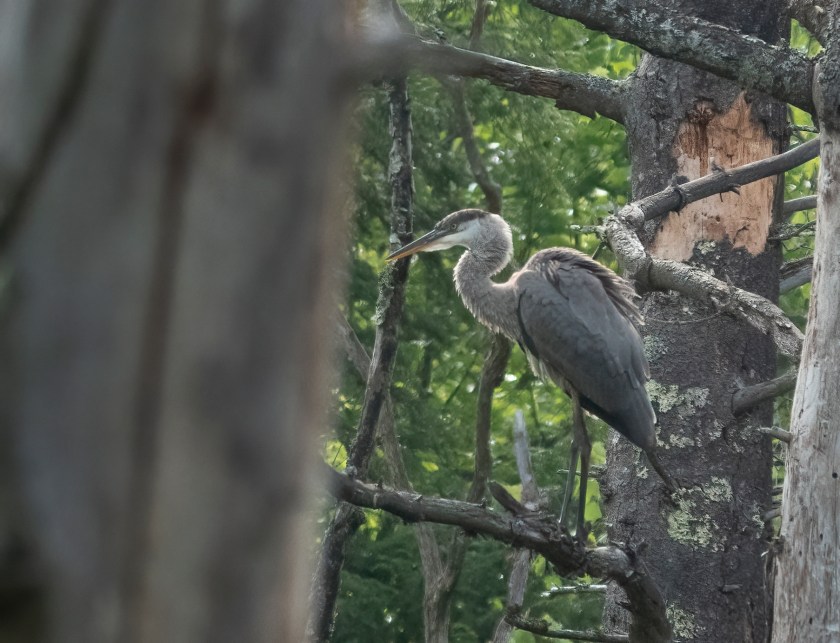
By the same pond, a heron was hunting in the reeds:
It flew up when I moved:
A mudlarking Solitary Sandpiper caught some sort of crayfish:
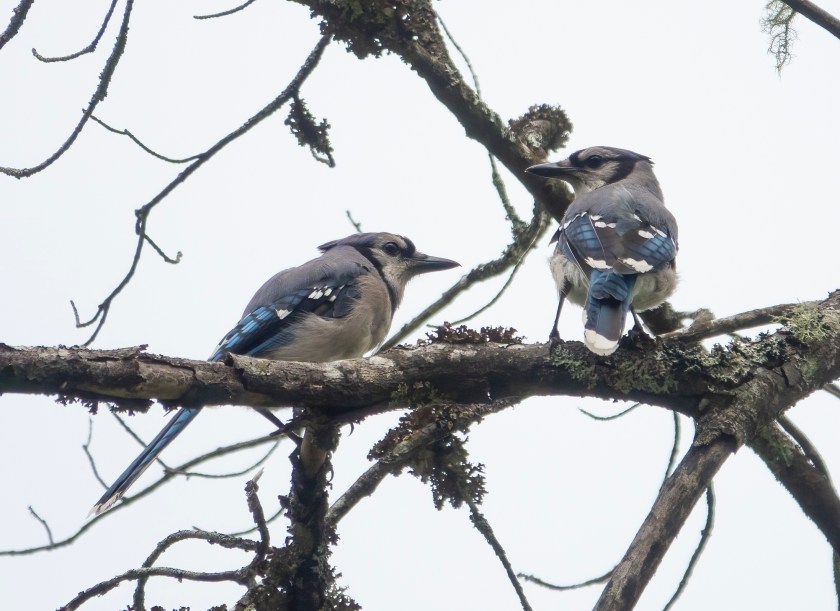
In the branches above, two young Bluejays played:
A Ruby-throated hummingbird gorged on a pond-side clump of Touch-me-not (Impatiens capensis) flowers, aka orange jewelweed:
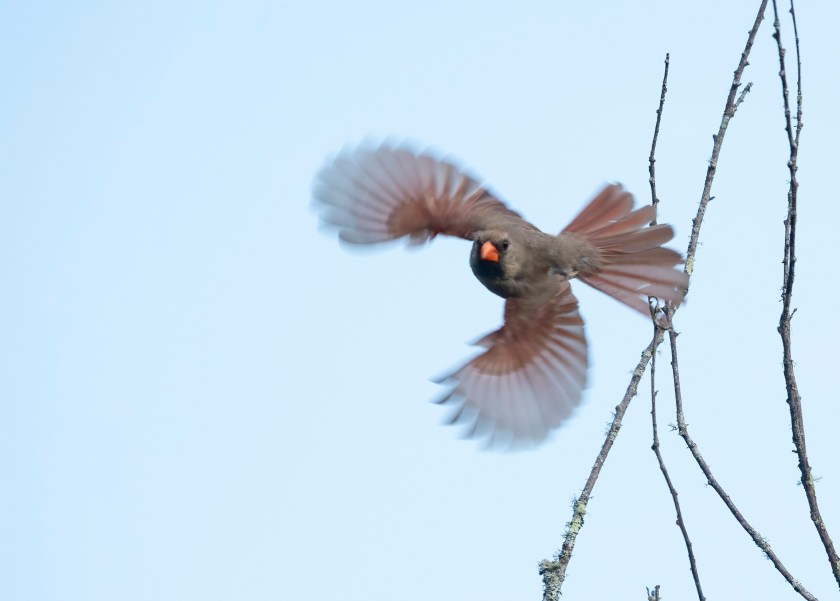
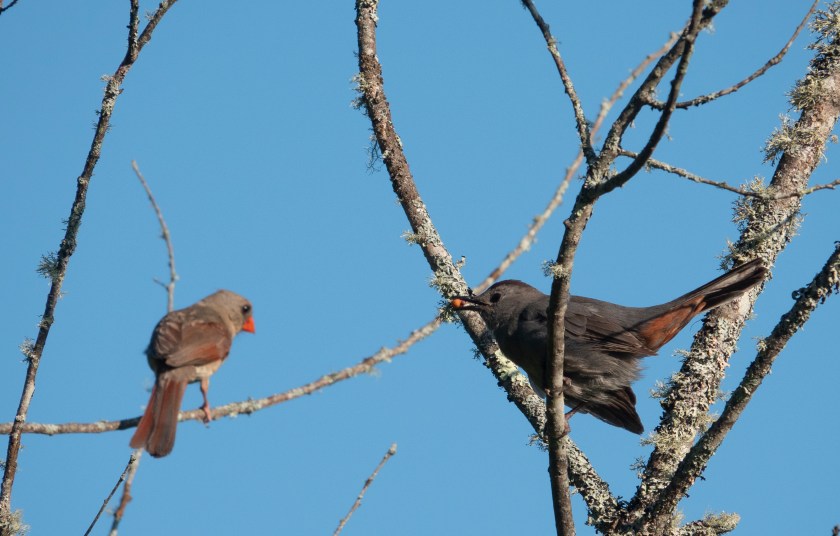
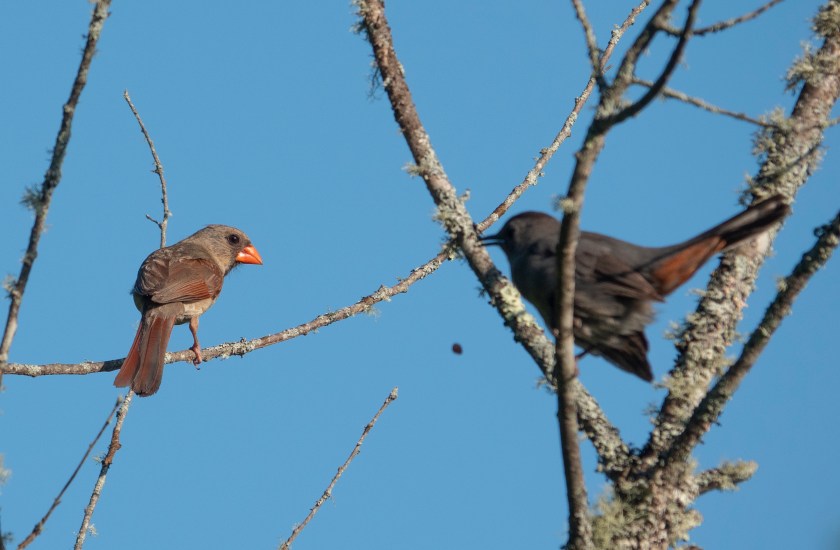
Back in the garden, a Grey Catbird had a scarlet berry trophy, but a female Northern Cardinal landed close by and disturbed its feeding:
In shock, it dropped the berry:
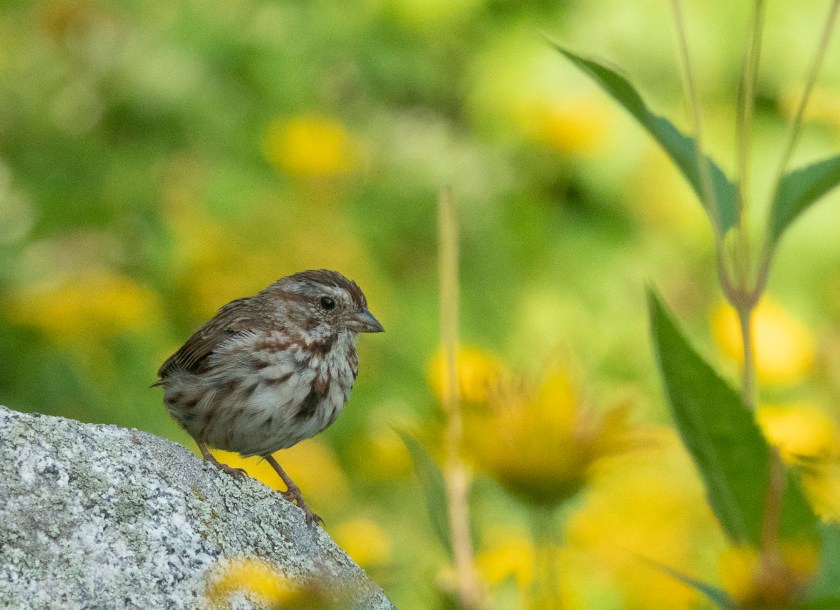
And a song sparrow hopped along the stone wall.
Nothing rare, but being surrounded by such creatures brings me happiness.
The iNaturalist app (iNat) has transformed how I and many others interact with nature. BiN (Before iNat) I would see something, and spend hours with one of a shelf-full of books trying to work out what I had seen. Now, I photograph it, enter a location, and show iNat the picture. And it knows! Or at least it gives me a shortlist of possibilities. It also shows me a map of where else it has been seen. Occasionally, mainly for small insects, it turns out it has hardly ever been seen in Maine, and I think, proudly, that I have documented a rarity. But have I??
Numbers can be low for many reasons other than real rarity; here are some of those reasons:
a thinly populated area, with few observers, true of my corner of Maine
it is only just starting to colonize an area, for a variety of reasons, so it may be locally rare but globally common
it lives in inaccessible environments such as marshes, or high in trees
it is drab and commonplace, so no-one thinks to submit an observation (house spider, ant)
it is hard to see and photograph, because it is very tiny, or well-camouflaged, or never stops moving
its numbers are indeed dropping, for environmental reasons such as climate change or habitat loss
I’ll show you a “rarity” or two, but hang onto that scepticism. One encouraging (but not at all conclusive) indication of rarity is that most of them don’t even have a common name! They have all been recorded 5 or fewer times in Maine. I’ve ranked them by the total number of observations, starting with the ones MOST often recorded, and ending with what might be the rarest:
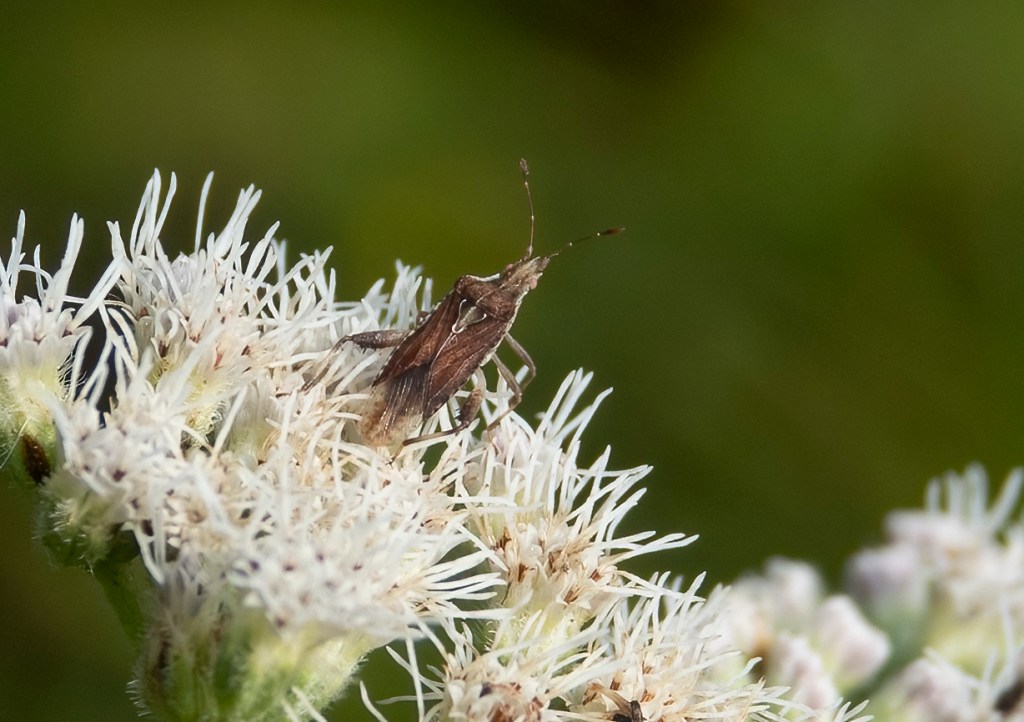
Harmostes fraterculus has 1161 total observations, 5 in Maine. It is on a Common Boneset flower.
This is compared to 5800 for the closely related Harmostes reflexulus, including dozens in Maine:
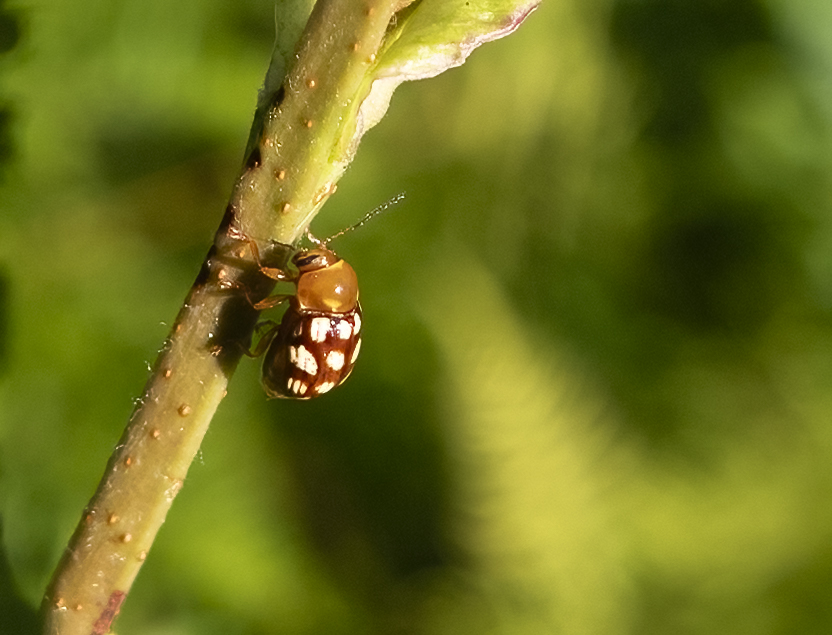
Fourteen-spotted Leaf Beetle, Cryptocephalus guttulatus, has 667 total, only 1 other in Maine. This seems to be the extreme northern edge of its range. A result of climate change?
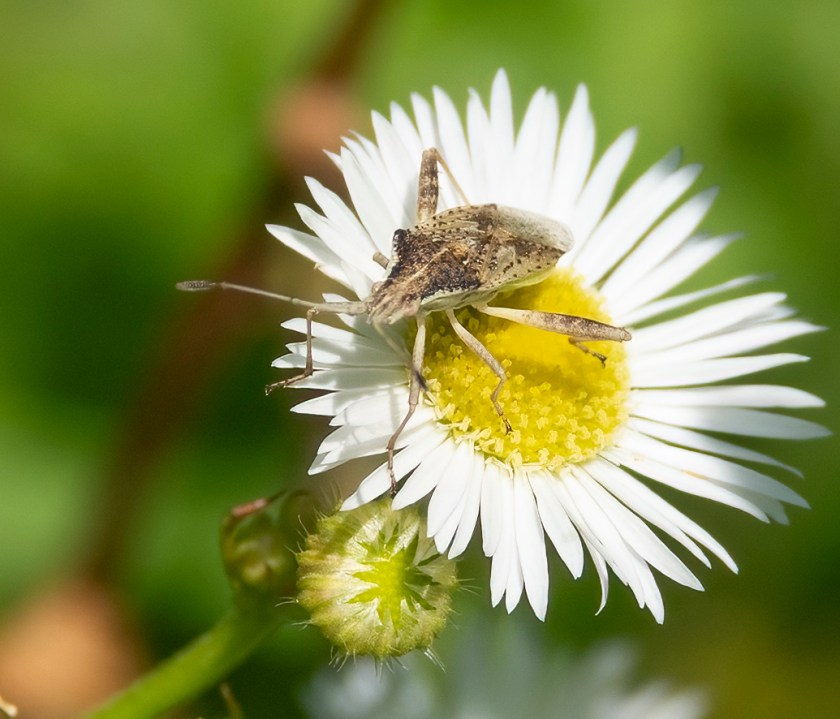
Stictopleurus punctiventris has 198 total observations, mainly in Canada. Only 5 others in Maine, 4 of them this year.
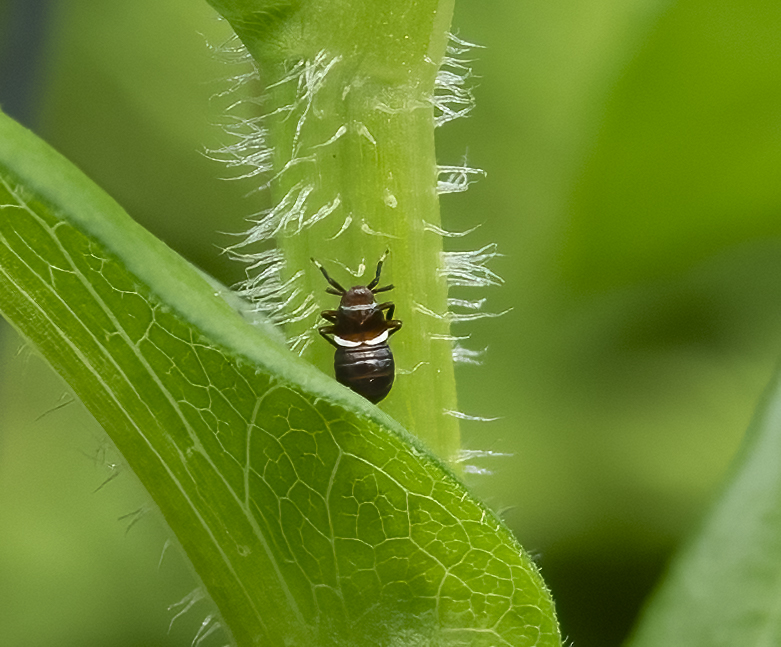
Pissonotus basalis has a mere 29 total observations, from Tennessee to Nova Scotia. None in Maine, except for me. This seems to be the best candidate for a real rarity, but it is very, very tiny, 3mm or o.1″and it also moved fast, so who knows.
To put all this in context, Maine has 370,421 observations of 6114 species of insects, and the most common observation, the Monarch Butterfly, has 4,523 observations. I suspect it would have far more but everyone knows what they are looking at, so they do not think to ask iNaturalist.
Do try it, it is a wonderful app, and you are contributing to citizen science when you upload an observation.
The past few weeks have been prime time for nesting birds and their young. No matter what the adults eat, the diet of a baby bird is pretty much entirely arthropods – insects, moths, caterpillars, spiders, and the like – foods that are high in protein, perfect for growing bones and muscles.
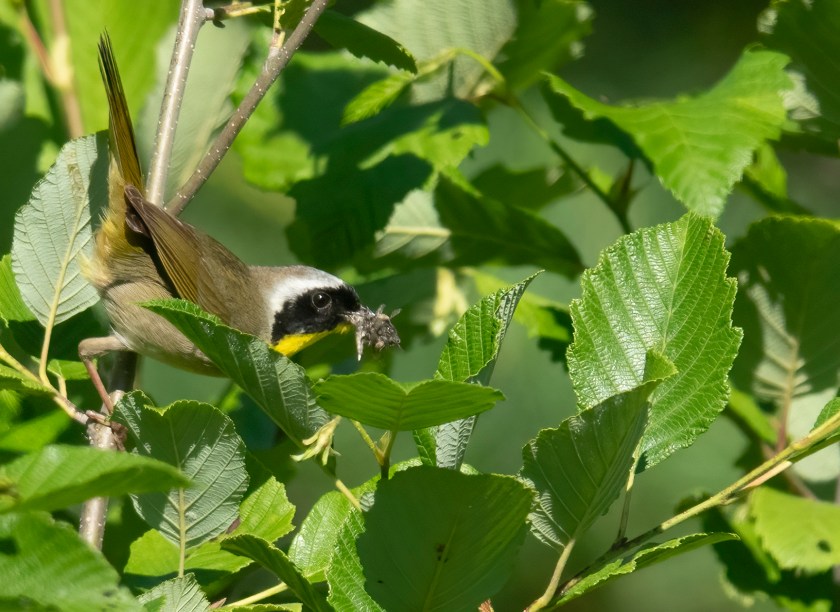
If a bird catches an insect for its own consumption, it usually eats it right away. So if it is carrying the insect around, the odds are high that it is on its way to feed its babies. A Common Yellowthroat male, with an unidentifiable insect:
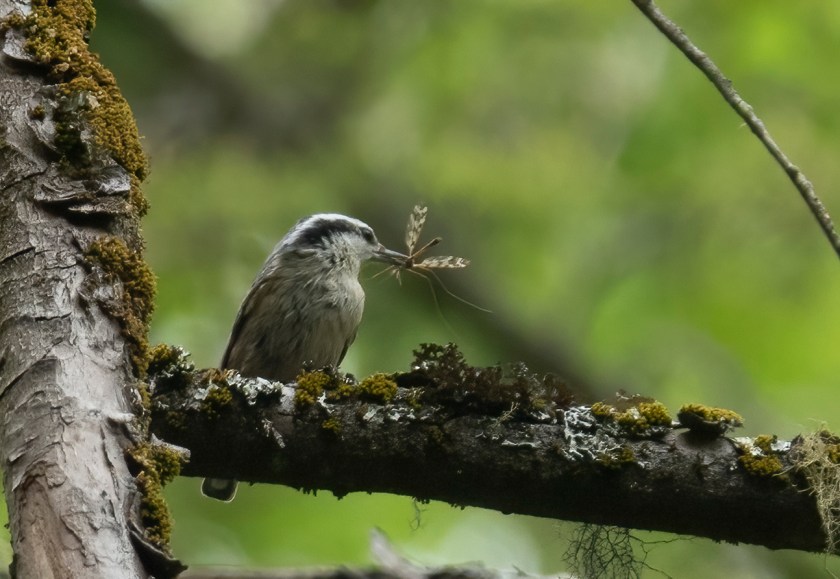
A female Red-breasted Nuthatch, deep in the woods, has caught a Cranefly. (The adults eat conifer seeds in winter, but arboreal arthropods in the breeding season). Only the male actually has a red breast!
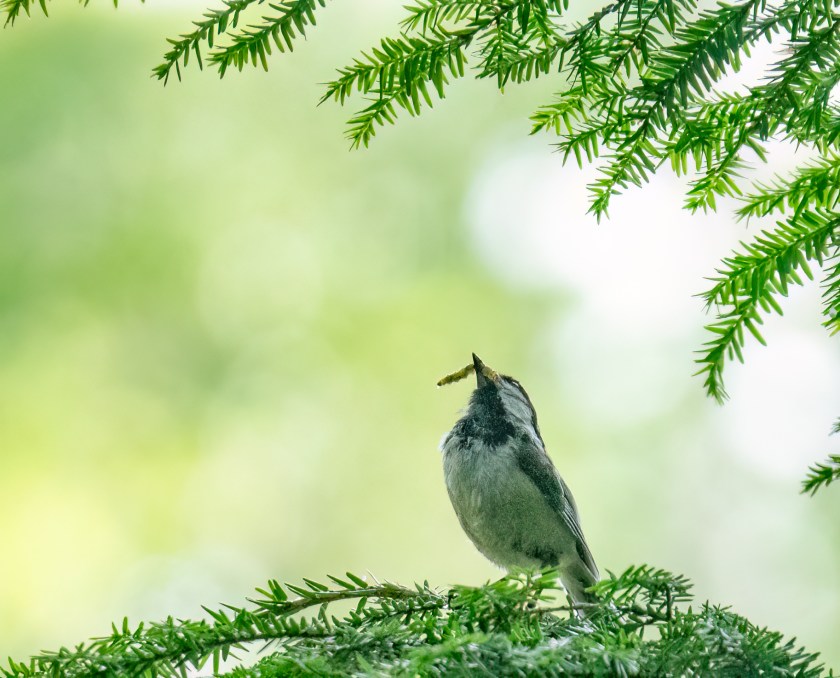
A Chickadee with a juicy caterpillar:
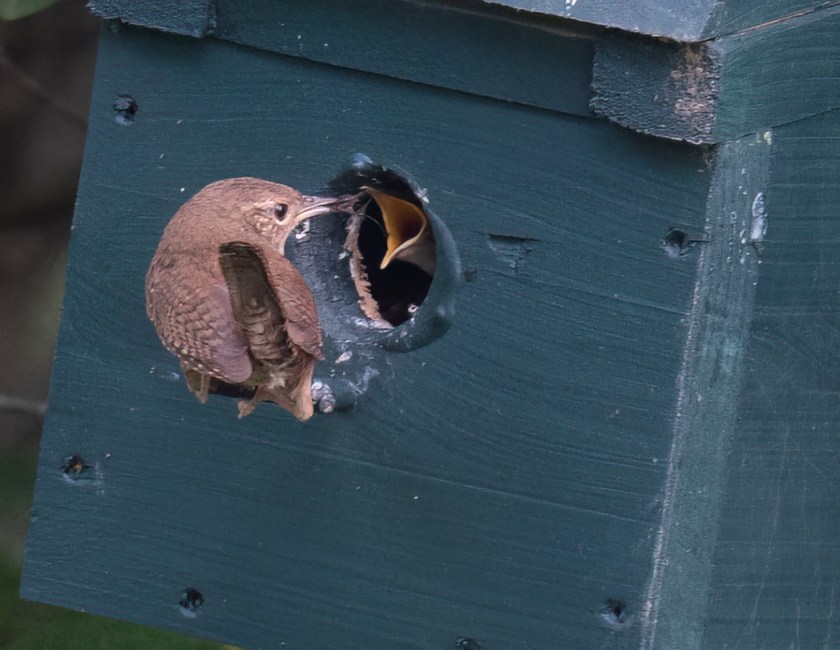
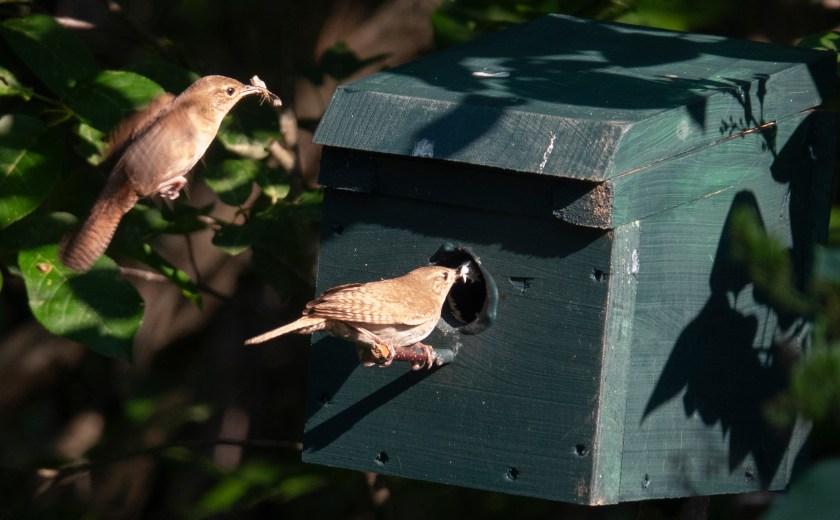
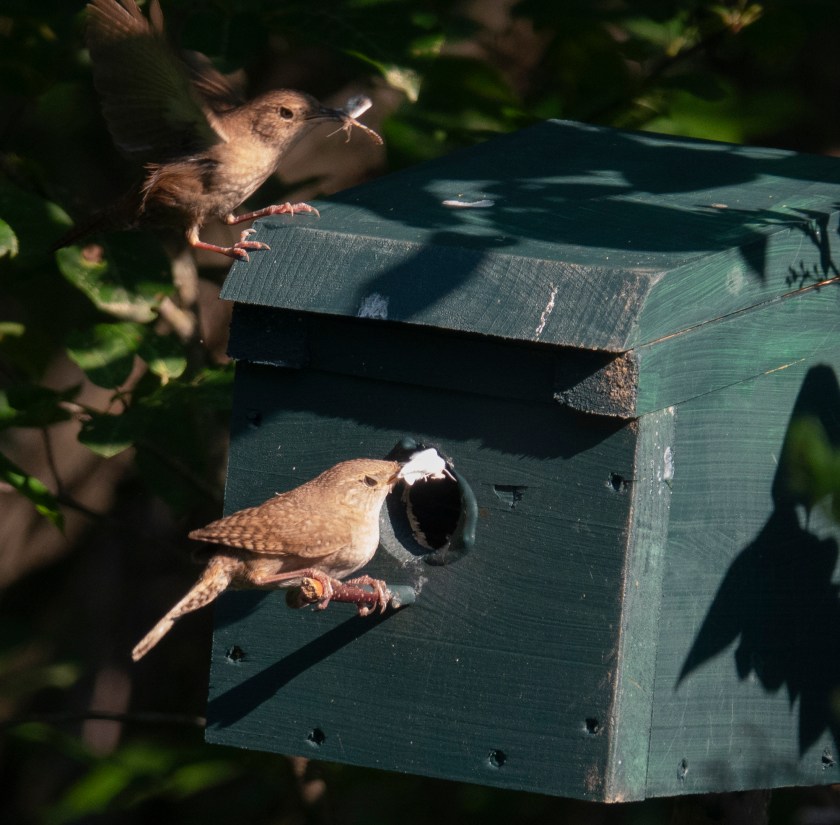
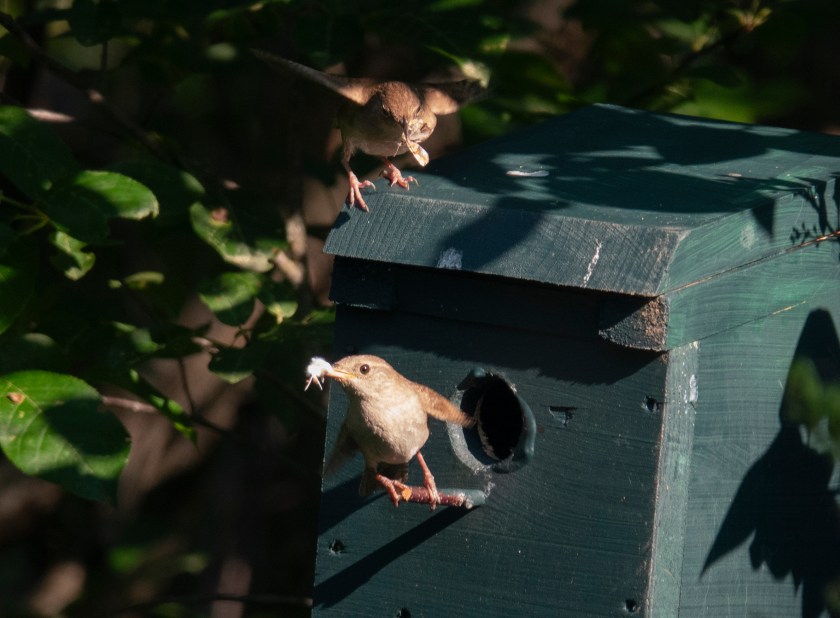
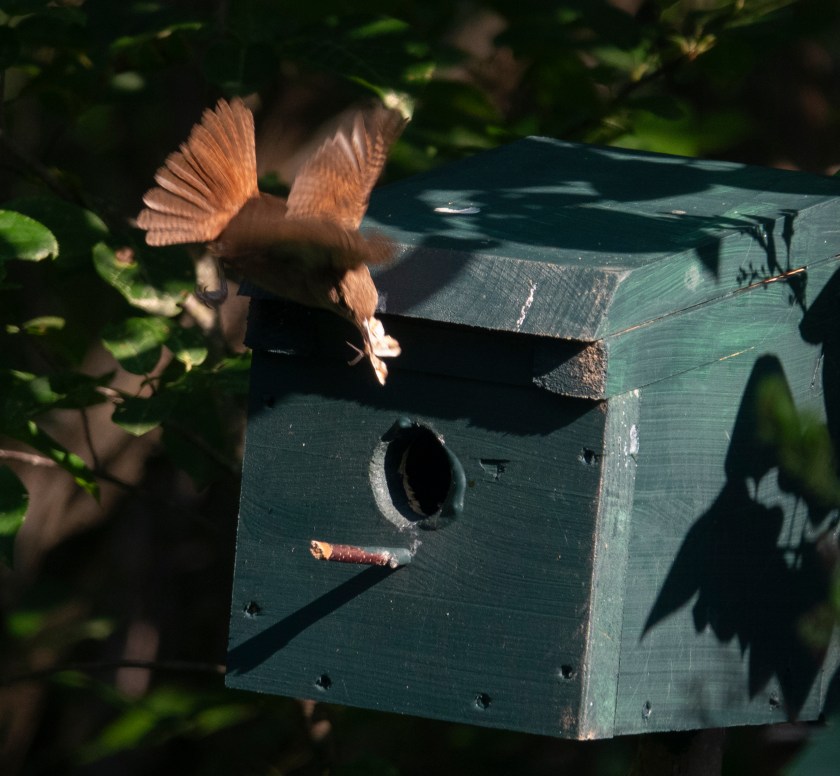
To see birds feeding the babies directly, you have to know where the nest is. The easiest way is to have a nesting box. These two Northern House Wrens came and went all day long with insects for the unseen young in the interior.
As they got bigger, they stuck their heads out in an importunate plea for food:
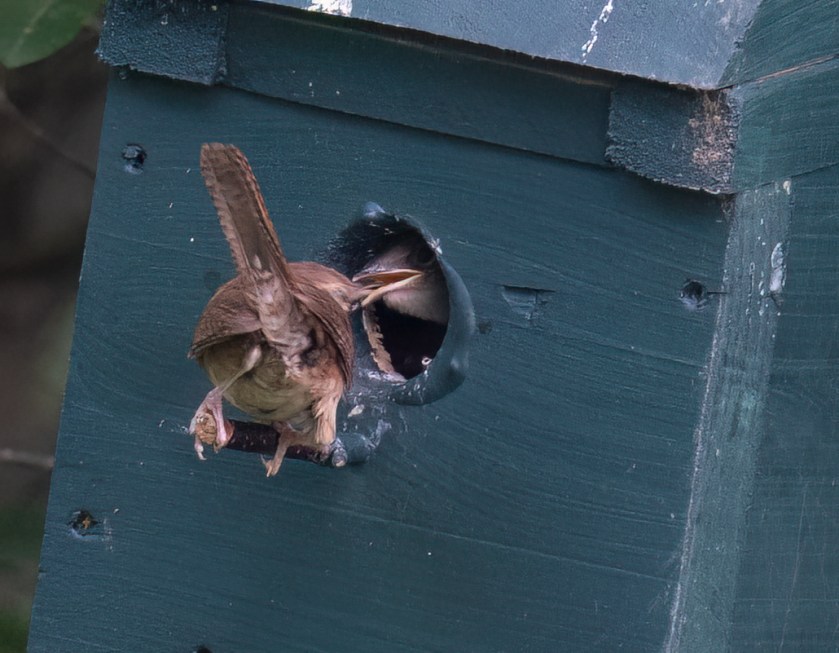
A sizable insect:
placed right in the baby’s mouth:
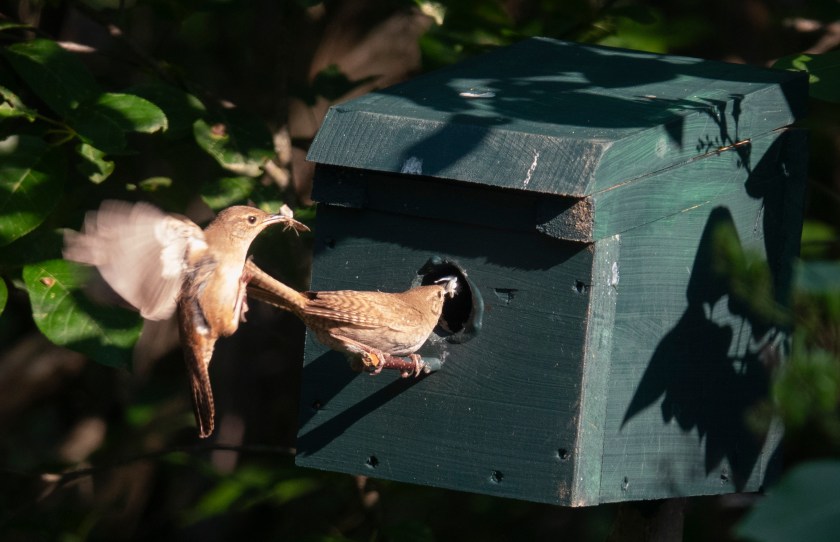
Occasionally, the two parents failed to coordinate, and arrived simultaneously, creating a traffic jam:
A polite dance ensued. ‘You first.’
‘I’ll wait’:
‘No, yours is bigger’:
‘All right, here I come’:
Eventually, the young will fledge, leaving the nest but staying nearby and still dependent on the adults for food.
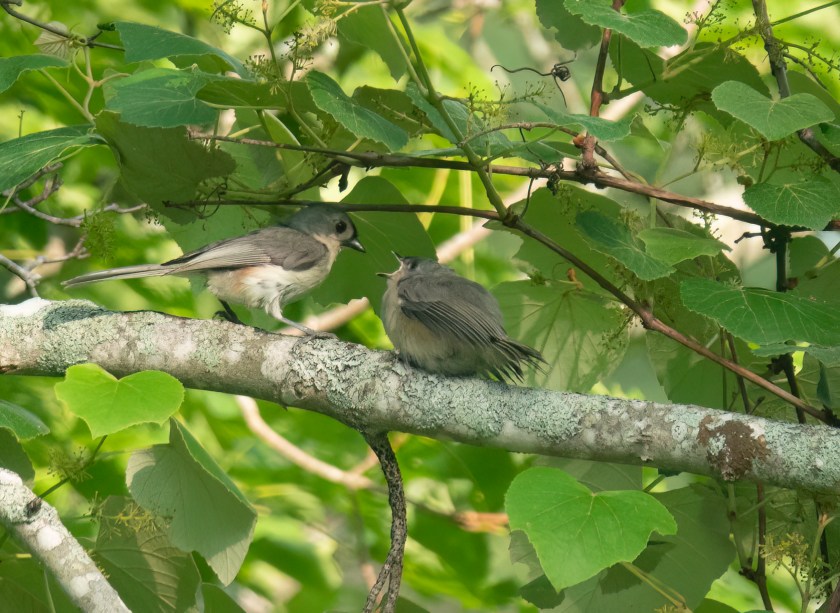
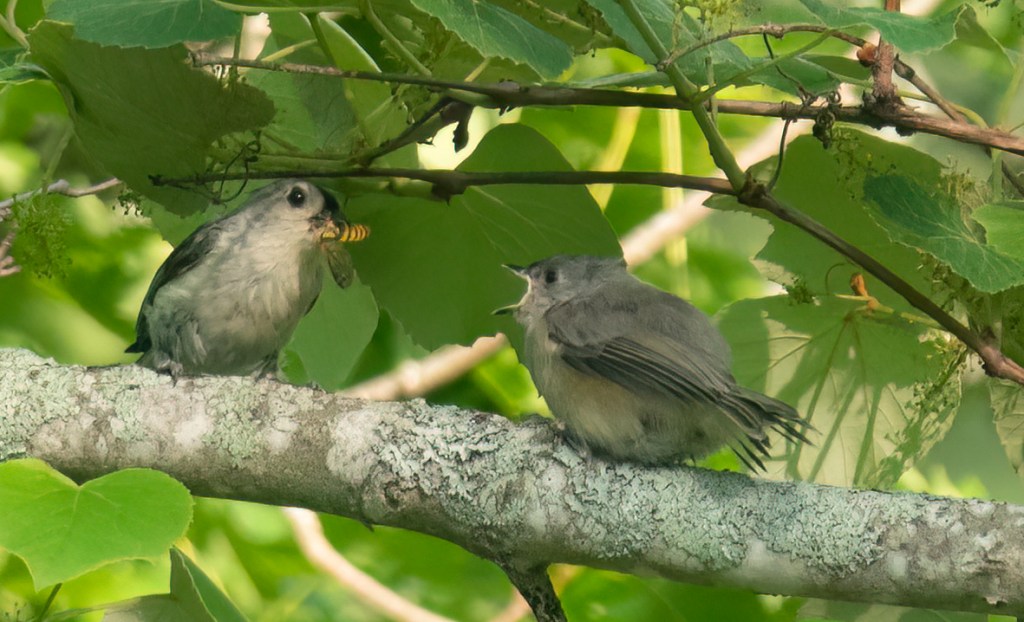
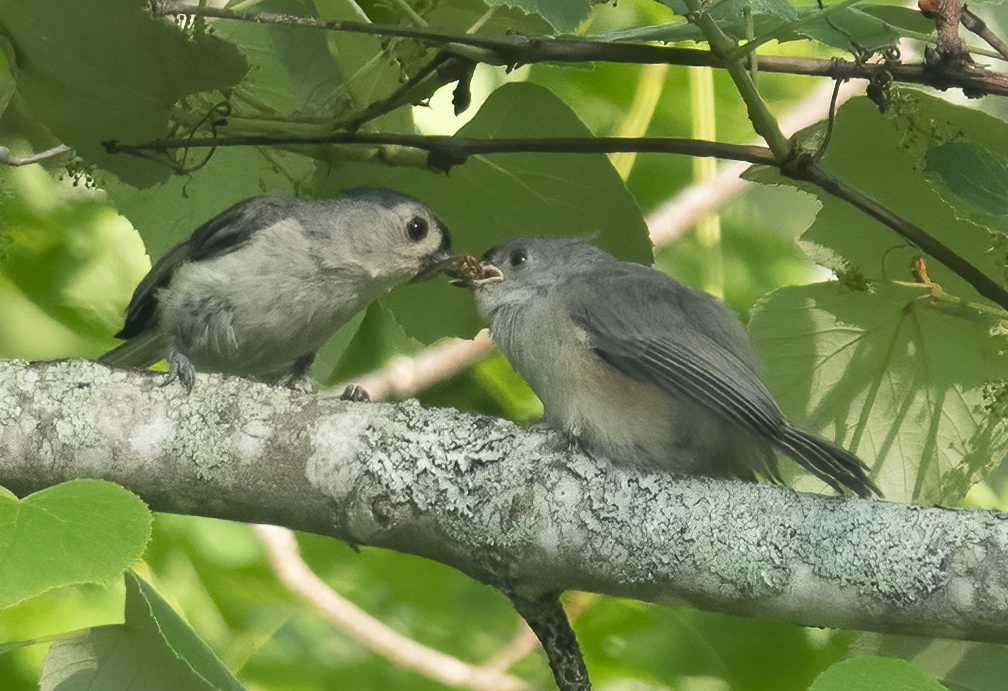
Tufted Titmouse adults eat 2/3 insects, and 1/3 seeds and mast, but they feed their young with insects, including bees. This one is feeding its fledgling, about 30 feet up in the trees.
I spent the last three weeks in England, and my first day back in Maine is always special. I settle down into this magical place with a sigh of delight and comfort. Here’s what I saw and heard that first June day: nothing dramatic, but the fabric of my world.
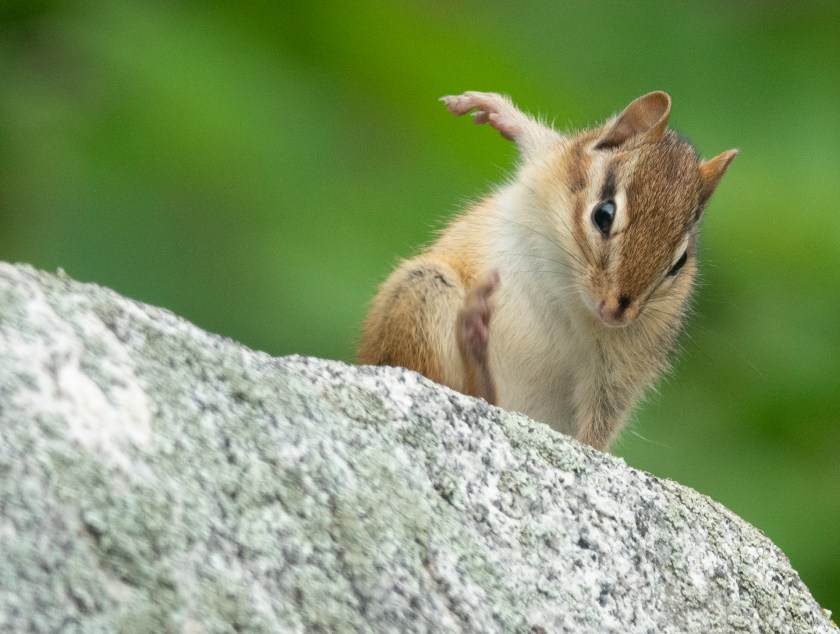
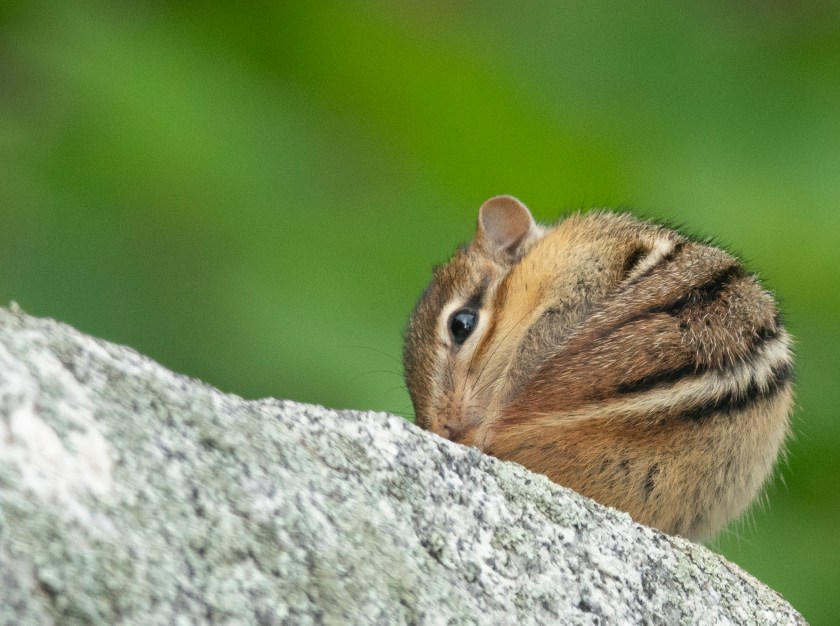
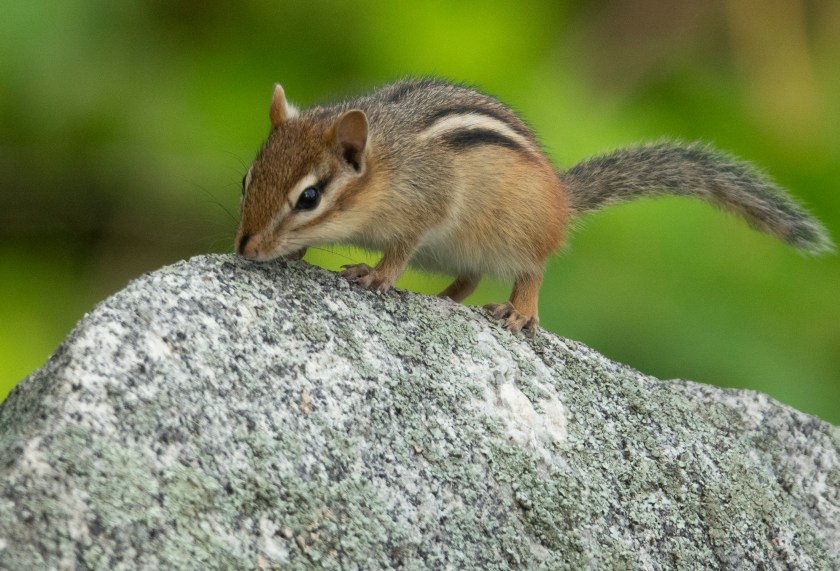
A chipmunk, grooming, not bothered by me so, long as I stayed in my chair and sipped my wine:
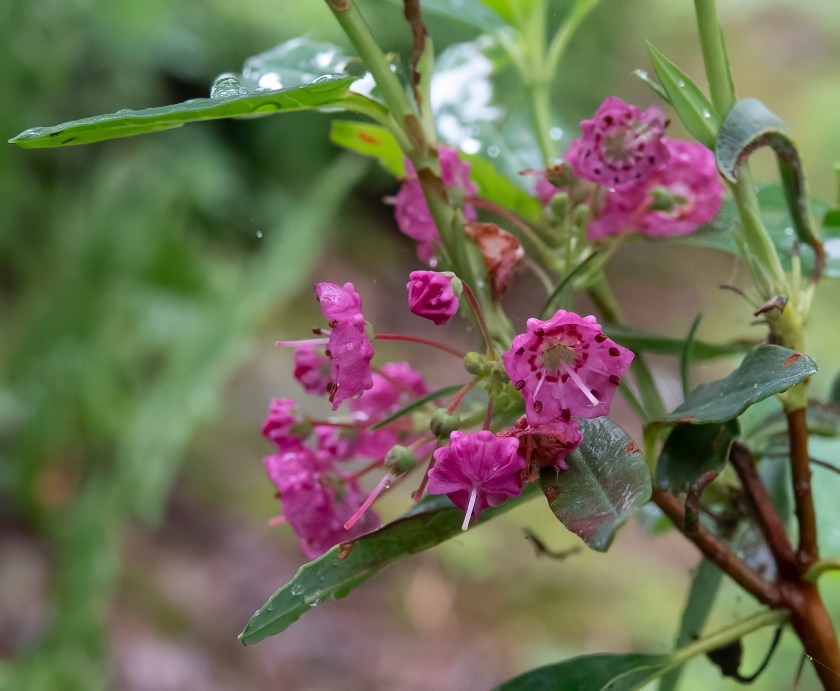
Sheep Laurel, Kalmia angustifolia, in flower by the beaver pond:
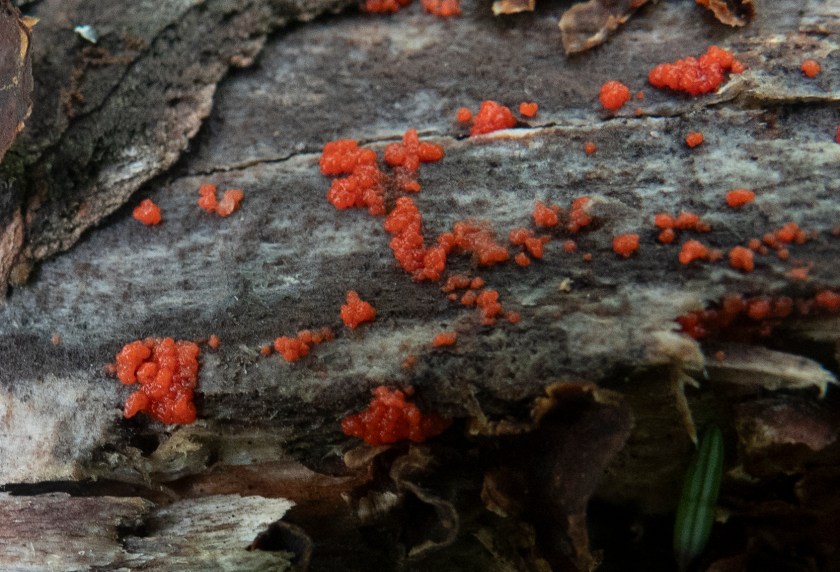
A minute scarlet jelly fungus, Tulasnella aurantiaca, on a rotting log:
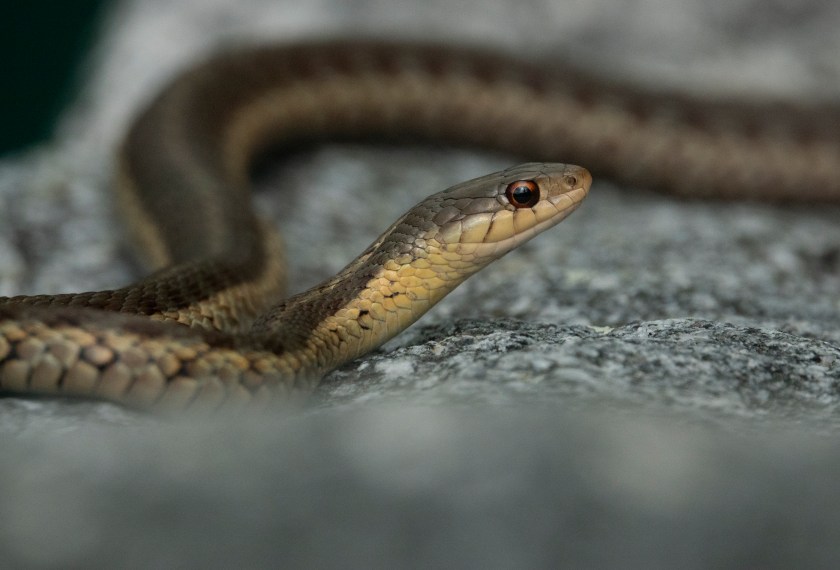
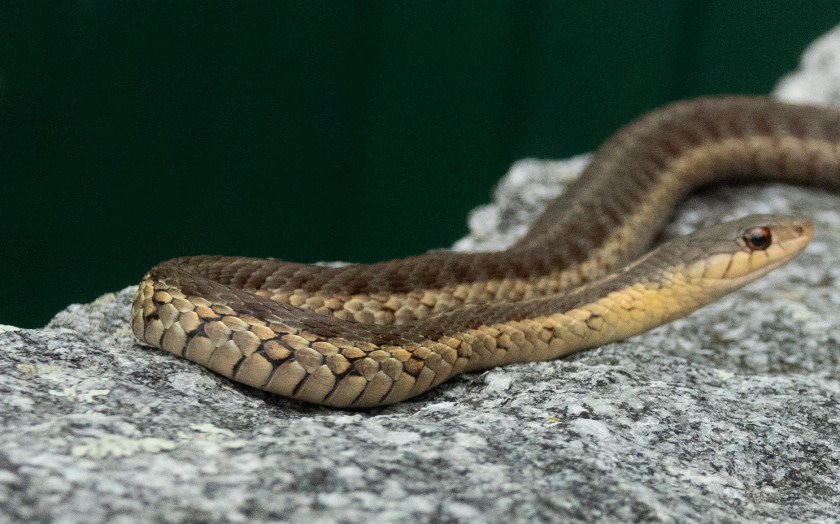
Two garter snakes on my garden wall, a favorite place when the granite has been warmed by a day of sun. Only one was willing to pose:
with sleek bronzed scales:
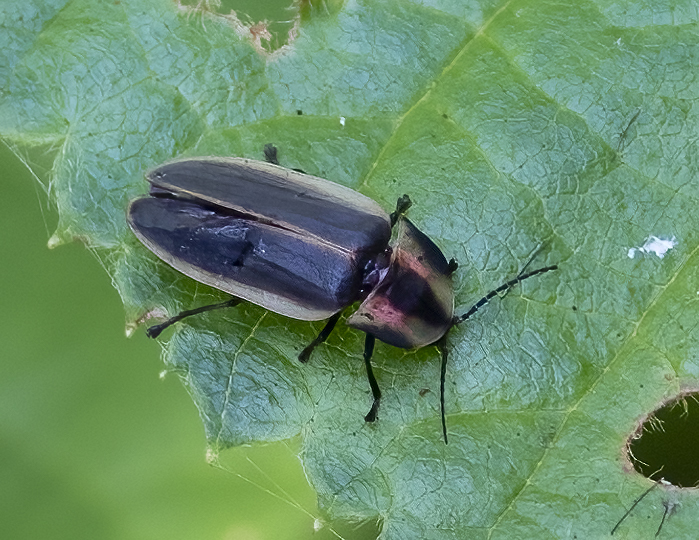
As evening fell, there were fireflies by the small vernal pool in the field, impossible to photograph, but like having fairies in the garden. The flashes are made by this Say’s Firefly, Pyractomena angulata.
After dark an Eastern Whip-poor-will, Antrostomus vociferus, called from right outside my window. A sort of nightjar, their scientific name reflects the fact that they are very, very loud, but I was delighted to hear it because they have become quite rare, classified as Near Threatened.
It is in the same place every evening, and one dusk it started up while it was still light, so I went out to try and see it. It flew up, and away, and I was sorry I had disturbed it, but it was back the next night. They nest on the ground, and I have looked, to no avail.
And then, at about 4am, a fox barked, sharp and rasping, very close to the house.
A wild and savage sound to welcome me home.
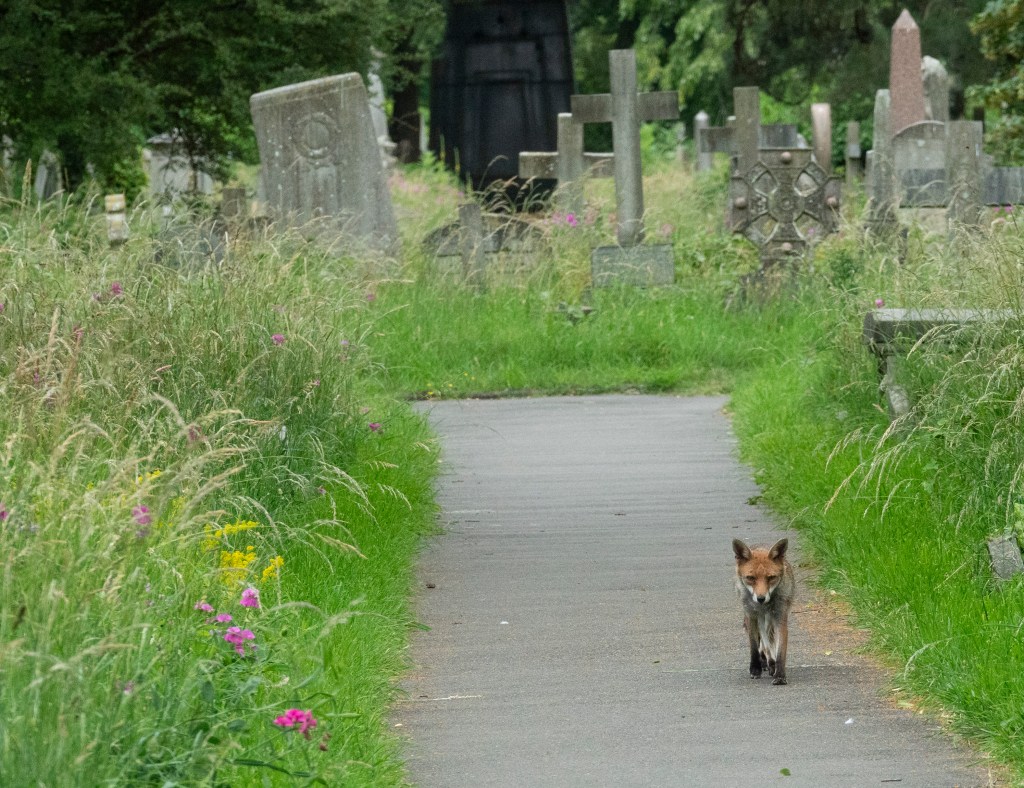
PS In London, foxes wander round Brompton Cemetery in broad daylight:
But here in Maine they are usually wary and I have never heard one bark by the house before.
PPS Google AI produced this excellent summary of how the firefly’s light flash is made:
“Fireflies produce their signature glow through a chemical process called bioluminescence, which operates in a specialized organ called a lantern in their abdomen. This reaction is highly efficient, converting nearly 100% of its chemical energy into light without producing heat. [1, 2, 3]
The mechanism involves four key components mixing in the insect’s light cells (photocytes): [1, 2]
Luciferin: A light-emitting compound.
Luciferase: An enzyme that acts as a catalyst to speed up the reaction.
ATP (Adenosine Triphosphate): The fuel for cellular work.
When the firefly takes in oxygen, the luciferase enzyme facilitates the binding of luciferin and ATP. This oxidation process creates an unstable, high-energy molecule. As this molecule quickly drops back to a lower energy state, it releases the excess energy as a visible flash of light. [1, 2]”
[My final Costa Rica blog post, I think.! Then back to Maine.]
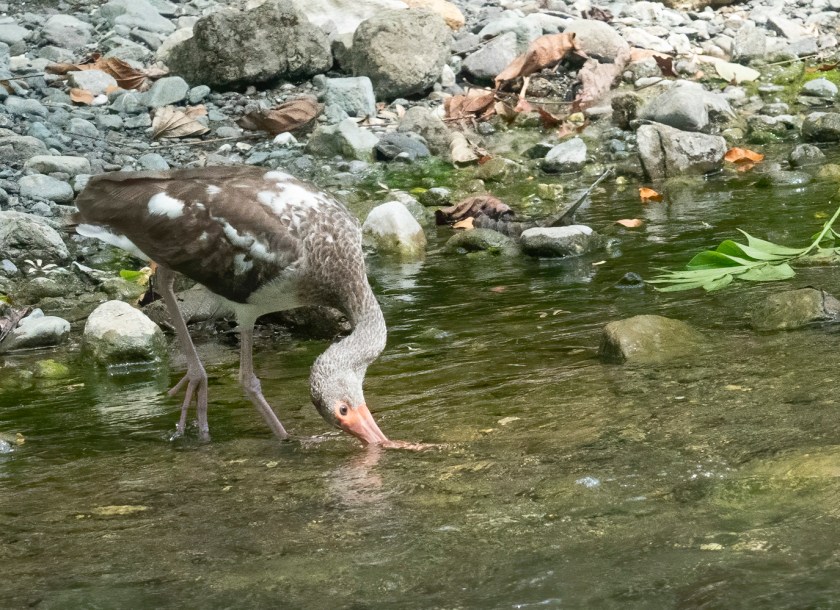
On the Pacific side of Costa Rica, we saw two juvenile White Ibises (or if you prefer, ibes (Latin), ibides (Greek)!), Eudocimus albus. They were hunting for crustaceans in the shallows of a small river:
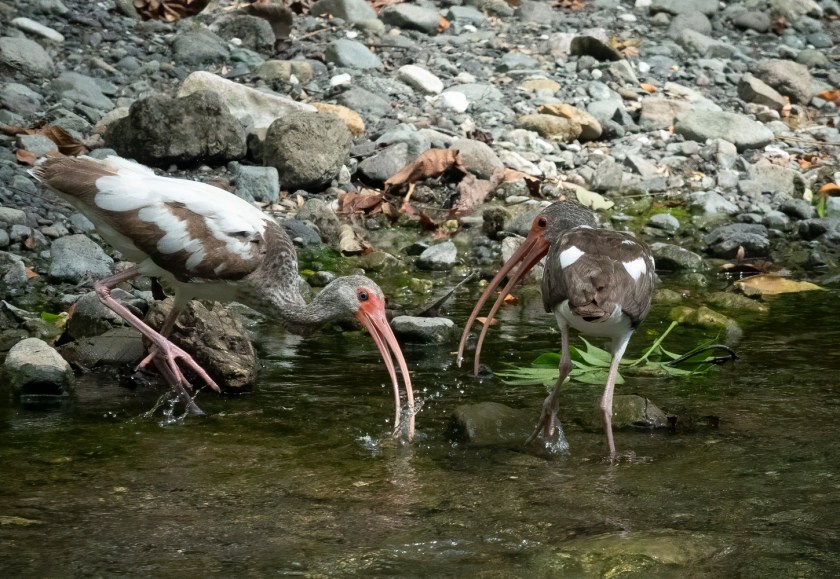
Their eyes focus on the tip of their beak, but they mostly forage by touch. The left-hand one found something:
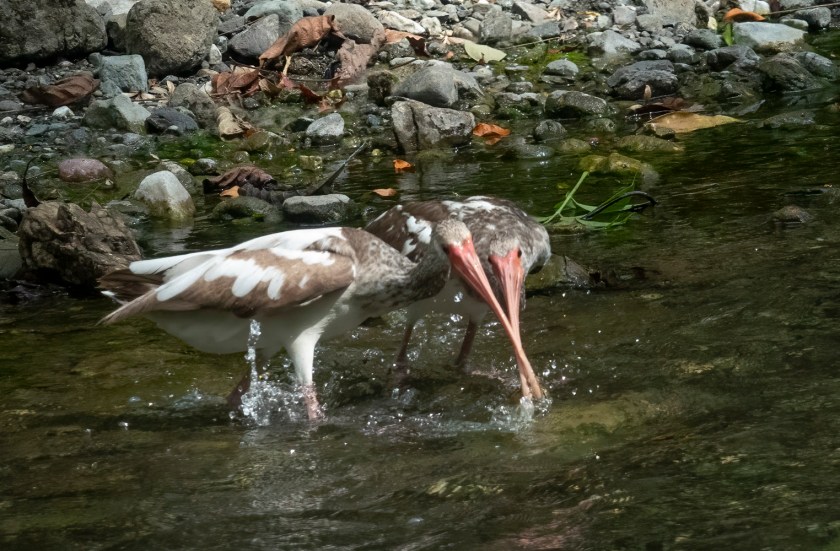
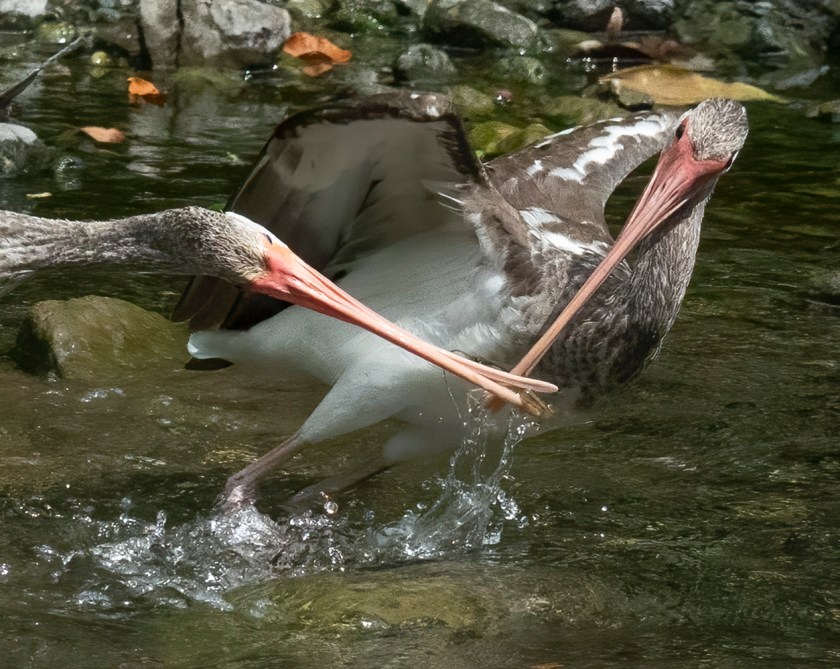
and a tussle ensued:
The original finder hung on, and brought up a crayfish:
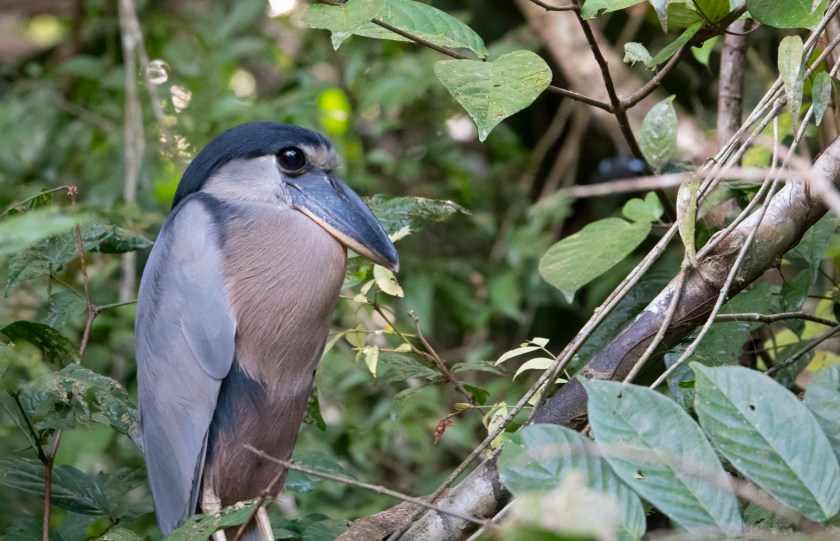
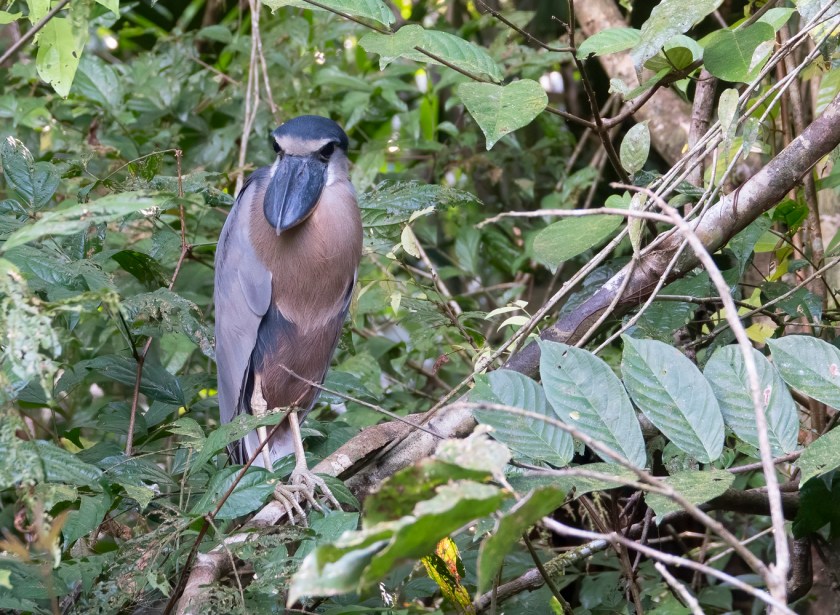
Drifting around the canals on the Caribbean side, in Tortugero National Park, there was a diverse heron population. My favorite was the Boat-Billed Heron, Cochlearius cochlearius. It has large eyes, and is mainly nocturnal:
It gets its name from the keeled bill:
The unusual bill is used as a scoop: the bill is lowered partly underwater and the bird walks forward, thrusting it in front. No other heron species does this.
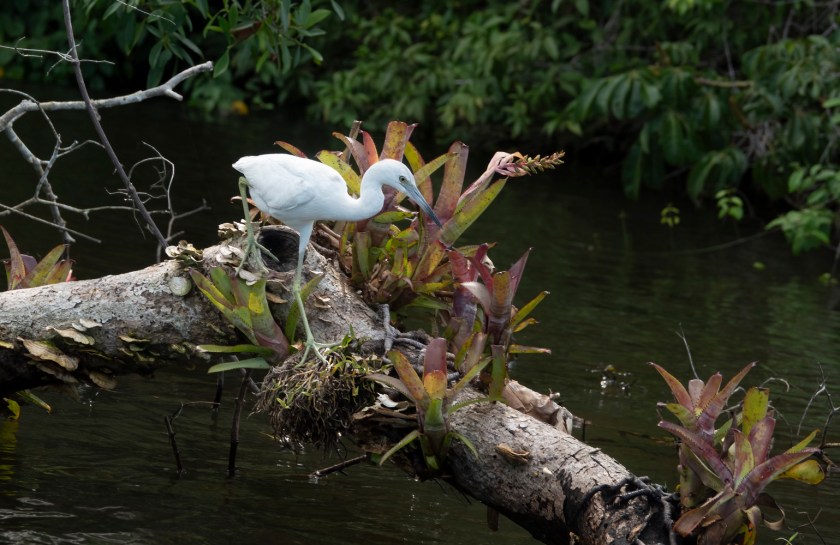
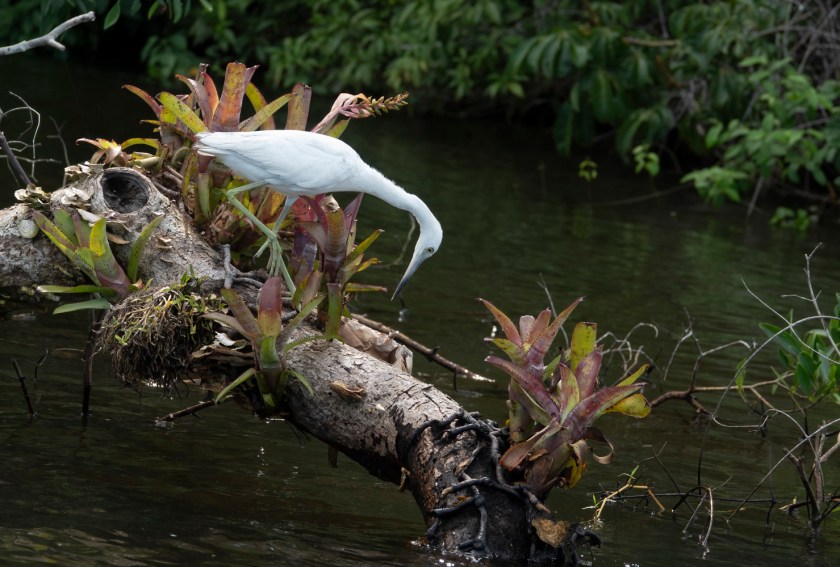
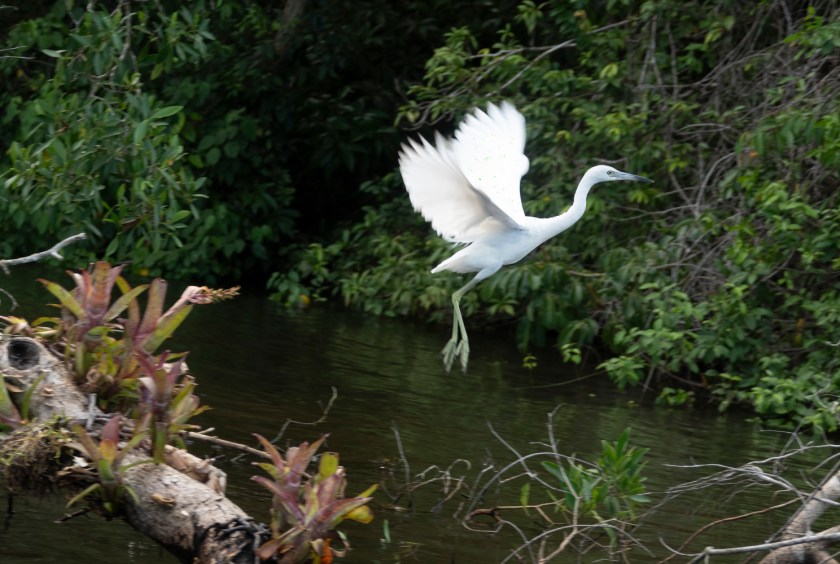
We saw many Little Blue Herons, Egretta caerulea. As juveniles, they’re purest white:
poking around on a fallen tree amongst the bromeliad plants:
but more skittish that the Boat-billed Herons:
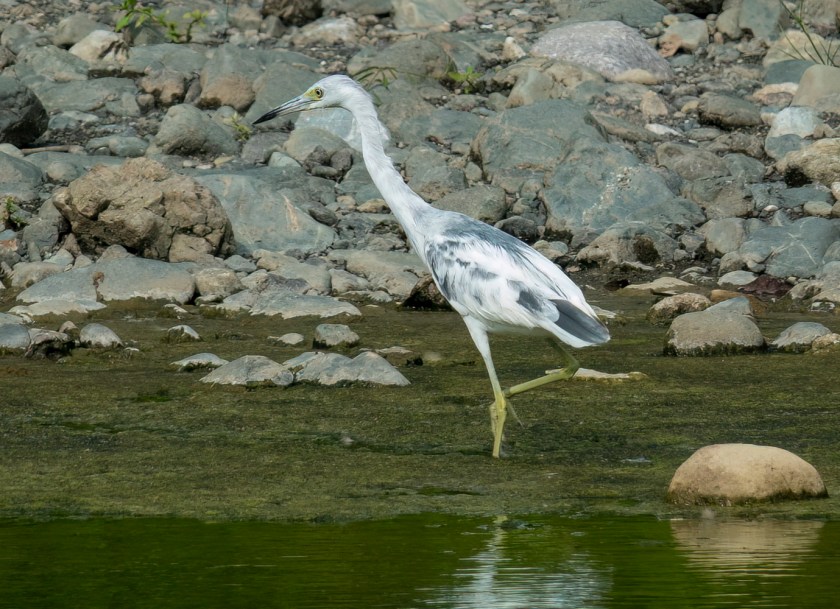
As they get older, their virginal white becomes splotchy:
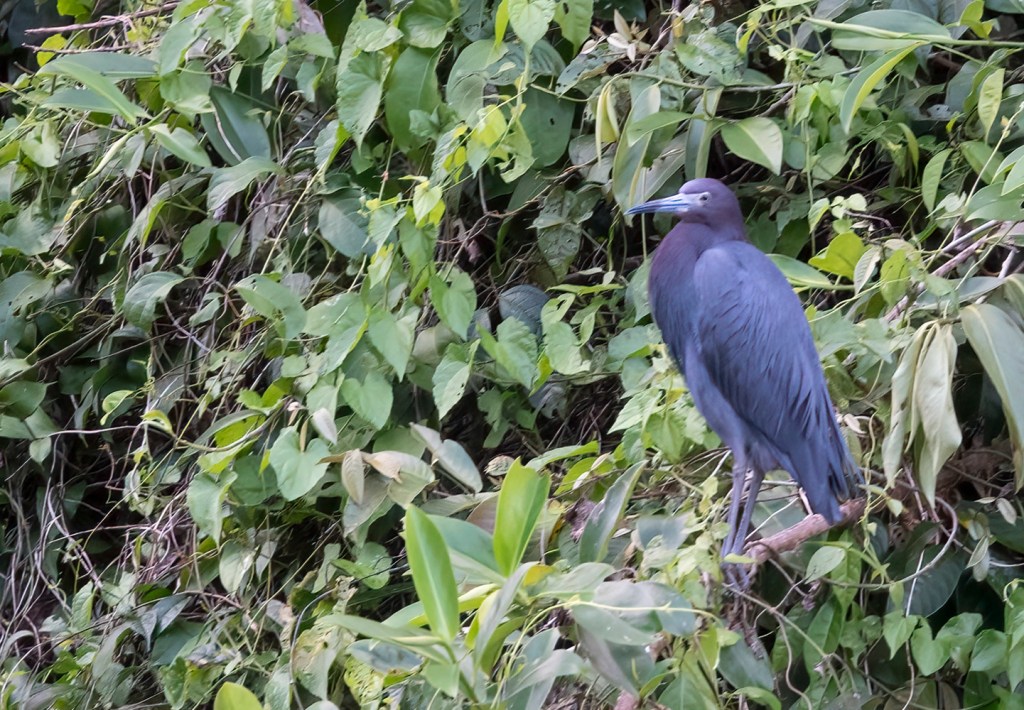
until it is entirely displaced by the adult purplish slaty blue grey:
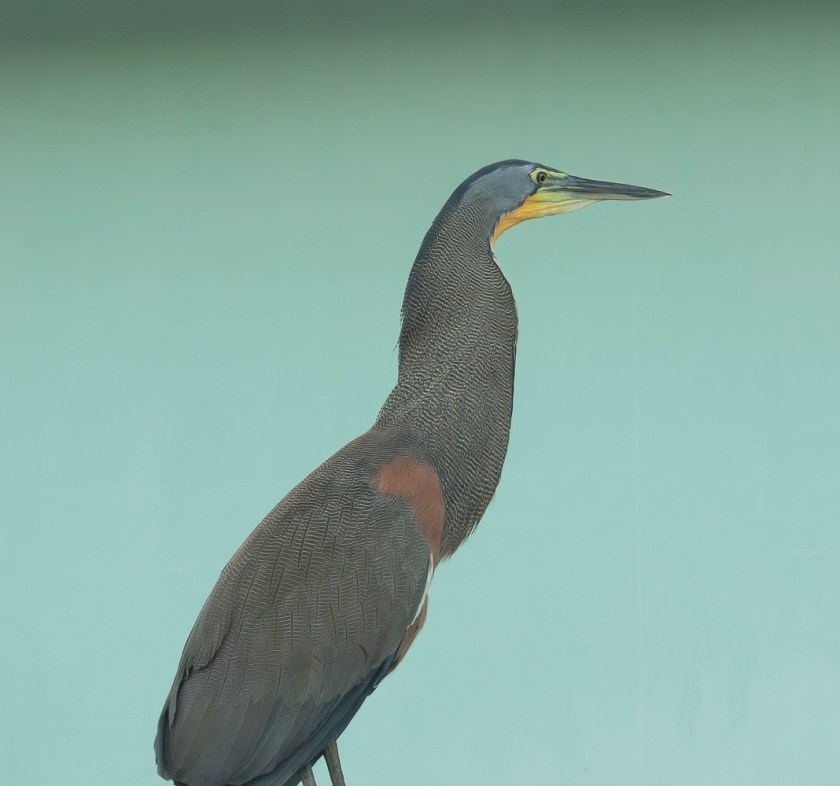
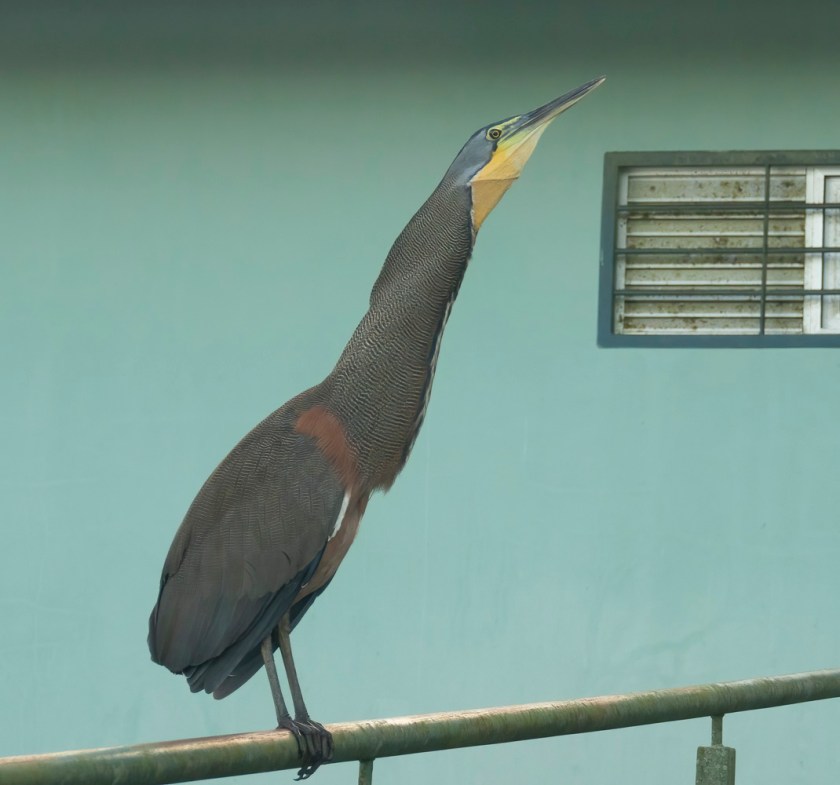
The Bare-throated Tiger Heron, Tigrisoma mexicanum, hung around the dock. This is not a wall-painting, but a real live heron:
From time to time it lifted its head, and gave forth its call:
They sing especially at dusk or dawn, and in the breeding season: listen to this video, which I’ve placed on YouTube in the hope that works (let me know if it doesn’t): https://youtu.be/pwoeHLOaHwM
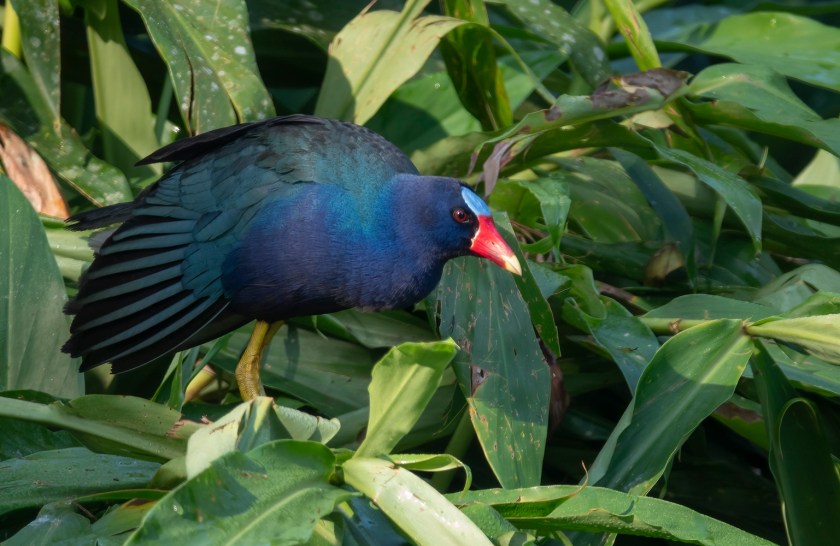
Perhaps the most technicolor bird was this denizen of the littoral vegetation, the Purple Gallinule, Porphyrio martinica:
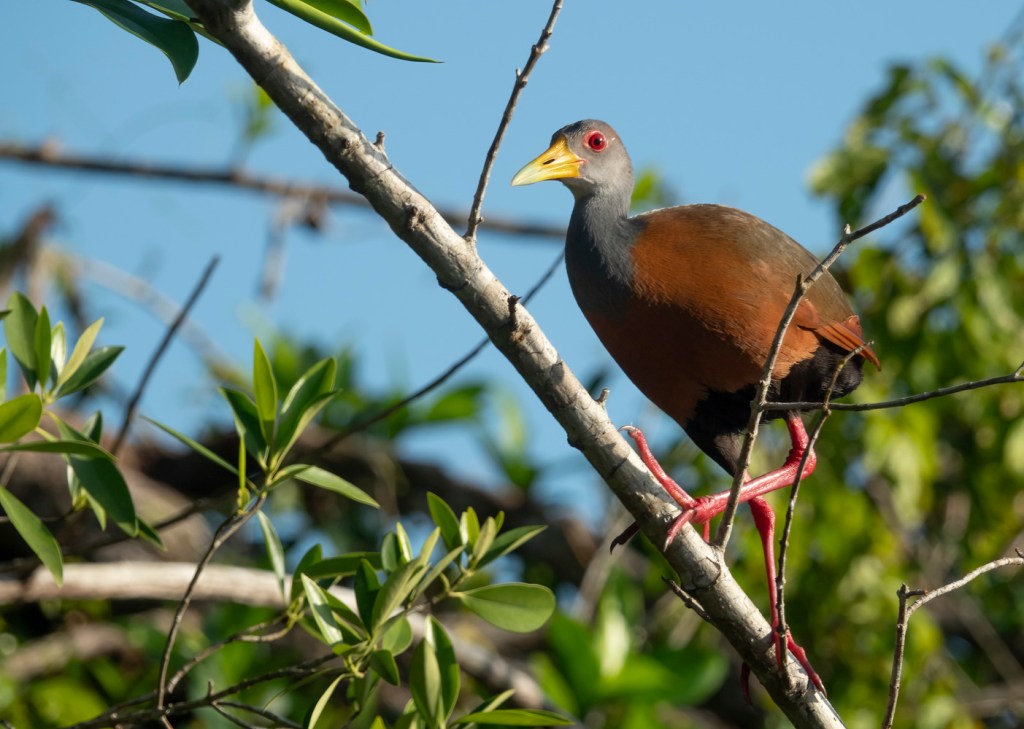
Like its drabber cousin, the Gray-cowled Wood Rail, Aramides cajaneus, it walks on floating vegetation and overhanging bushes:
PS Costa Rica’s location means it often serves as the southernmost part of the range for North American Species, like the White Ibis, and the northernmost part of the range for South American species, like the Gray-cowled Wood Rail. But yet other species are limited to Mexico and Central America, like the Bare-throated Tiger heron.
As summer reaches its peak, the nesting season is more or less over, but like teenagers the baby birds are not yet independent. They have mostly left their nests, and sit on branches cheeping urgently for food deliveries. Soon they will have to fend for themselves, and then migrate. Mortality is high in this interlude betwixt the parental home and true adulthood.
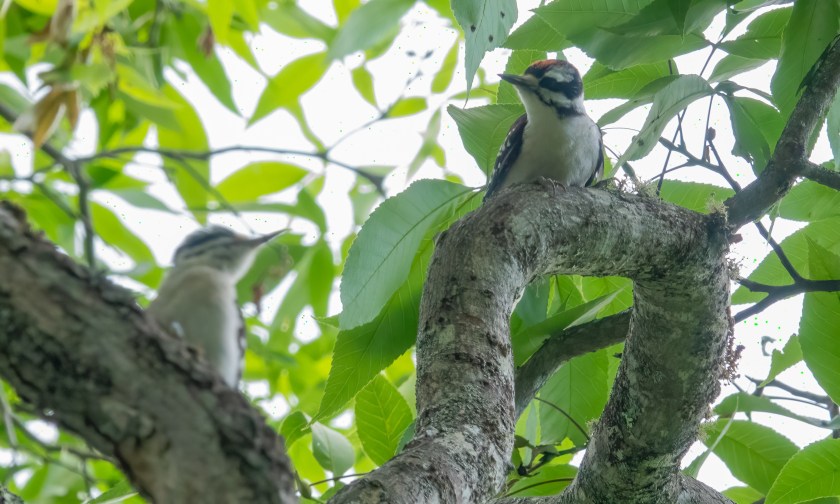
These are some I have seen in the last few weeks. In my big hickory tree, two Hairy Woodpecker chicks hopped around:
Two Hairy Woodpecker fledglings
The House Wren fledglings are still being fed, three days after leaving the nest, and several trees away:
Northern House Wren fledglings
A White-breasted Nuthatch seemed to have only a single chick:
White-breasted Nuthatch and fledgling.
A chickadee had ended up on the ground, but it clambered back up to a low branch shortly after I took the photo.
Black-capped Chickadee fledgling on ground by beaver pond.
The next shot is a food delivery by a Common Yellowthroat mother, right:
Common Yellowthroat fledgling, left, and mother, right
She then pokes it down the fledgling’s throat:
A hummingbird posing on my garden trellis:
Ruby-throated Hummingbird fledgling.
The scaly head feathers are distinctive for juveniles. At this age, you can’t reliably tell if it is male or female; the male’s ruby throat only develops later. However, male fledglings usually have streaks on the throat. so the pure white throat of this bird suggests it is female…
On the water, the ducklings are becoming more independent too. This Wood Duck duckling was nowhere near any adults, with just one sibling.
Wood Duck ducklings
This Hooded Merganser is further along:
Hooded Merganser duckling
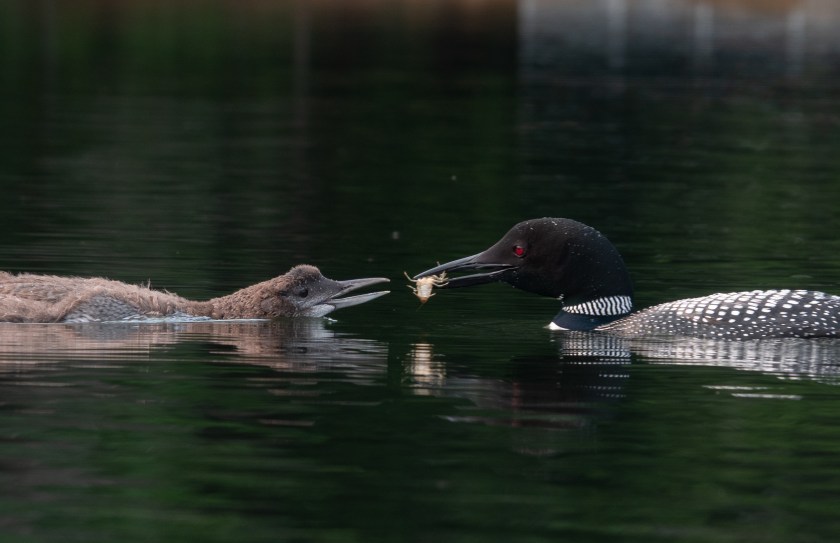
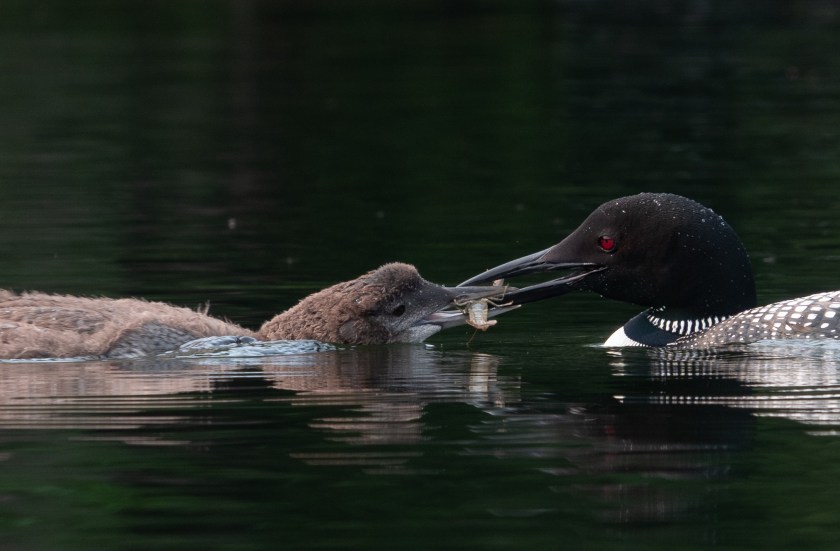
The loon chicks are still being fed, either with (quite large) fish:
Fish deliveryLunch
or crayfish:
Reaching for a crayfish appetizerHandoverComplete
You can see that their downy plumage is being shed as the serious feathers underneath take their place.
Watching a new generation flutter out into the world is a special privilege. Cross your fingers and hope for the best.