Wapiti, anyone?

[The other large mammal in Mongolia’s Hustai National Park is the wapiti. It took me some considerable time to understand what we were looking for, because our guide used the names wapiti, moose, elk, and red deer interchangeably. In Eurasia, “elk” is often used for what Americans call moose, but there are no moose in Hustai. We were, it turned out, looking for a close relative of the North American elk, Cervus canadensis, but the subspecies sibiricus. To avoid the confusion with moose, the park rangers call them by the Cree name “wapiti”. “Red deer” was in fact a red herring: it was once thought that red deer, Cervus elaphus, and elk were the same species, but that is now known to be incorrect. C. canadensis has a wider rump patch and paler-hued antlers. ]

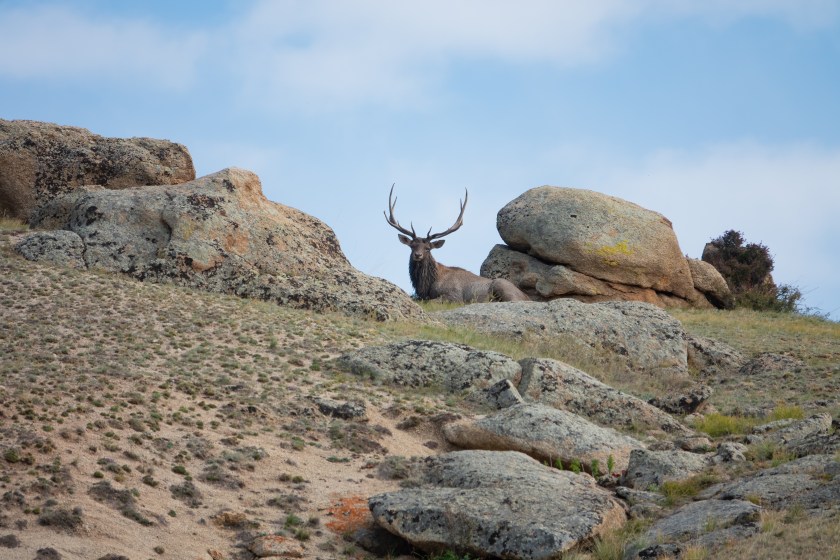
So, let’s stick with wapiti! Hustai has around 1300 of them, and they are not endangered. Here is a handsome bull wapiti, resting from his day’s exertions. It is the mating season, so he either has a herd of twenty or more females to keep under control, or he is trying to win a herd away from another male. Either way, an exhausting job.

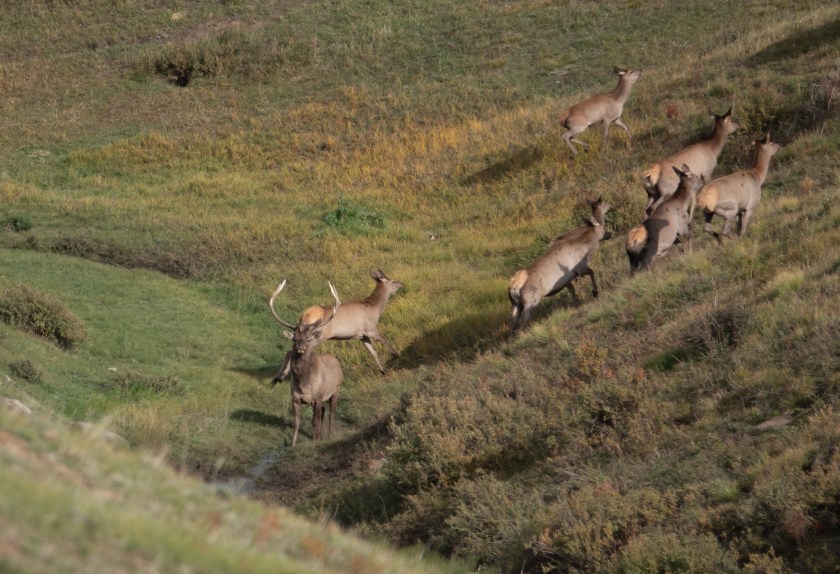
This is a group of females:

Their lord and master rounds them up:

and moves them higher up the hill to a safer spot:

If he senses another male nearby, he may bellow, or rather “bugle”, an eerie sound. He stretches out his neck, and lowers his larynx to make his voice deeper and thus make himself seem bigger.

There was a larger male somewhere off to the left, but there was also a very young male right next to him, a so-called “spike” male (bottom left), whose antlers have not yet branched; eventually, the dominant male will throw him out of the herd.

The male bugled frequently, but best of all was one morning at dawn when we had gone to look for wolves, and we heard wapiti bugling intermingled with wolves howling. Magical.

The herd moved down towards us to drink from a tiny stream.

The male kept a very close eye on both them and us:

When some of them headed across the stream his displeasure was clear:

and they thought better of it:

After all this effort, his reward is near: the tongue licking the air is scenting an enticing female:

A man’s job is never done.

Saiga and other ungulates

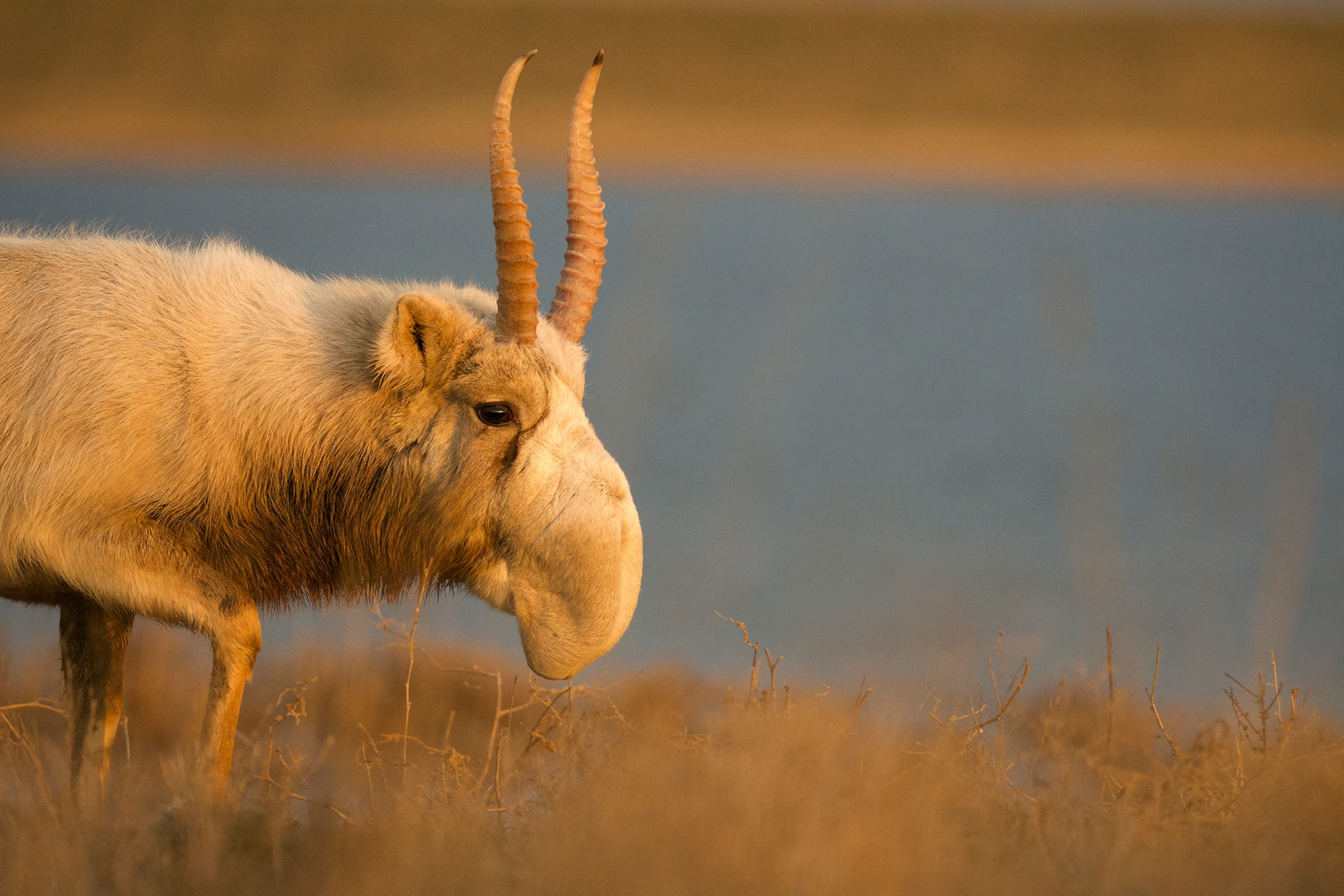
There are several different species of antelope and gazelle in the parts of Mongolia we visited. Of these, the Saiga antelope was top of our list, for three reasons. First, this antelope has grazed the steppes since the last Ice Age, alongside the Woolly Mammoth and the Siberian Tiger. Second, it is a bizarre-looking creature, with the older ones developing an extraordinary proboscis-like nose. Third, it almost disappeared from the steppes of Central Asia in the early 2000’s, being classified as Critically Endangered. It has since recovered remarkably, and is now classified as Near Threatened.

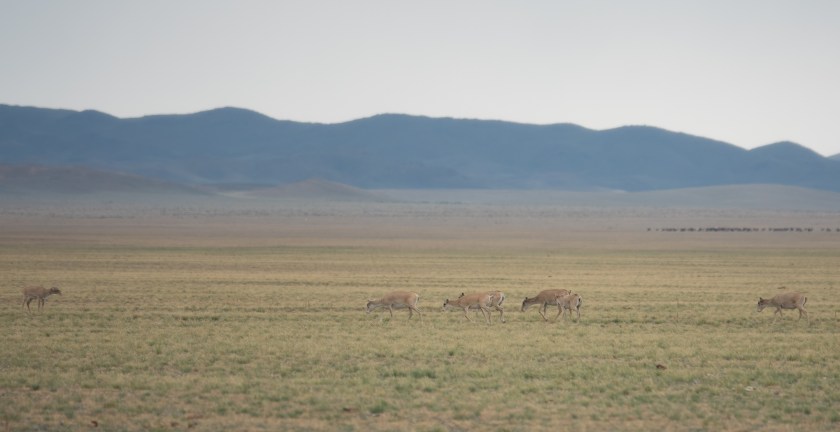
The rugged mountains where the snow leopards live are separated by wide valleys of steppe grasslands. This is Saiga territory. They are skittish, so we never got very close, but we saw a herd of around 30 animals sharing the vast flats with sheep and goats (right in background):

and cattle:

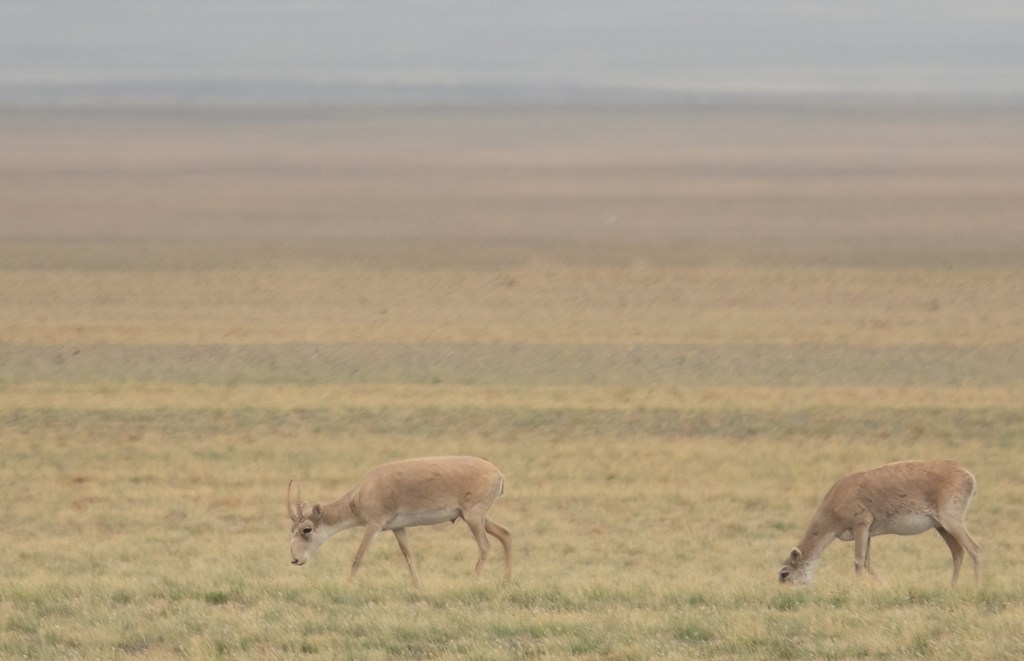
They hold their heads low, even when running:

They have Roman noses and a lugubrious face:

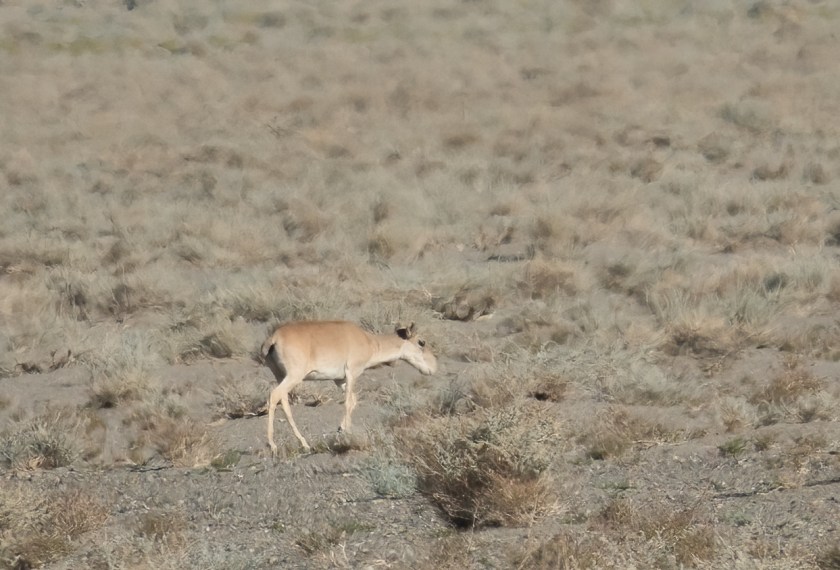
Another day we saw a single doe:

walking all alone and solitary across the plains :

What we didn’t see, sadly, was a mature male with a fully developed proboscis, so here is a photo from National Geographic:

The reasons for the saiga’s precipitous decline were many. After the Soviet Union broke up illegal hunting increased dramatically, driven mainly by demand from China for the horns for traditional medicine. The Pasteurella multocida bacterium caused mass deaths in 2015, and the Peste des Petits Ruminants Virus (PPRV) spread from livestock in 2017 and killed nearly 80%. It gets worse. A 2021 study showed that Foot-and-Mouth Disease has also spread into the saiga herds, with a mortality rate of 34%.

The rebound in population is extremely encouraging, but they are not out of danger yet.

PS We also saw Goitred Gazelle in the Altai, and Mongolian Gazelle in the west of the country, but too far away to photograph usefully. Here are some Mongolian Gazelle, grazing alongside a herd of horses:

They’re not endangered at all, I am delighted to say, despite being hunted for centuries: “a passage in the 13th-century Secret History of the Mongols tells how a young Shigi Qutuqu managed to round up a herd of gazelles in a winter blizzard.” (Wikipedia)

A Fluffy Lion

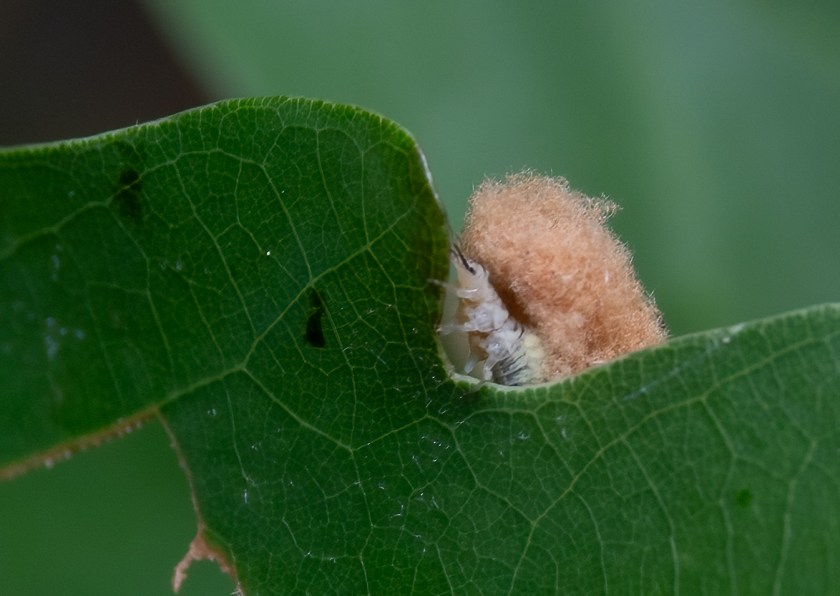
Yesterday morning I saw a small piece of fluff on an oak leaf.

In nature, anomalies catch the eye, so I looked more closely. It moved! So I picked it up. A minute tail and a couple of legs poked out.

The whole thing was about 1/3″long. I tried to turn it over to see the bug underneath, but it righted itself in a microsecond. But when I put it on my thumb it tried to escape, walking steadily along my thumb looking for an off-ramp:

And when I put it back on the leaf, it beat a retreat over the edge of the leaf to safety:

Here is a video:

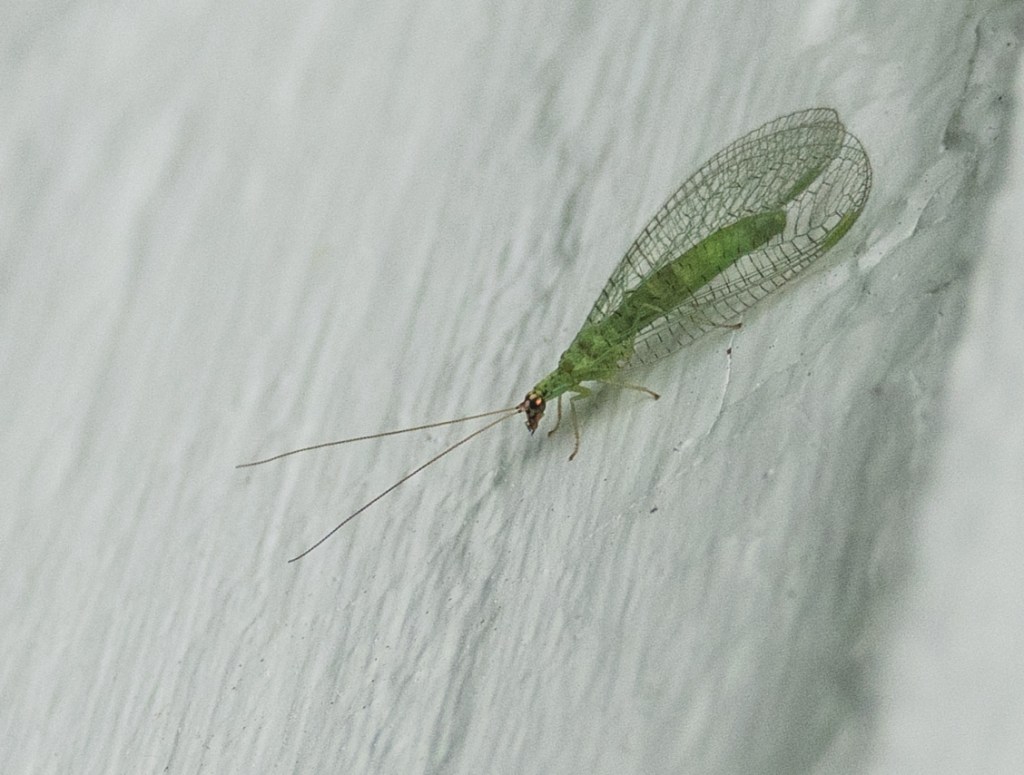
It is the larva of a Stripe-horned Lacewing. Here is a Golden-eyed Lacewing adult, a close relative:

Some species of lacewing larvae, like mine, load detritus on their backs as camouflage to fool birds, and very effective it probably is too, though it didn’t fool me for long.

They feed on aphids, and are sometimes described as alligator-like, both for their body shape and their bite: here is the larva of a Red-tipped Green Lacewing, showing those ferocious jaws:

The Missouri Department of Conservation has a graphic description: “The larvae, sometimes called ‘aphid lions’, are insatiable predators of other insects, especially aphids. A lacewing larva grasps the aphid with its grooved, caliper-shaped jaws, often lifts it up in the air, then drinks the fluids in the aphid’s body. A single lacewing larva can eat an aphid a minute, for hours, and not slow down. ” As a result they are sometimes sold as a natural form of aphid control.

Just shows you can be small but scary, more elegantly put by Shakespeare in Midsummer Night’s Dream “Though she be but little, she is fierce “

The Dangerous Phase

As summer reaches its peak, the nesting season is more or less over, but like teenagers the baby birds are not yet independent. They have mostly left their nests, and sit on branches cheeping urgently for food deliveries. Soon they will have to fend for themselves, and then migrate. Mortality is high in this interlude betwixt the parental home and true adulthood.

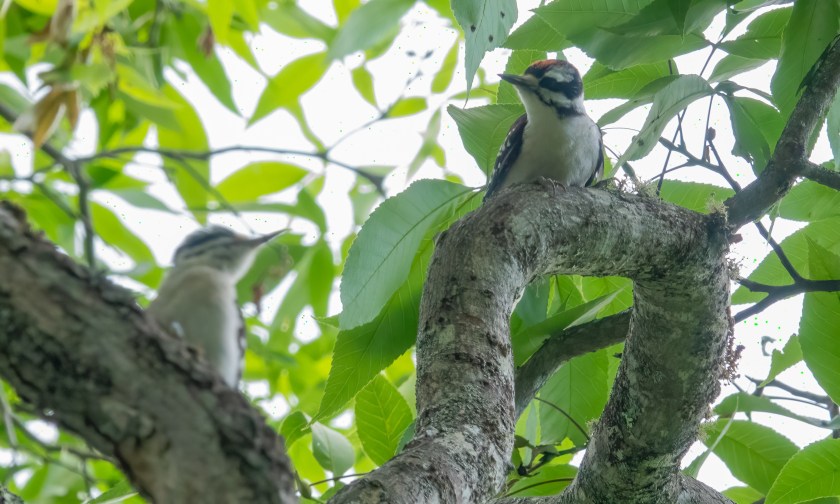
These are some I have seen in the last few weeks. In my big hickory tree, two Hairy Woodpecker chicks hopped around:

Two Hairy Woodpecker fledglings

The House Wren fledglings are still being fed, three days after leaving the nest, and several trees away:

Northern House Wren fledglings

A White-breasted Nuthatch seemed to have only a single chick:

White-breasted Nuthatch and fledgling.

A chickadee had ended up on the ground, but it clambered back up to a low branch shortly after I took the photo.

Black-capped Chickadee fledgling on ground by beaver pond.

The next shot is a food delivery by a Common Yellowthroat mother, right:

Common Yellowthroat fledgling, left, and mother, right

She then pokes it down the fledgling’s throat:

A hummingbird posing on my garden trellis:

Ruby-throated Hummingbird fledgling.

The scaly head feathers are distinctive for juveniles. At this age, you can’t reliably tell if it is male or female; the male’s ruby throat only develops later. However, male fledglings usually have streaks on the throat. so the pure white throat of this bird suggests it is female…

On the water, the ducklings are becoming more independent too. This Wood Duck duckling was nowhere near any adults, with just one sibling.

Wood Duck ducklings

This Hooded Merganser is further along:

Hooded Merganser duckling

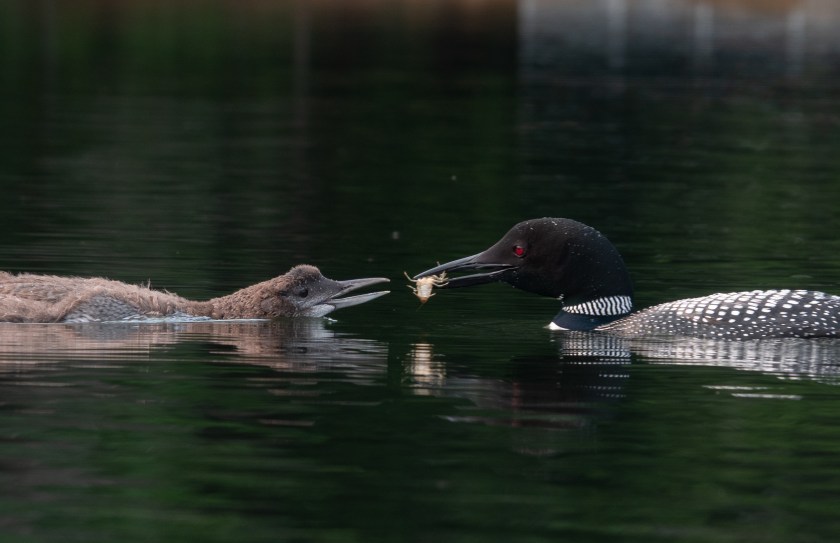
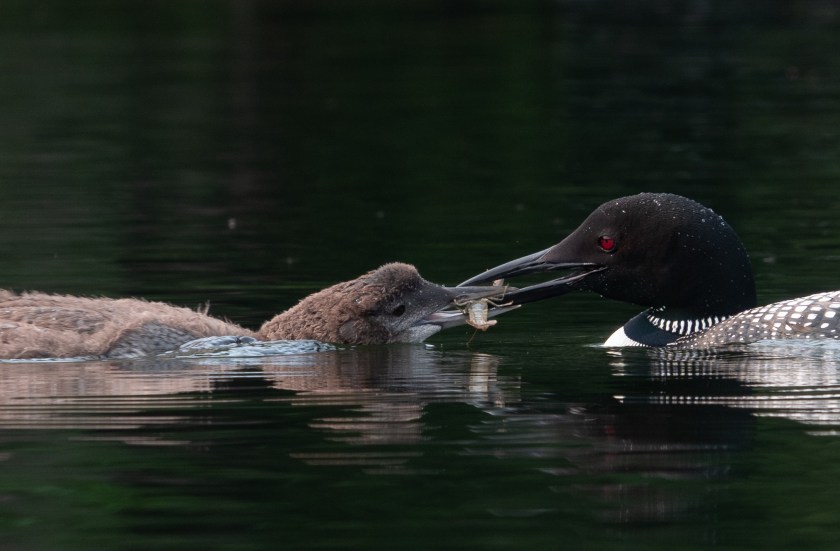
The loon chicks are still being fed, either with (quite large) fish:

Fish delivery
Lunch

or crayfish:

Reaching for a crayfish appetizer
Handover
Complete

You can see that their downy plumage is being shed as the serious feathers underneath take their place.

Watching a new generation flutter out into the world is a special privilege. Cross your fingers and hope for the best.

A Beetle Magical Mystery Tour

[This post is guaranteed to elicit from any under-10 year old an “Ew, gross!” response.]

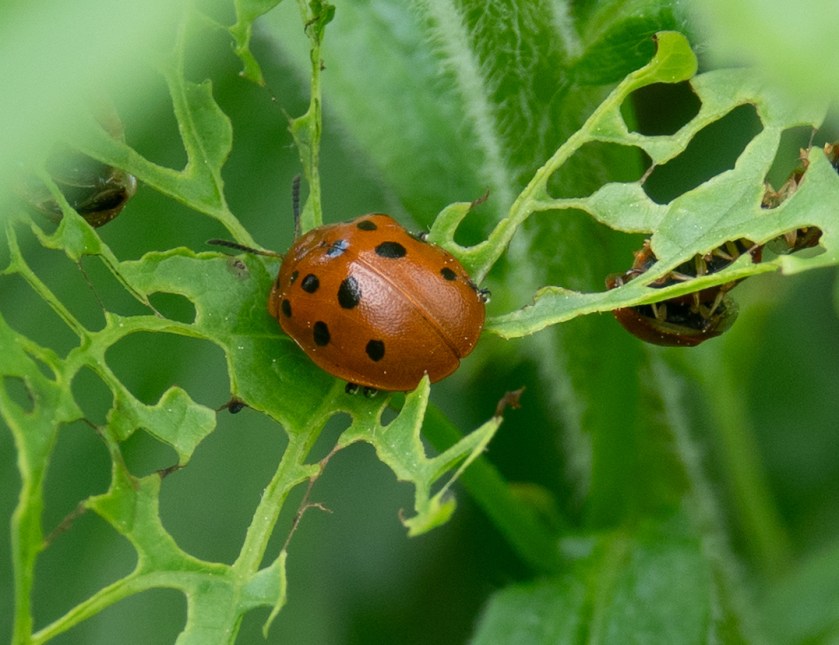
There are at least two different beetles casually called the Milkweed Leaf Beetle. Both are red, and both do indeed eat milkweed leaves, but there the resemblance ends.

The Argus Tortoise Beetle, Chelymorpha cassidea, looks like a ladybug (aka ladybird!) but is a bit bigger at 9 to 12 mm (0.35 to 0.47 in) long compared to 5.5 to 8.5mm for the Harlequin Ladybug.

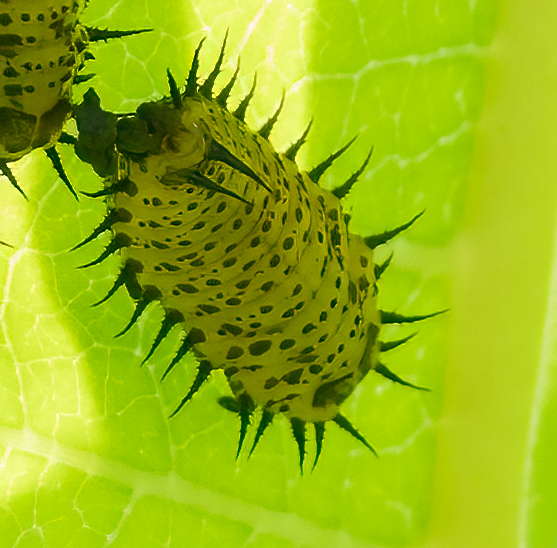
They have the most extraordinary larvae. Here is a trio:

Look at the rightmost one more closely. It has a pair of “horns” at the butt end, called the caudal furca.

Every time it poops, it deposits the output on these horns, building up a substantial lump.

This is called a fecal shield. It curves over the top of the larva like a sort of Roman helmet, and it can be moved or waved around, reminding me of the periscope of the (quite different) Beatles’ Yellow Submarine.

The purpose of this bizarre and rather disgusting construction, seems to be defense against predators (in this case my intrusive camera lens).

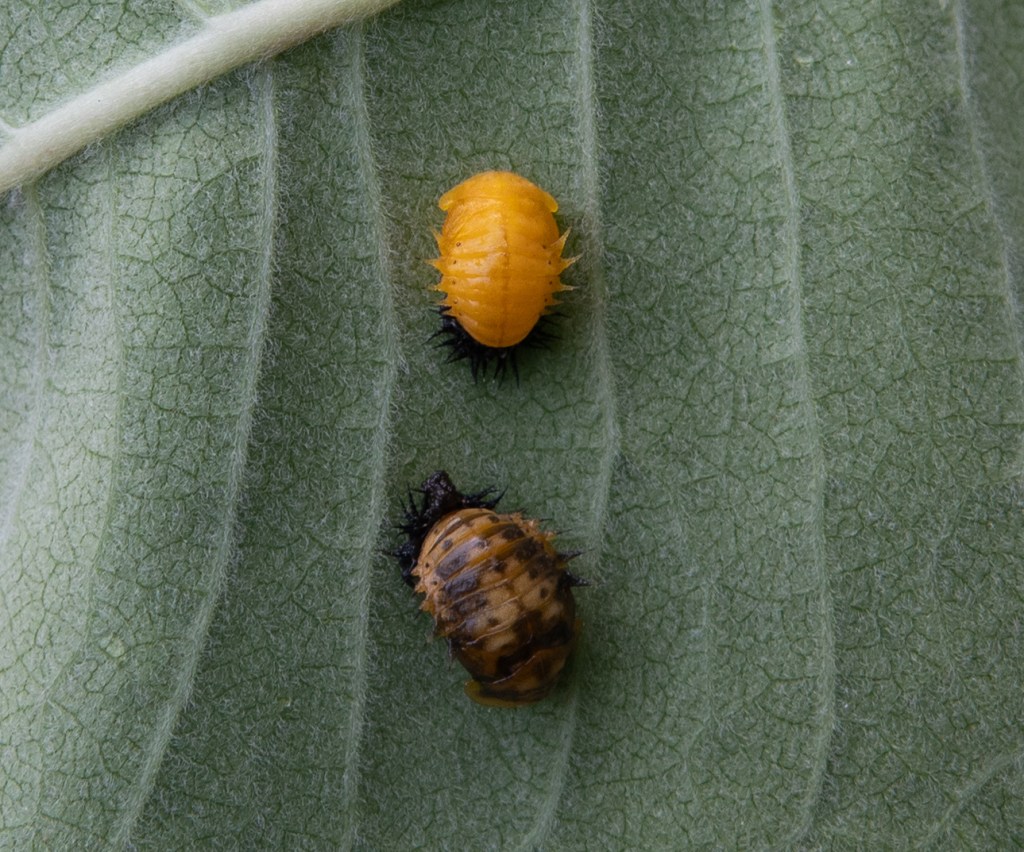
The previous photos were taken at midday on Monday. By 3.04pm on the following day the larva is beginning to form an oval golden pupa, though it is still soft:

At 5.25pm the bottom one has begun to darken, and meanwhile the top one has begun its transformation too:

And by 10.45am the next morning, both have completely changed their color, and hardened into their final pupal forms:

They will drop to the ground, and a new beetle will appear later this summer.

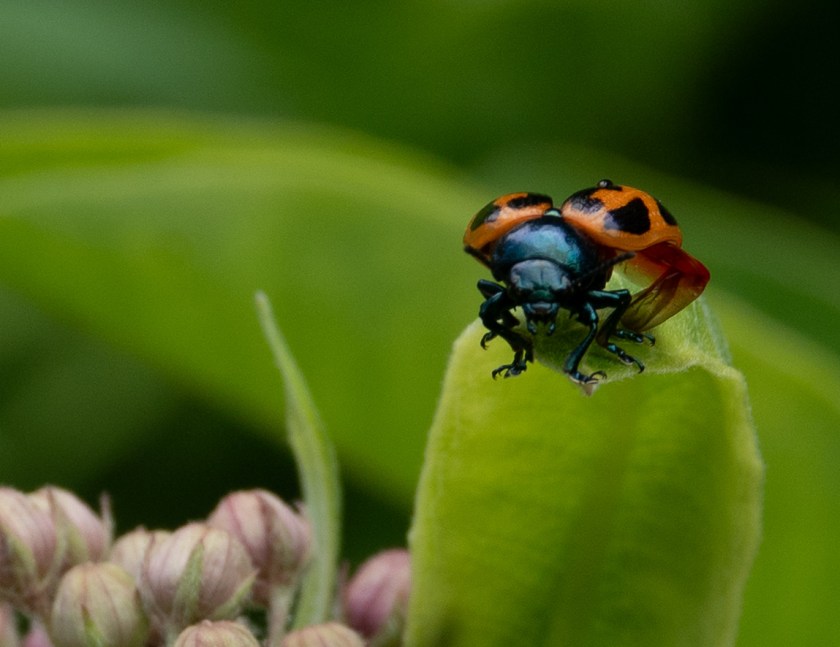
The unrelated Swamp Milkweed Leaf Beetle, Labidomera clivicollis, is also red on the outside:

When it wants to move to a new plant, it goes to a high place:

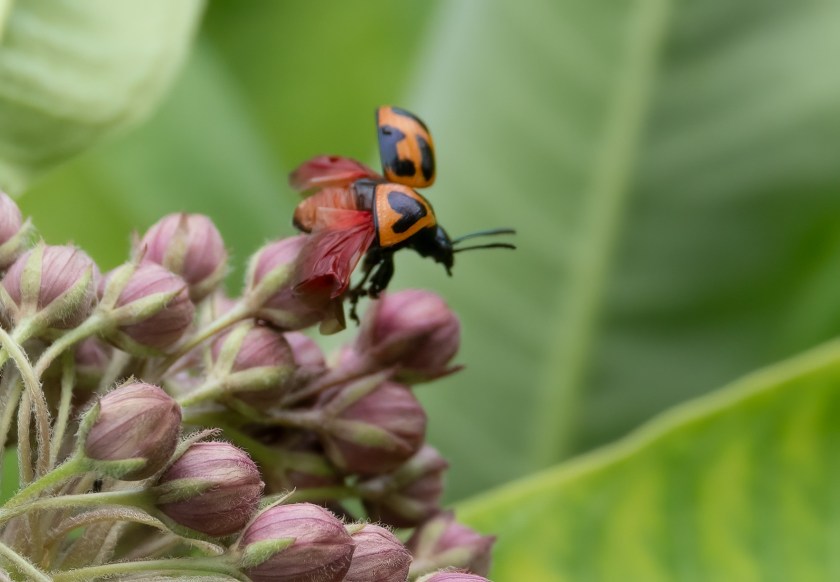
opens those wing cases (elytra):

and unfurls its wings. Lo and behold, they too are red.

An unexpected magical mystery delight.

PS The following one minute video is extremely boring, but shows you that the larvae with their fecal shields are perfectly mobile. For hard-core beetle people only.

Miracles do happen

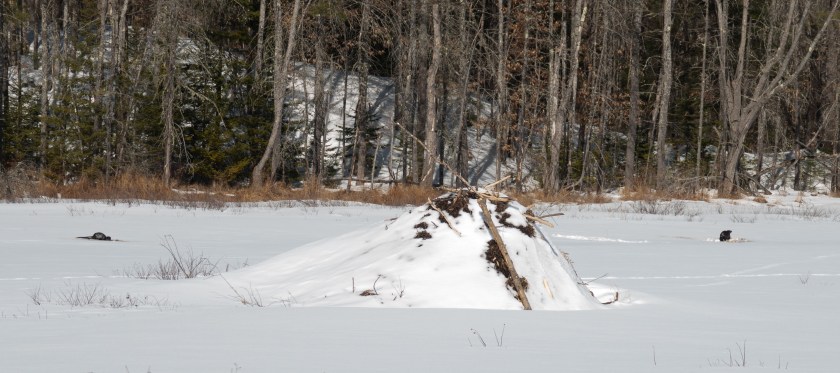
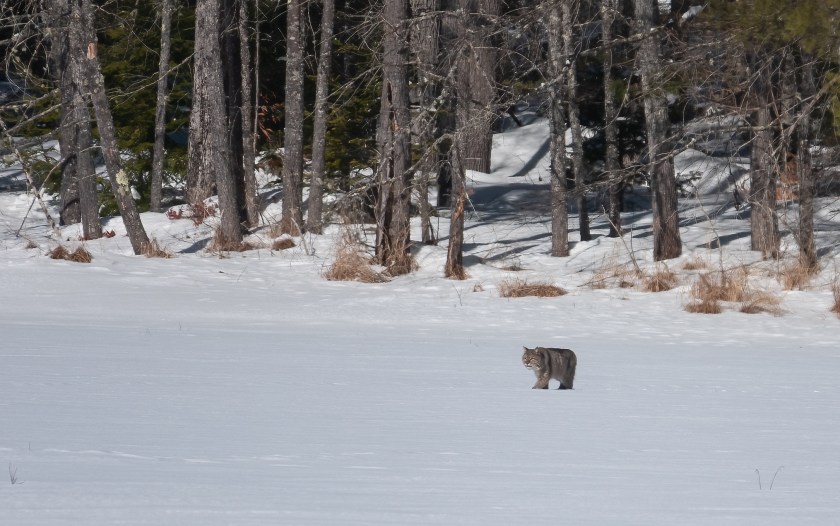
I have lived in Maine on and off for 43 years, and never seen a bobcat. I have caught them on camera traps, and seen tracks, but that’s it. Until now.

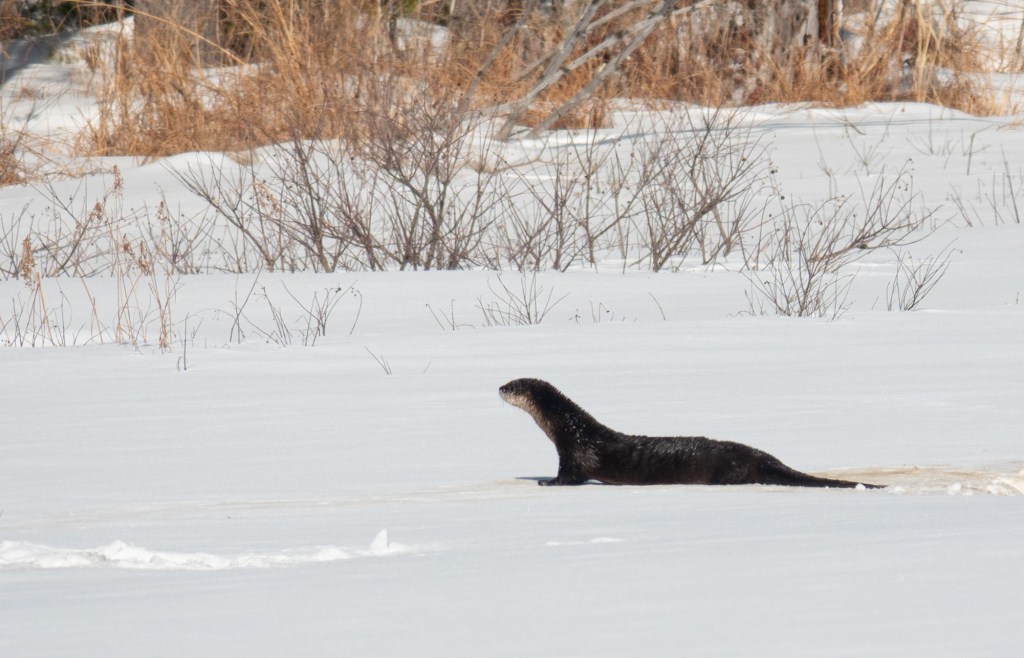
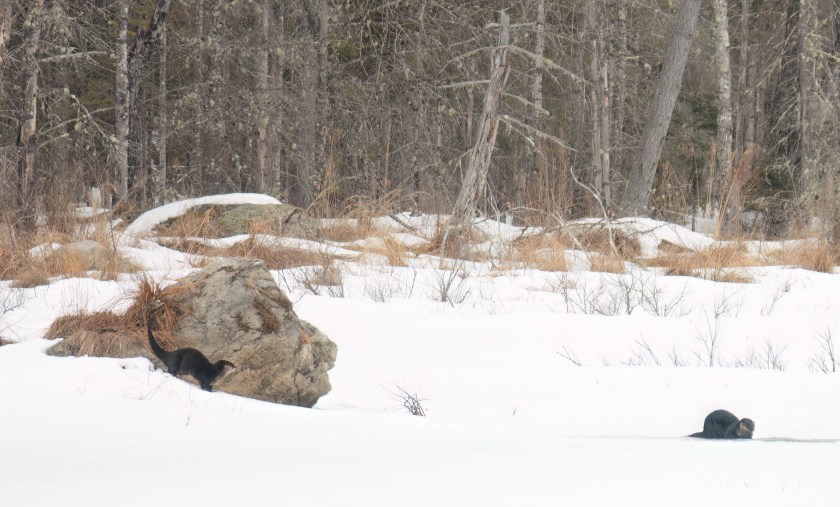
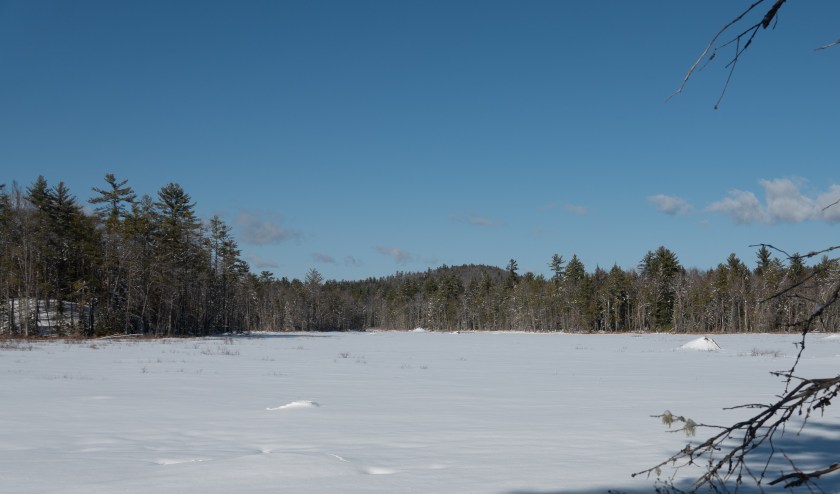
I was out for the second time that day snowshoeing and hoping to see otters. None. I had turned for home, and as always I looked over my shoulder one last time in case they had appeared as I left.

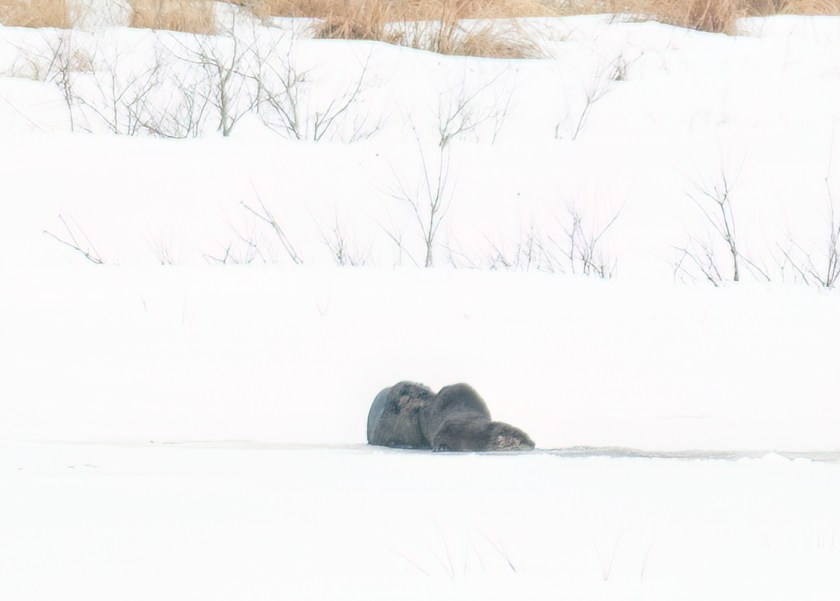
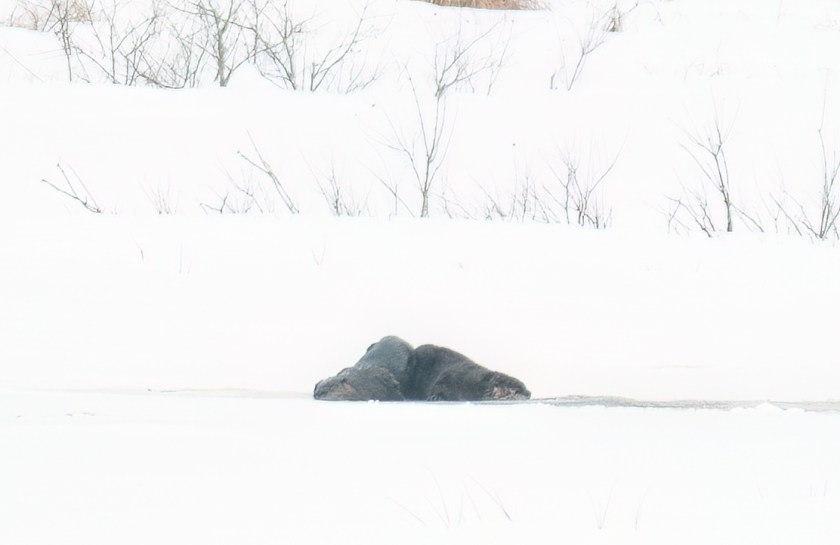
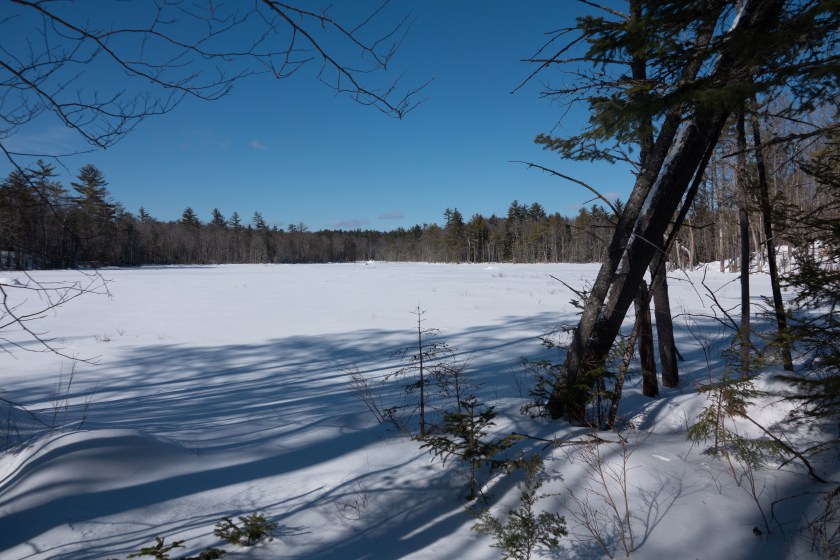
And there one was, on the far side of the pond. So, I headed back out for a closer look:

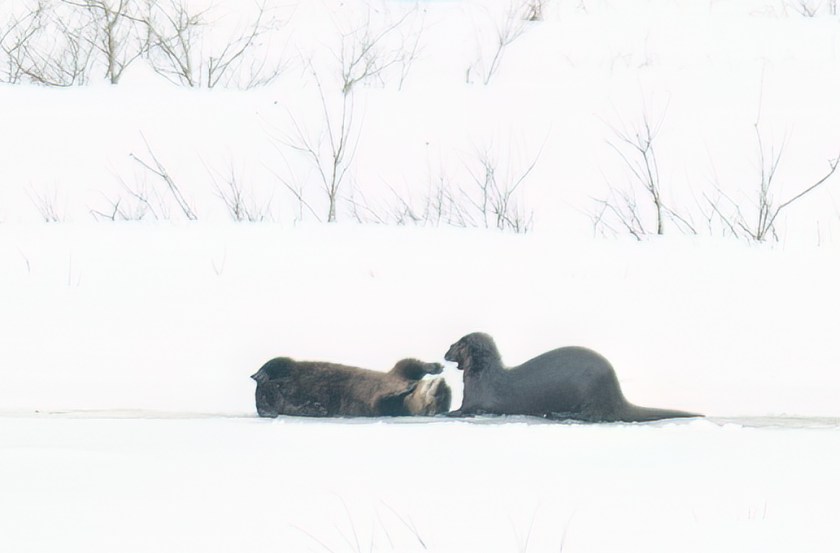
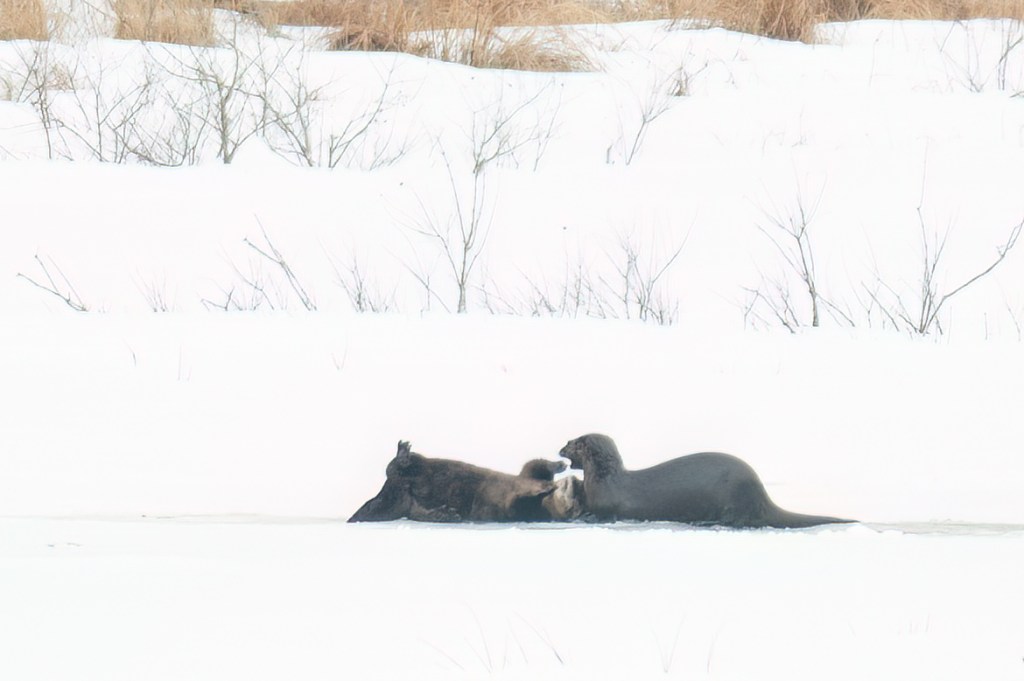
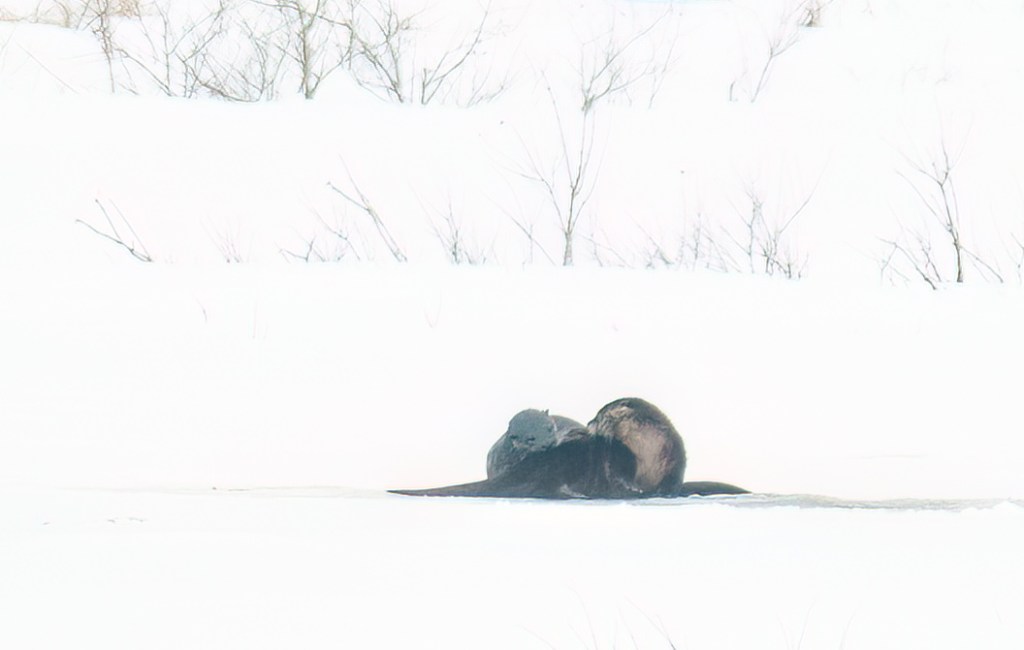
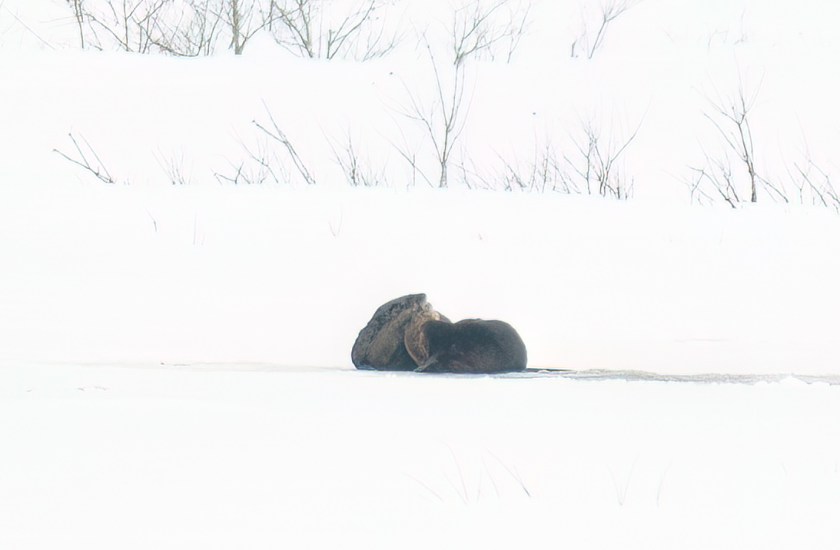
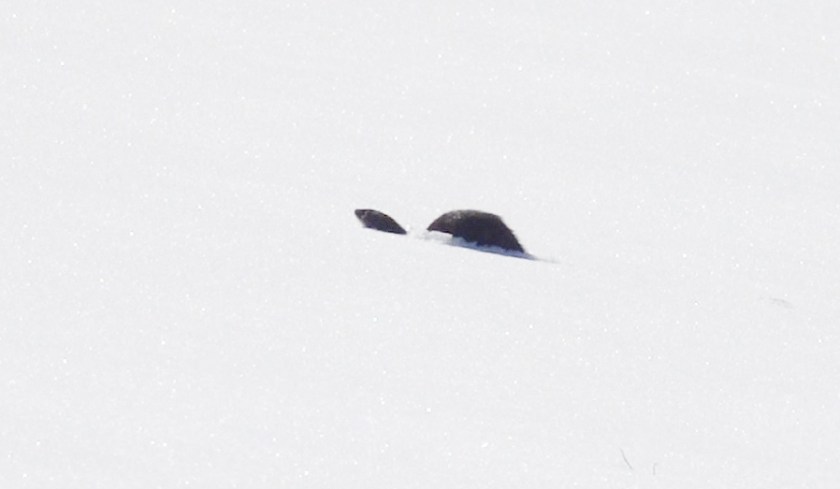
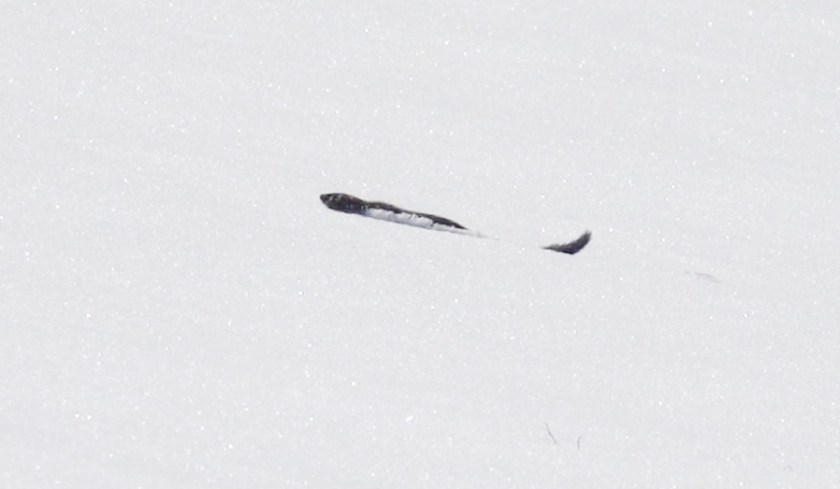
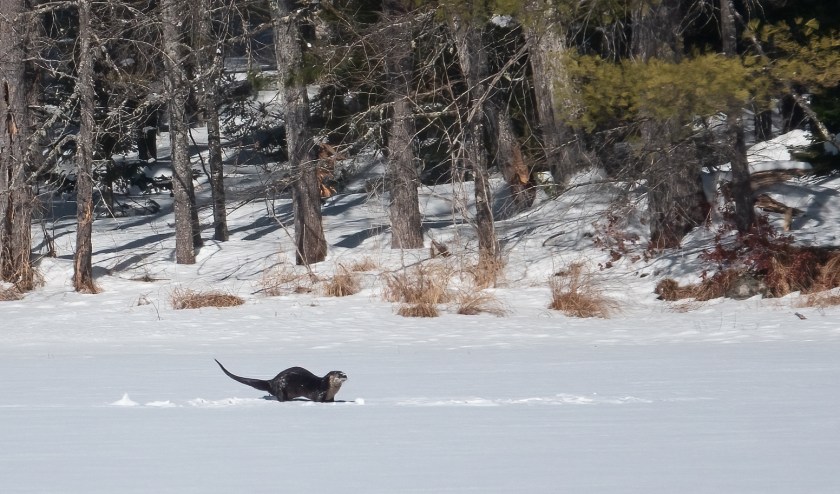
The otter dived under the ice, but there was another shape on the snow, rounder and fluffier:

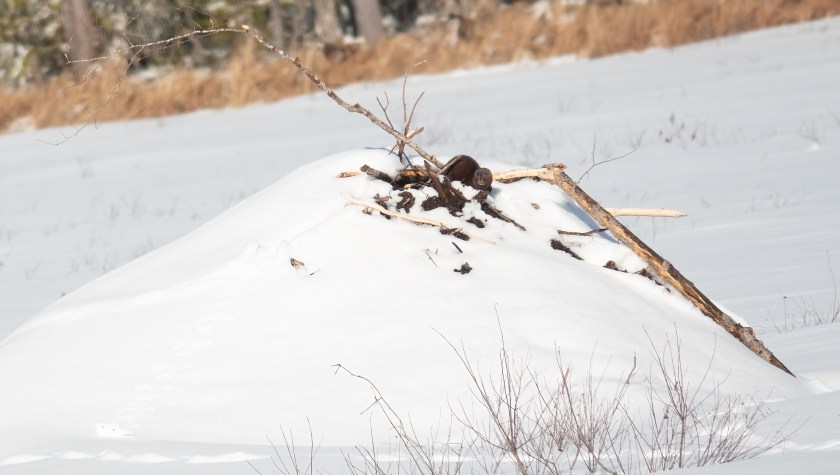
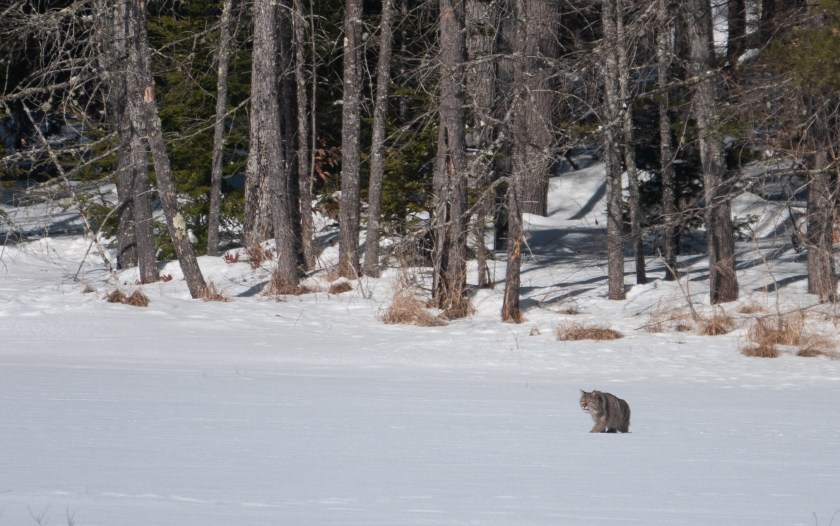
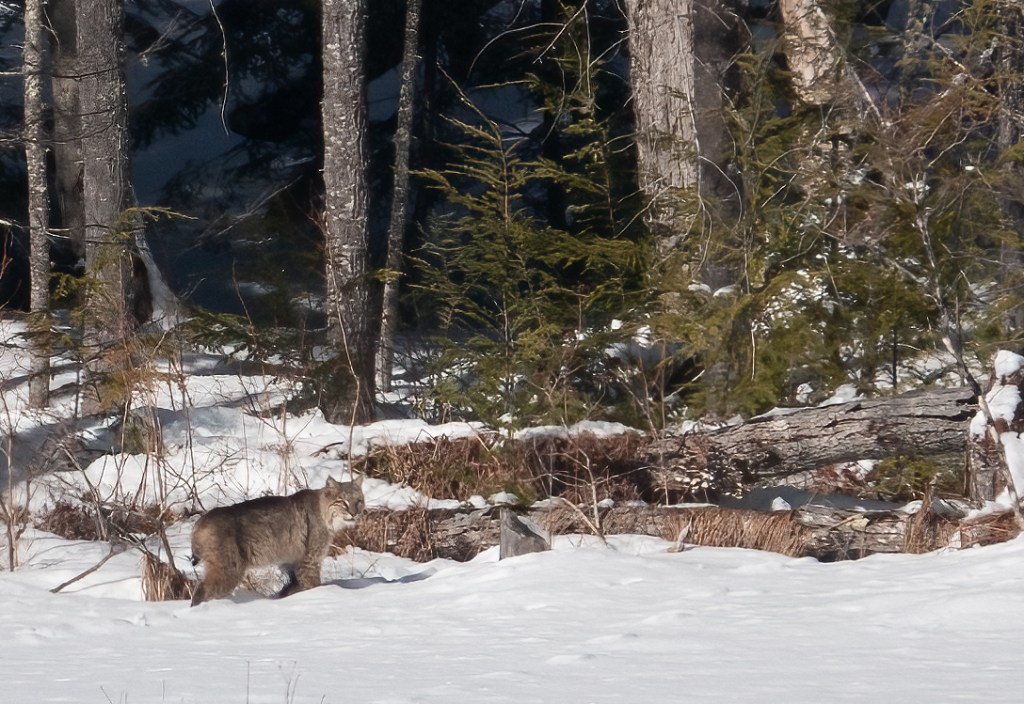
My first ever bobcat, Lynx rufus. I took a few shots from very far away. It was barely moving, carefully placing one silent rear paw in front of the other:

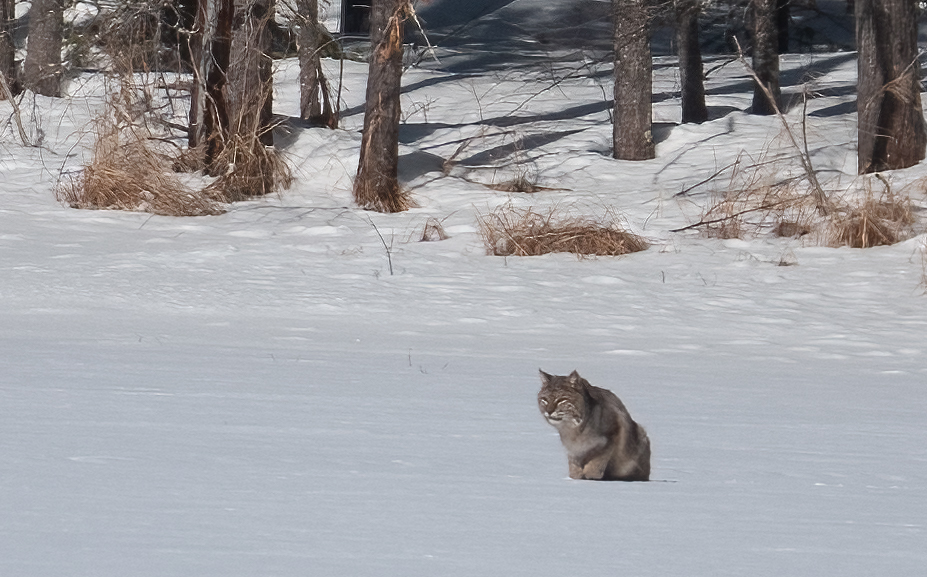
then settling into a crouch:

I wasn’t sure, but I wondered if it was preparing to stake out the otter hole. I was a very long way away, so I moved a little closer. From my new angle, I could see that it was now right next to the otter hole (the disturbed snow to its left):

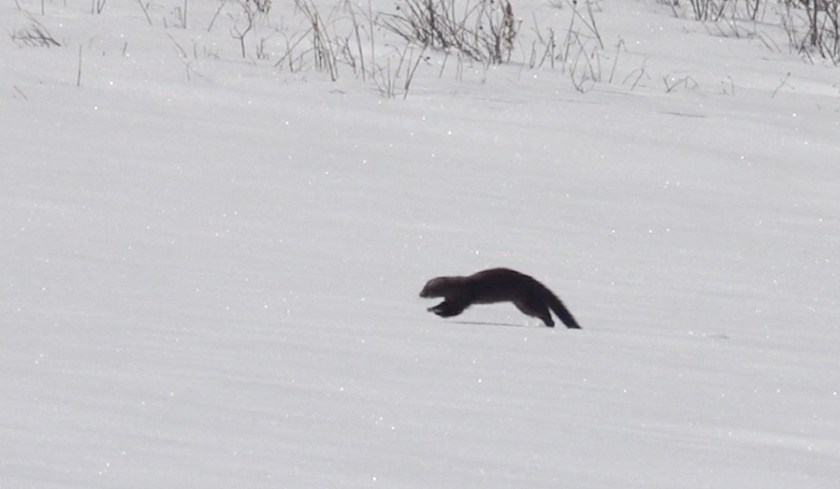
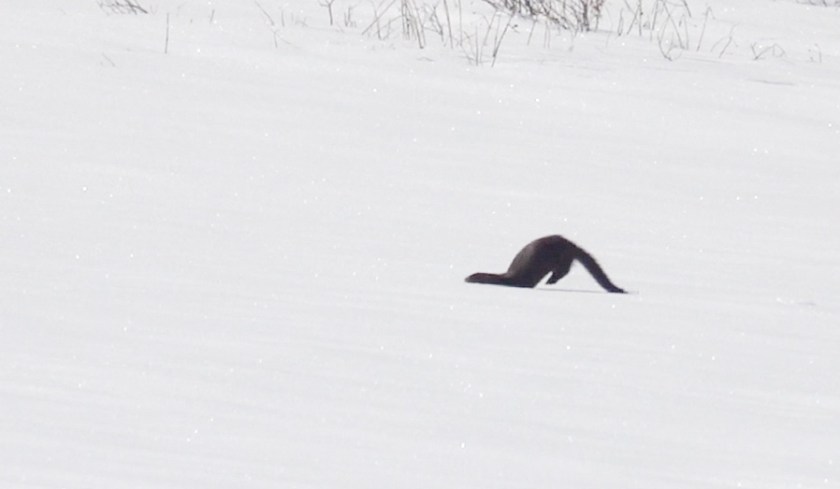
But it smelled me or heard me or saw me,

and took off, just letting me snatch a short video:

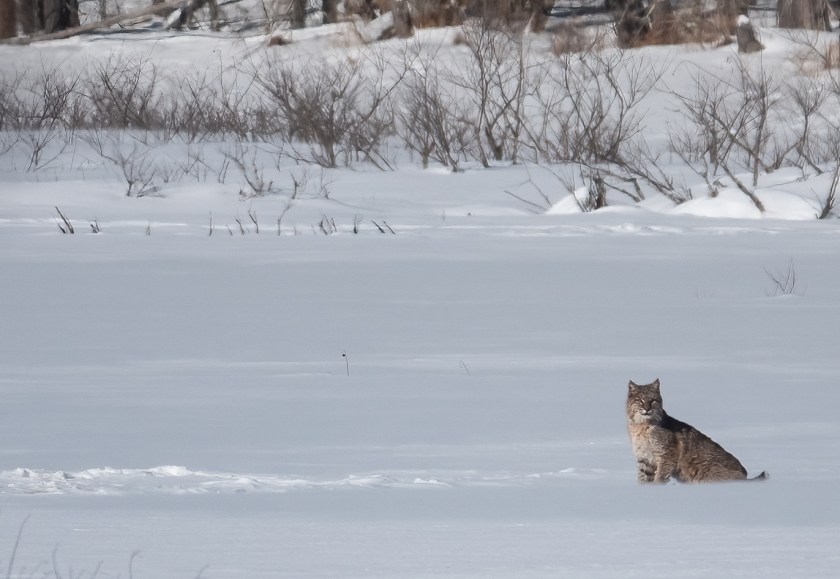
It stopped on the edge of the woods, and looked back reproachfully:

Three minutes of a privileged glimpse into its world.

I have since tried to discover if bobcats hunt otters. There is the occasional reference to otter remains being found in the stomach contents of bobcats, but that’s about it, and these could easily have been either carrion, or very young otters. An adult otter would be a formidable prey, being much the same weight as a bobcat. Look at this video of a bobcat recoiling from an angry otter: https://www.youtube.com/shorts/TJZlFwmdo64

Their main food is snowshoe hares, but they do very occasionally eat fish, so they may have been trying to steal the otter’s catch. See Newbury and Hodges 2018 for more on their diet. Bobcats’ feet don’t cope well with deep snow (unlike Canada Lynx), and we have had plenty of snow this winter, at the northern edge of their range, so my bobcat may be very hungry indeed.

Scott Lindsay, Regional Wildlife Biologist at the Maine Dept. of Inland Fisheries & Wildlife, agrees that it was unlikely to be hunting otters, and he tells me that bobcats are curious, and it was probably just checking things out.

PS Maine has a total bobcat population of around 1500, and a female’s home range is about 23 square kilometers. So it is not surprising that they are hard to see! There’s some useful,information here, including how you tell the difference between a bobcat and a Canadian Lynx.

https://www.maine.gov/ifw/fish-wildlife/wildlife/species-information/mammals/bobcat.html

“The gardener of the Patagonian wetlands”, Part I *

I first saw this animal not in Patagonia, but in the hills of Tuscany, on the edge of a hamlet, next to a tiny stream, or more precisely a ditch. There was a narrow path to the ditch through the long grass and we were discussing what had made it.

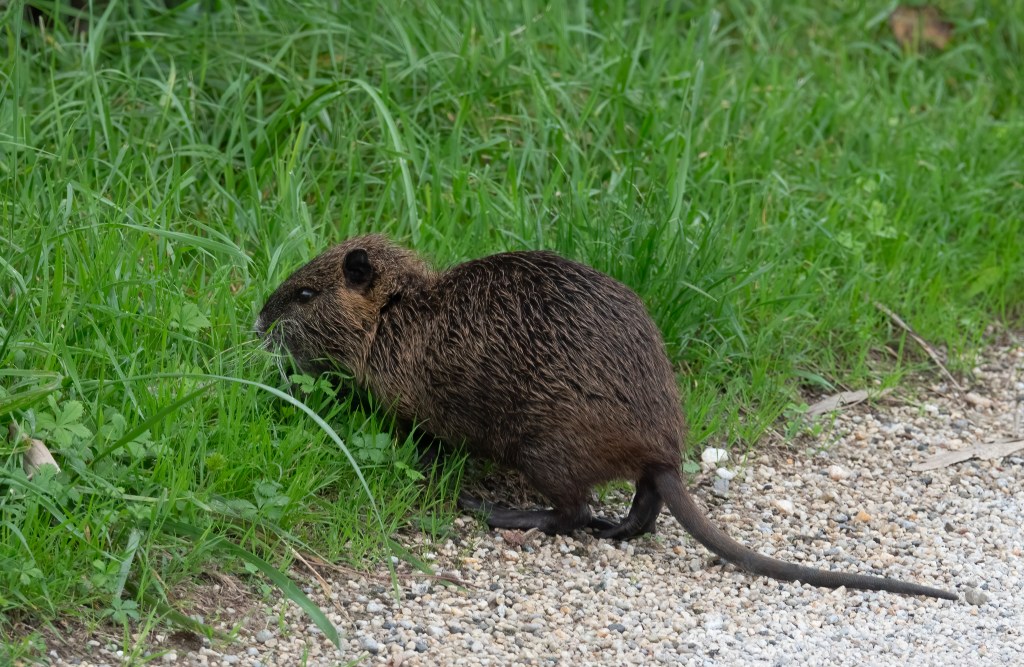
It was a nutria, or coypu. Native to South America, it was brought to Europe and the US for fur farming, and escaped (or was released when the fur farms closed). Its scientific name is Myocastor coypus, literally “mouse beaver”. Its many names are confusing. Coypu is preferred in South America, where nutria can also mean beaver or otter. In Italy it is sometimes called castorino, little beaver, and in Germany Sumpfbiber, or swamp-beaver. In much of Europe and the US it is considered an invasive species, damaging water banks and crops like rice as it burrows into them.

It weighs 10-20lbs:

and has webbed hind feet and a naked tail:

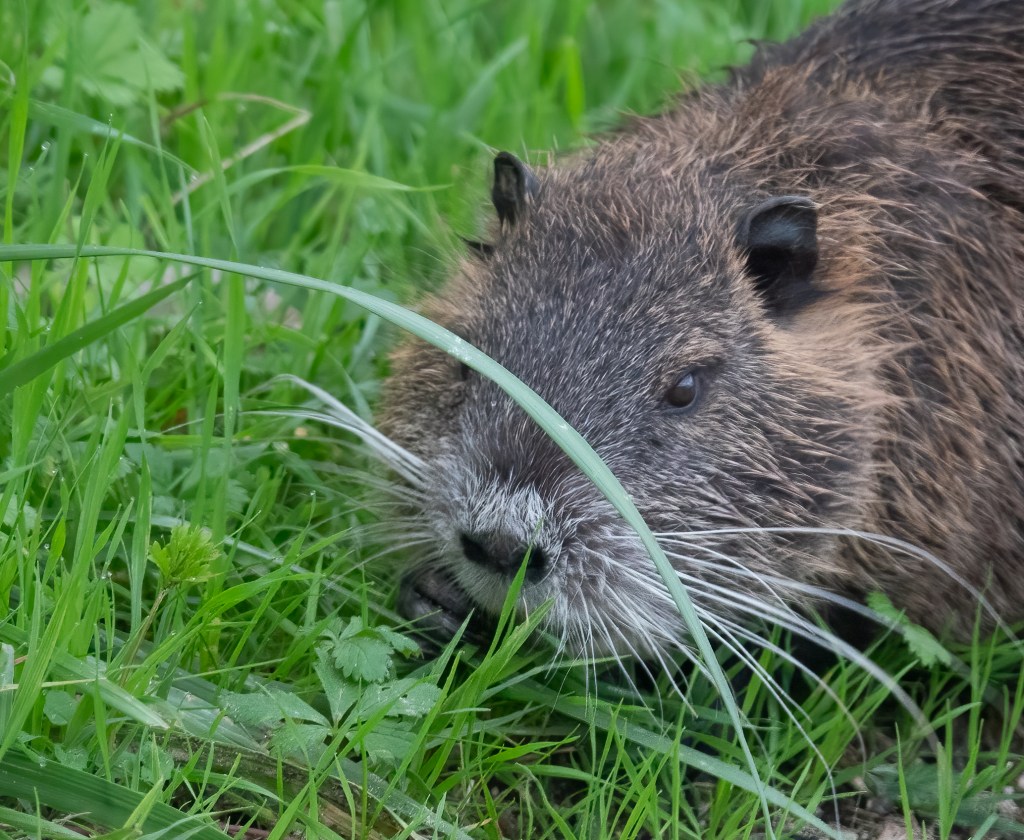
and a white muzzle with long whiskers:

If you rank some other aquatic rodents by size, starting with the smallest, you get muskrat, coypu, beaver, and then capybara. All are vegetarian, but their ranges differ. Coypu and capybara don’t like the cold, which limits their range to balmier latitudes. Nonetheless, once they get loose they can expand their territory amazingly fast. This map showing how they conquered France and beyond is from Schertler et al 2020:

How do they do this?? They live to about three years old in the wild. A litter averages four, but can be as large as thirteen, and they can mate again 2 days after giving birth, so a female can have six or seven litters in her lifetime, potentially adding up to a tally of 91 offspring!.

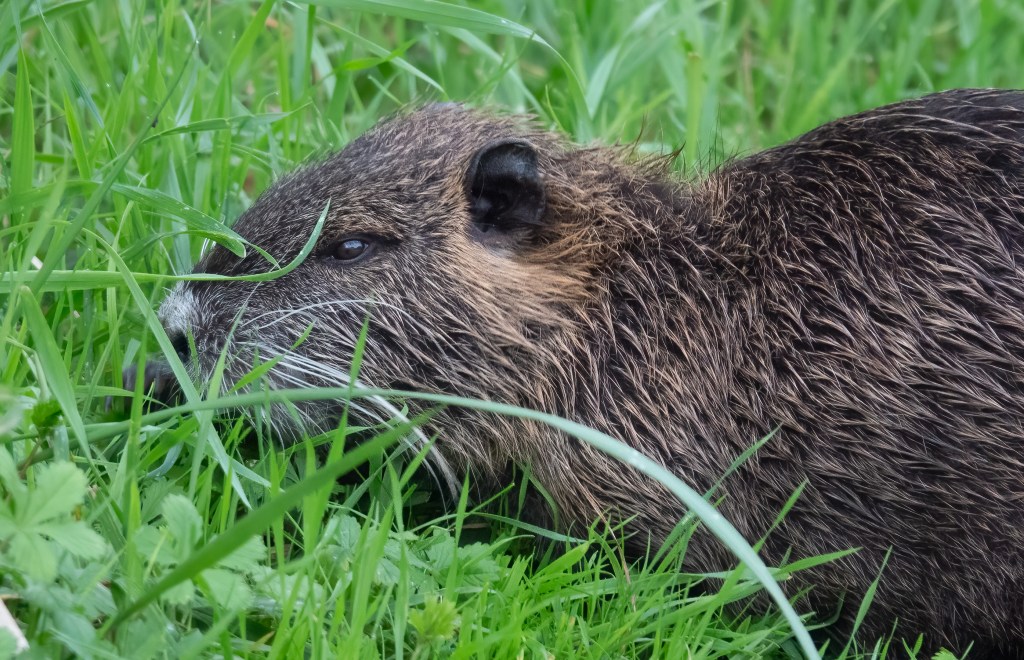
They were bred for the fur trade because of their remarkable coat. From the outside in, they have 3in long guard hairs, then beneath that a coarse dark brown mid-layer fur, and a thermal undercoat of soft dense grey under fur. This underfur is itself called nutria.

Like beavers, their teeth grow all their lives and are orange. Coypus are mainly nocturnal or crepuscular. They build subterranean burrows and also floating platforms.

I am off to Chile soon, and hope to see them there, where they belong.

PS Coypus get about. They have also surfaced in Japan. This 1996 poem by Ito Shinsuke is transliterated from Japanese; the word nutria has become Japanese nutoria..:

“Shirasagi mo Sugamo mo Koi mo kechirashite/ Sasagase gawa wo Nutoria yuku.”

The English translation:

“Pushing away white herons, ducks, and carp/ The nutria goes his way in the River Sasagase.”

PPS My title is the Argentinian nickname for coypu

Beavering away

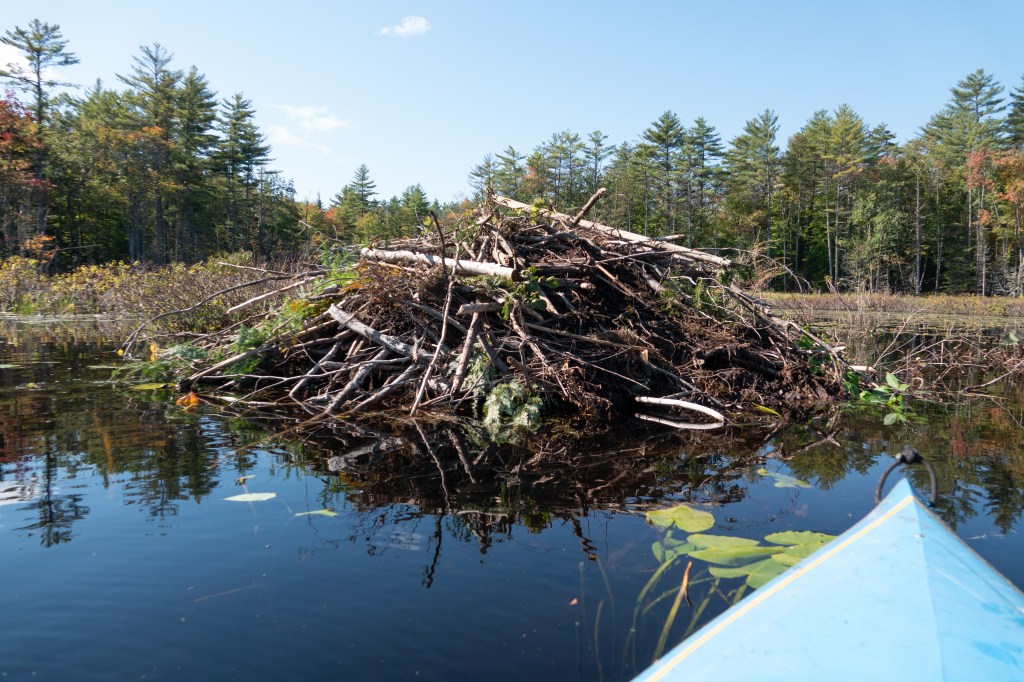
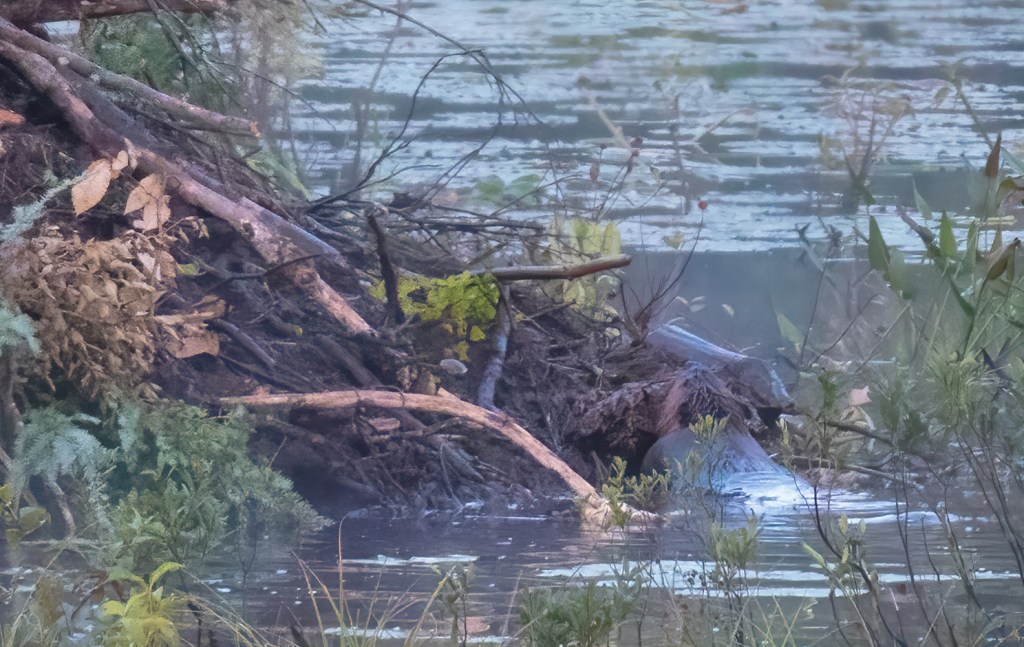
The beaver(s) have been very busy building a new lodge for the upcoming winter. My blue kayak is for scale:

The beavers are completely nocturnal, so each morning I take a photo from the shore, and compare it to the previous day for progress.

They build a heap of vegetation, pretty haphazard. As it grows they add mud, then more vegetation, including limbs up to maybe 3″ diameter, but also hemlock twigs and other leafy branches. I created a short stop-motion movie out of a series of shots, but you’ll need sharp eyes to spot the difference from day to day. A green branch gets added, but then wilts and turns brown or gets covered by woody debris:

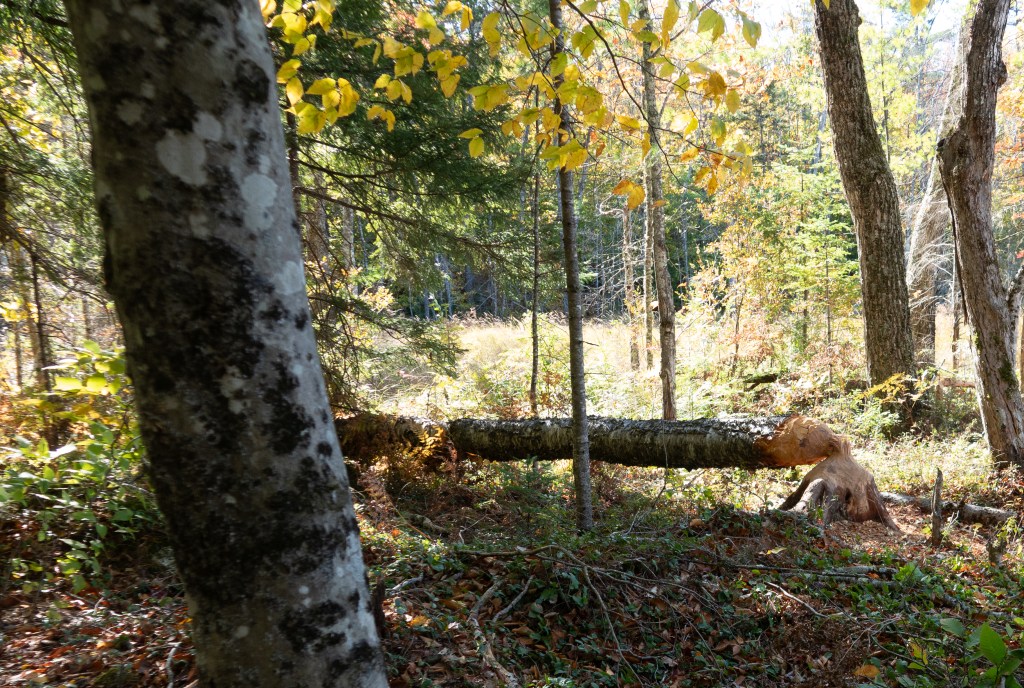
Their raw materials come from naturally fallen trees, or ones they have cut themselves:

And which finally fell in a windstorm some days later:

They felled the small hemlock below, and then returned and pruned off all the side limbs:

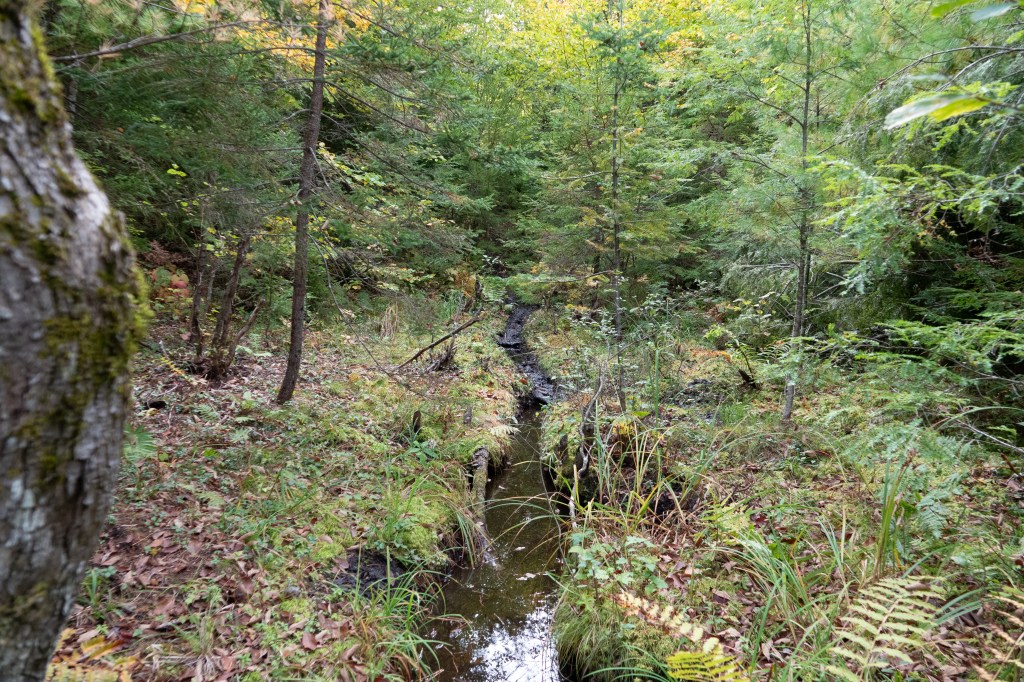
If there aren’t enough trees close to the water they sometimes build canals, which allow them to stay in the water for longer and also float trees down to the pond:

And in this case it looks as though they were used as a source for mud, which they scraped off the banks:

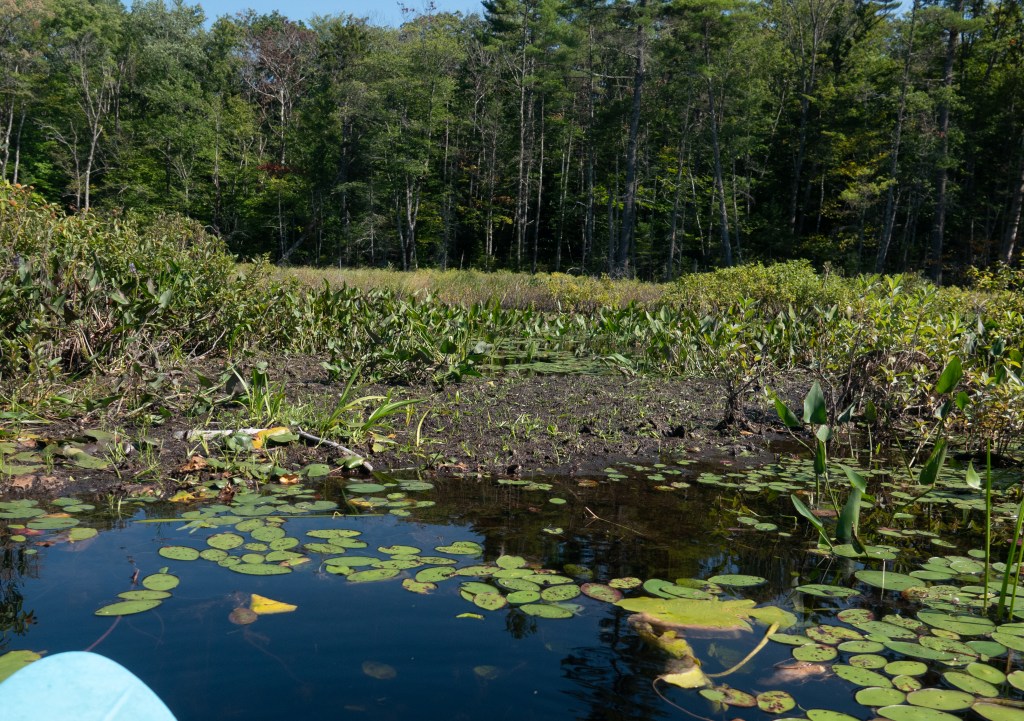
Mud also comes from shallow areas of the pond. In the photo below they scraped a mud bank next to the lodge of all its vegetation to get at the mud:

I tried very hard to catch them in the act of building, but it’s tricky when they are nocturnal, and 30 minutes walk deep in the woods behind my house. Eventually I got up at 5.45am, drove part of the way into the woods in the dark, and positioned myself just as it was getting light enough to see the lodge. I did this three mornings in a row, and finally saw a beaver pushing a big lump of mud up onto the lodge. By the time the light was good enough for a decent photo he had stopped work for the night, so this is the best I can show you. He’s in the bottom right-hand corner, sleek and wet from the pond, with his back to the viewer:

I also tried in the evenings, but no joy.

Here is what a mudded section of lodge looks like close-up.

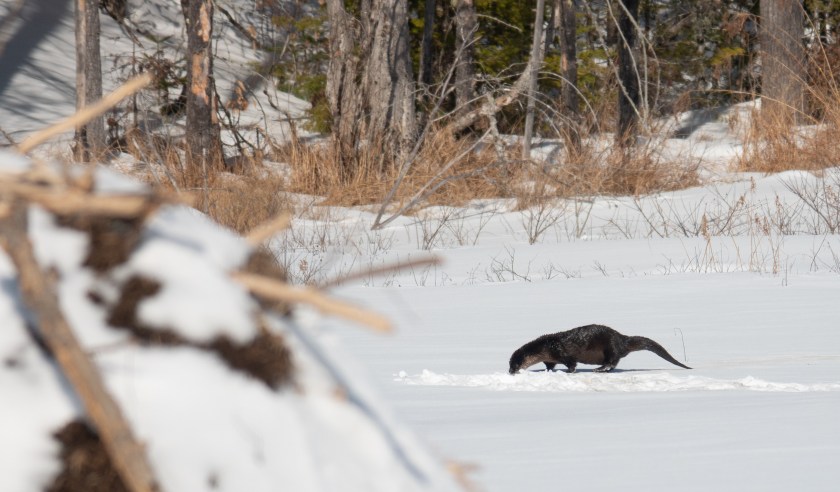
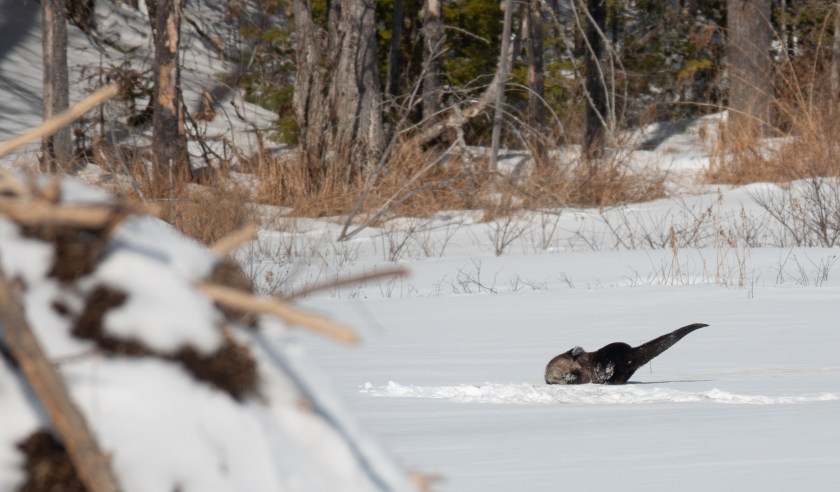
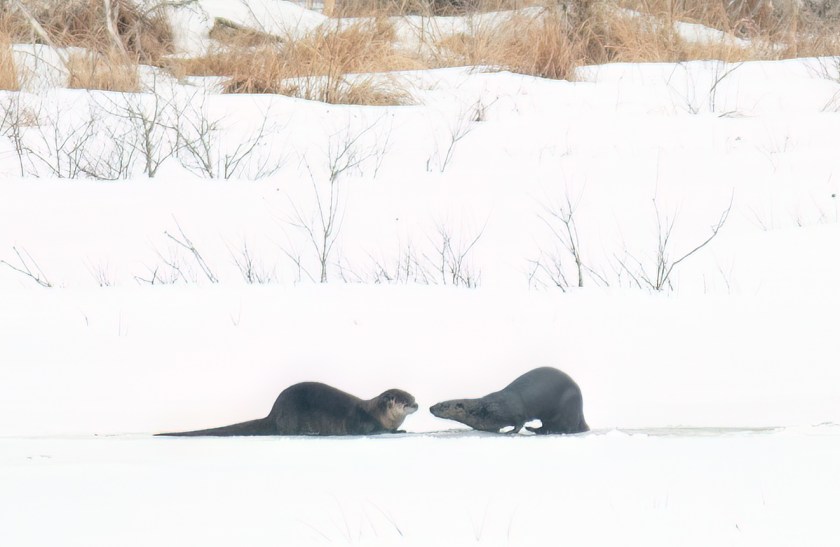
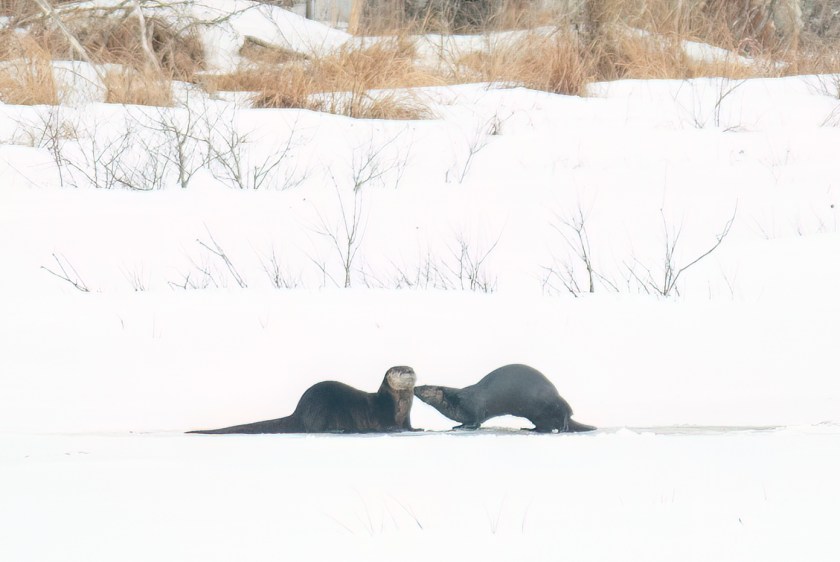
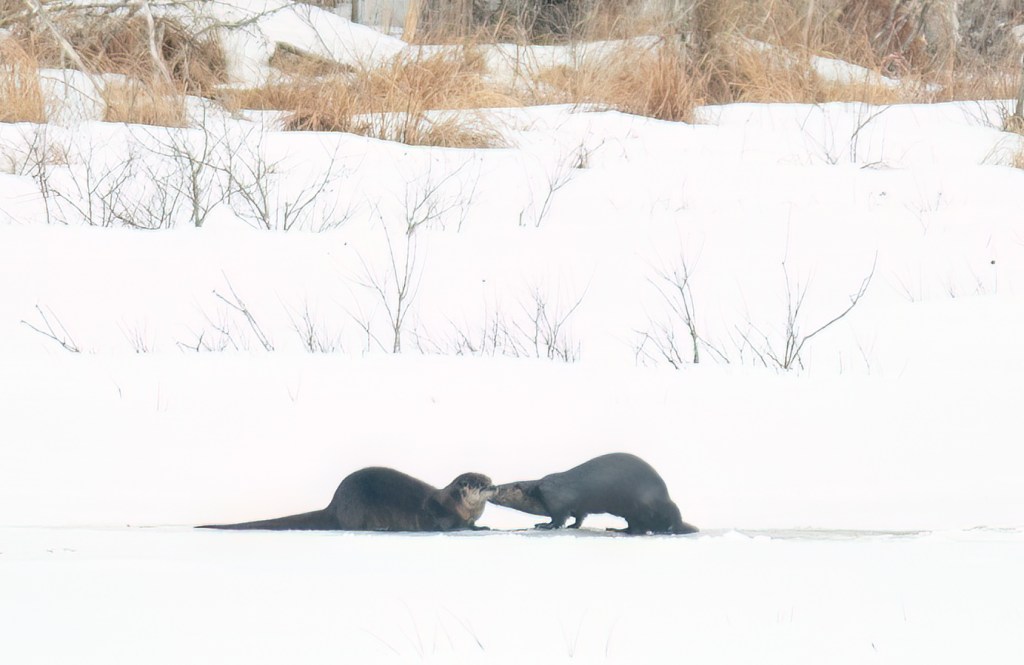
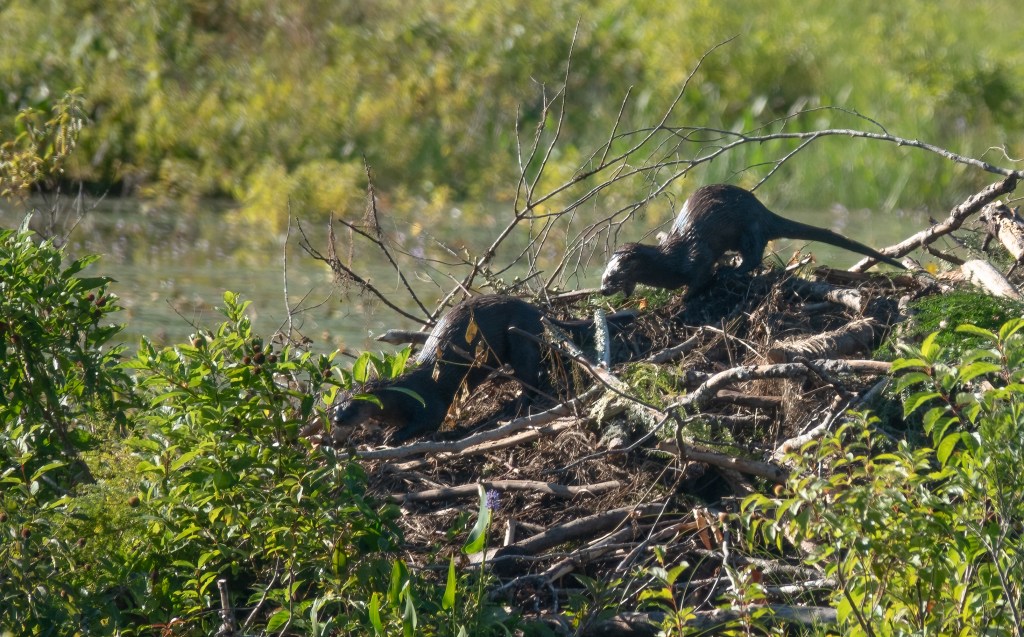
As the lodge grew, the local wildlife came to visit; a mother and teenage otter:

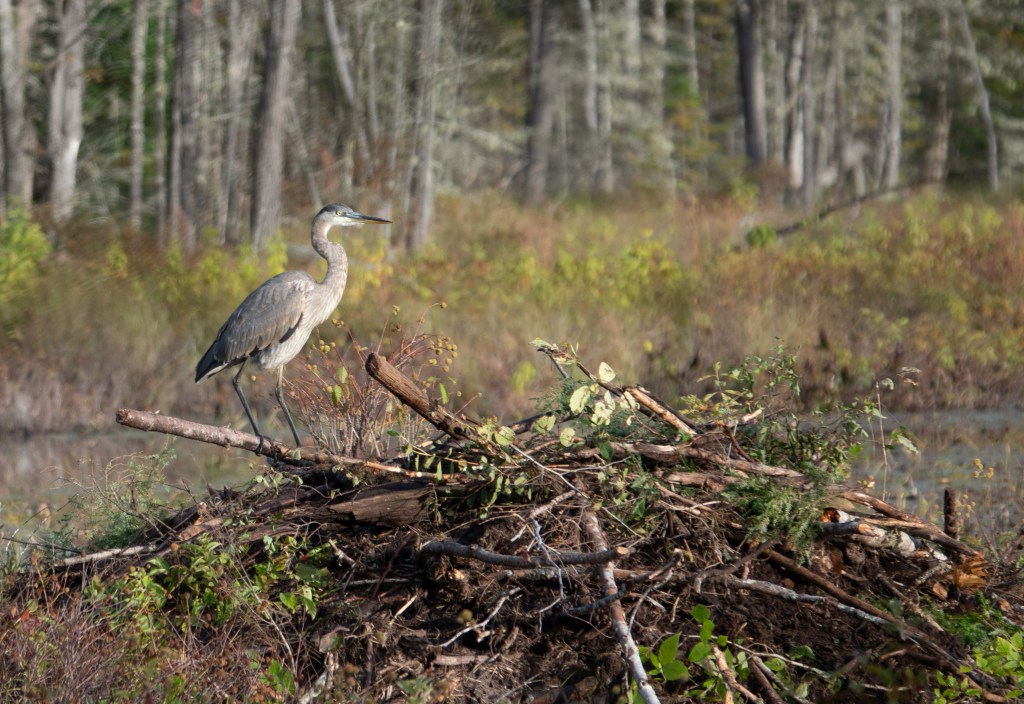
and Great Blue Heron.

The beavers are wise to prepare for winter. As fall shows its colors round the pond, here is an abandoned beaver lodge, apparently ablaze: