New Years Eve in the Cotswolds, and the sun set on 2017:

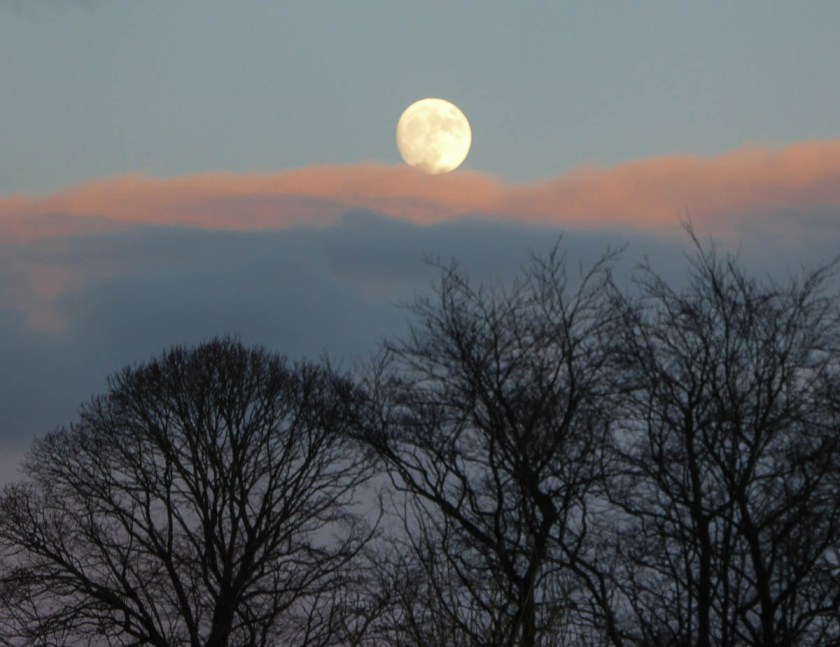
But 30 minutes later the moon rose:

And the first day of 2018 offered a rainbow:

and perhaps something wonderful at its end:

(I left my good camera behind, but technology is very forgiving.)
New Years Eve in the Cotswolds, and the sun set on 2017:

But 30 minutes later the moon rose:

And the first day of 2018 offered a rainbow:

and perhaps something wonderful at its end:

(I left my good camera behind, but technology is very forgiving.)
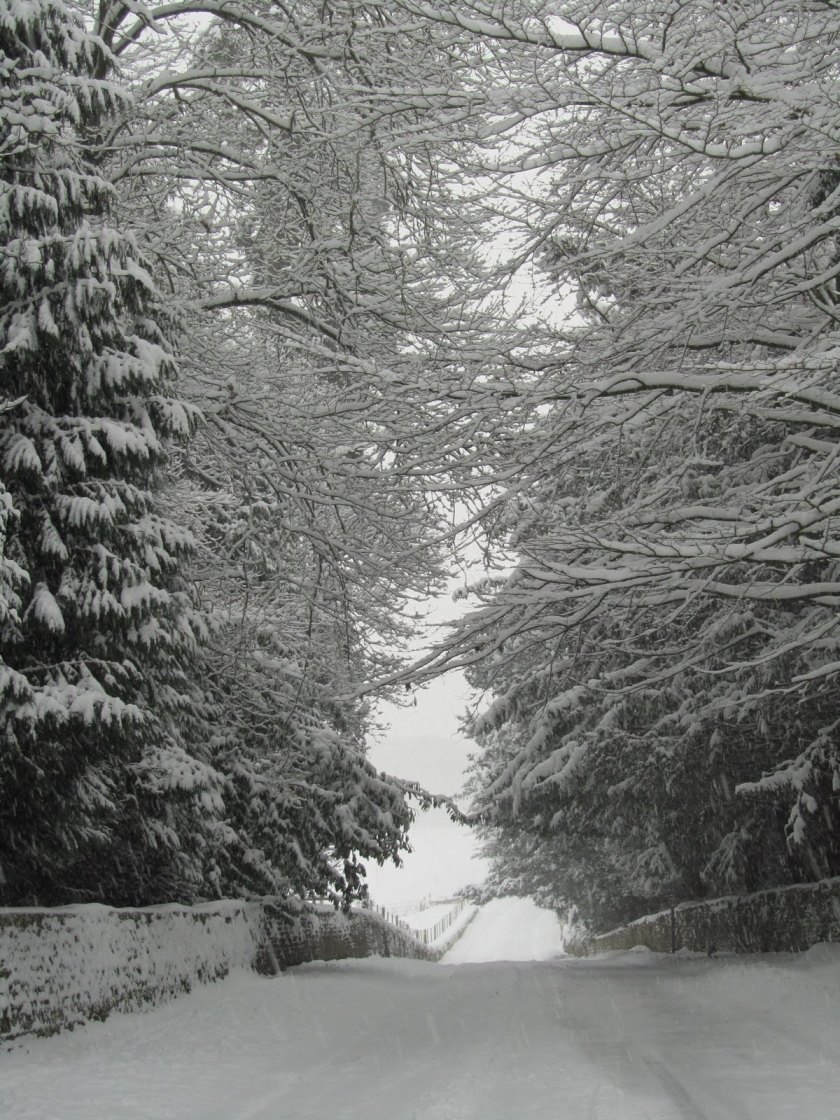
In the last few days we have watched the pristine beauty of an icestorm on Christmas Eve, followed by six inches of fresh powdery snow on Christmas morning.
And through the deep deep freeze life goes on. Our new granddaughter Ellie arrived today, 8lbs 3oz and a lot of black hair!

The scarlets and vermilions of these Ecuadorian cloud forest wildflowers eclipse any poinsettias in my local shops.
Or these:
Or these:
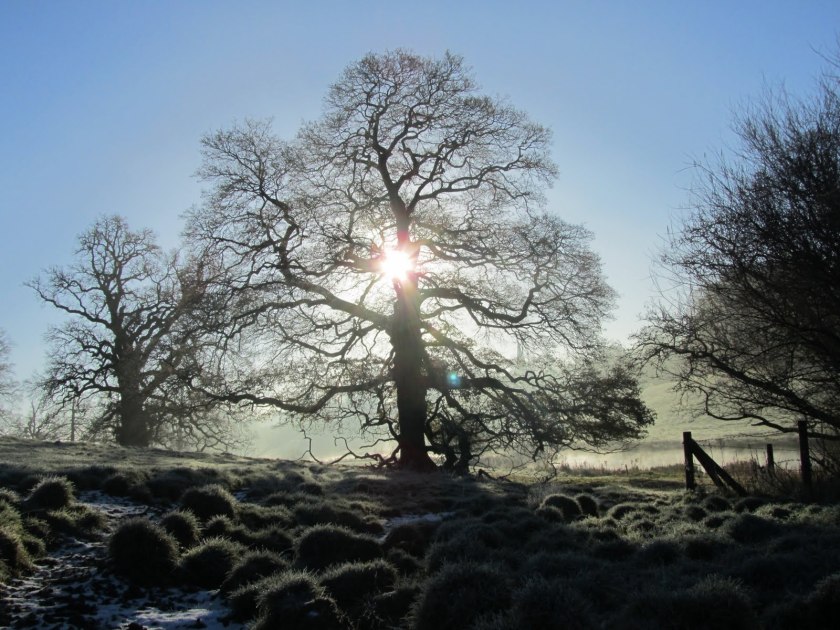
But our colder Christmas surroundings bring snow and frost, with a different whiter beauty.


And so enjoy this time to remember old and true friends, and reach out to new ones.

Have a wonderful Christmas and New Year.
Ecuador has five or six proper toucans: they are my kind of bird, being large and grand and brightly colored, so even I can see them. Most are sub-tropical, but some are montane species living in the Andes cloud forests on the Western slopes, like my first one.
This male Plate-billed Mountain Toucan was perched on a branch near his nest, and inside the nest hole his mate was sitting on their eggs. We thought he had brought food to sustain his lady-love, but eventually he selfishly ate this himself. The huge beak has serrated ‘teeth’, but despite this vicious-looking piece of machinery they are mainly fruit-eaters, supplemented by only occasional insects and lizards.

The nest is in a perfectly round hole in a tree, and the female was not visible, although the guides said they had seen her.

These are birds that really shouldn’t be able to fly: their bills are enormous, and they look ludicrously unbalanced. The mystery was solved for me a few years ago in Brazil, where my lodge had a toucan’s bill on display. It turns out they are extremely light, being made of bony struts filled with a spongy keratin-like material. The photo below shows off his fine wings, which must help manage that beak in flight.

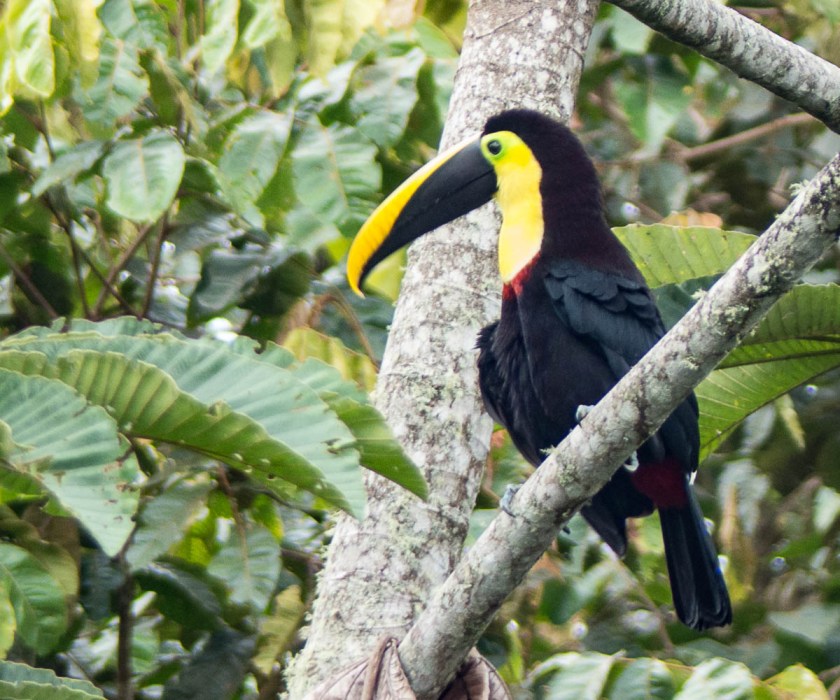
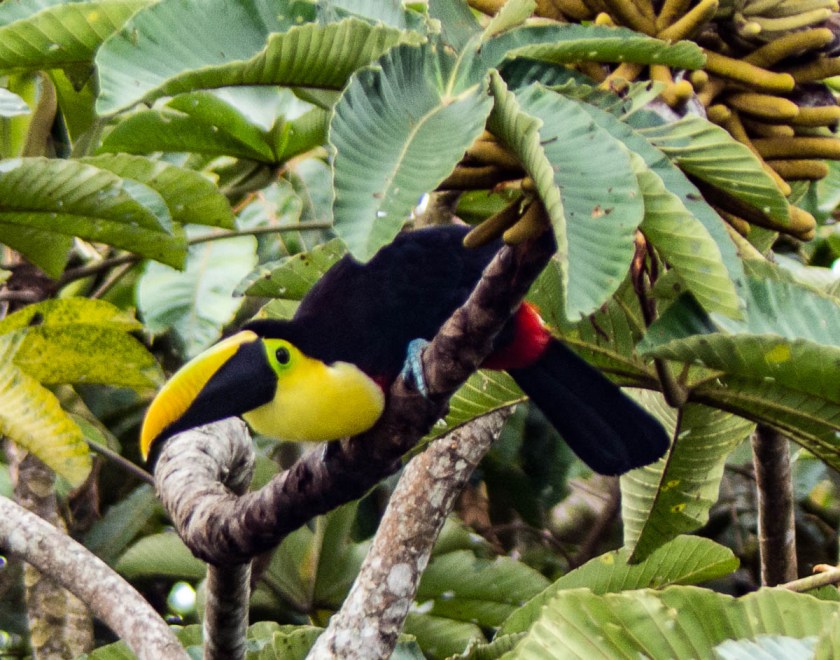
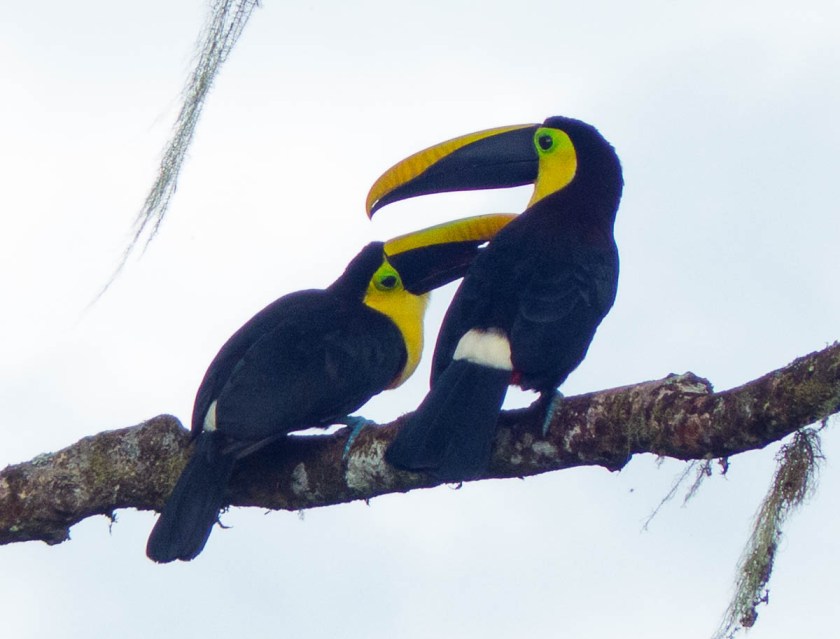
My other toucans were Black-mandibled Toucans, also known as Yellow-throated Toucans, living in the sub-tropical Sumaco area on the Eastern slopes, in a large fruiting tree near my lodge:

They have bright blue feet, and flashes of red on the vent.

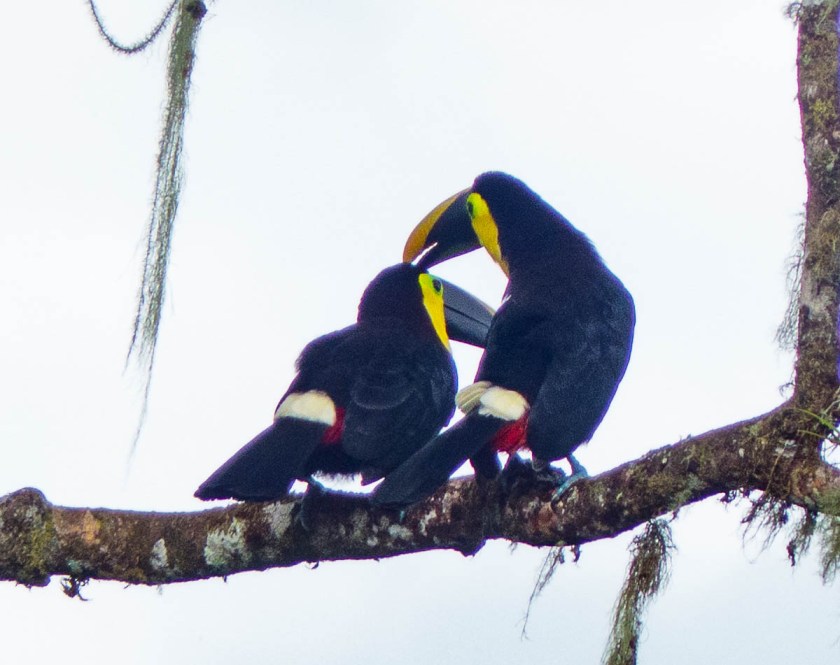
This one was part of a devoted pair, who spent long periods sidling up to each other, and taking turns grooming each other surprisingly delicately with those gigantic beaks.


A final check:

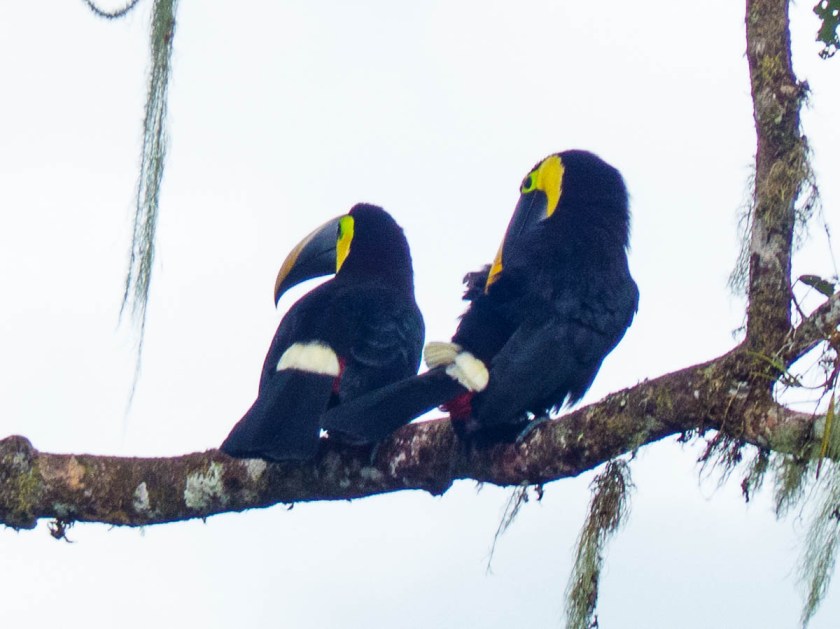
And time to pose for their portrait.
(In breeding season, pairs separate out from the larger flocks in which they mainly live.)
Spoiler alert: Vegetarians should stop reading now!
Out one night with a flashlight, we came across this slender, elegant snake on a tree trunk, enjoying a late-night snack:

From this angle, the poor lizard has a disconcertingly human sacrificial appearance.
More dramatically, we were on the Napo River in a small boat watching flocks of parrots on a clay-lick, when the guides suddenly became very excited, pointing at the trees in the top right-hand corner of this photo:

None of us could see anything, but after some considerable time they calmed down enough to explain that a very large python was draped among the creepers, and it had caught a parrot. So, here are two photos taken twenty minutes apart, at a considerable distance, and from a rocking skiff, of the cruel constrictor.
In the first one, the poor parrot is being slowly asphyxiated.

And in this second one, it is halfway down (actually, up) the snake’s gullet, beak first (which you would have thought might be rather painful, but then feet first wouldn’t be great either).

A genuine ex-parrot. (Credit: Monty Python).
A Red-tailed Boa, by the way, can get big enough to eat a deer, so a mere parrot doesn’t have much chance.
To cheer you up, here are the ones that got away.


Ecuador hosts other remarkable birds in addition to hummingbirds. I’m saving toucans till later, but here are two you might enjoy.
The Hoatzin is a prehistoric-looking creature, seen all over the place near Napo Wildlife Lodge in the Amazon basin. Known locally as the Stinky Turkey, it eats only leaves, and so its digestive system is rather like that of the cow. The enzymes in its crop that help with this task mean it emits a nasty smell if cooked (hence its name) so it thrives unmolested by hungry humans. Their nests overhang slow-moving water, and then if a nestling is threatened it falls in, swims to the water’s edge, and climbs back up to the nest with special hooks on its wings.


The Andean Cock-of-the-rock lives at higher elevations, between 1000 and 2000 meters in the slopes of the Andes. The male’s head and neck are resplendently scarlet on the Western slopes, and tangerine on the Eastern slopes, both with a black and silver body and wings. The feathers of its crest and face completely envelop its beak, so from the neck up it looks like a fuzzy sock with stick-on eyes.


The male does a spectacular display in the lek, but sadly I didn’t see this. They are otherwise shy and hard to see, but I got a good look at this one on the Eastern slopes at Wild Sumaco lodge.
Underpinning the pyramid of life in the Ecuadorian forests is a huge insect population.
Among my personal favorites are the stick insects, extremely well-camouflaged if they stay still amongst the leaf litter, but easy to see if they emerge into the sunlight:


On the whole, though, the best insect sightings are at night, like this leaf insect, whose extravagant costume mimics every blemish and hole in a typical leaf:

Or these two, whose paths crossed in the dead of night, so one simply climbed over the other and continued on its way. The one underneath moved its feet a few millimeters, but did not seem at all discombobulated. (These photos were taken 30 seconds apart).


Or more intimate encounters, as evidenced by these two couples, quietly canoodling until rudely disturbed by us:


All alone outside our dining room was the biggest and most handsome chap of all, a good six inches long:

But some insects survive the night only to be snapped up at first light by the toucan barbets that frequent the hotel’s outdoor lights at dawn…

The food chain goes on, and builds the pyramid of life.
Ecuador has about 134 different species of hummingbirds. Compared to 1 in Maine and 0 in England, this is really quite overwhelming. They are not good at staying still for photos, and they are also not easy to identify, but the variety is astonishing. I have been completely unable to exercise self-control and limit my number of photos, so stop when you get bored.
Different shaped beaks to fit into specifically-shaped flowers:


with whip-like tongues:

“Ears”,

Crests,

or tails that Isadora Duncan would envy, like these:


Some have fluffy pompoms round their ankles.

They are also very territorial and engage in frequent spats:

And most of them are iridescently glorious, with what is called “structural color”. The iridescent colors “are the result of the refraction of incident light caused by the microscopic structure of the feather barbules. The refraction works like a prism, splitting the light into rich, component colors. As the viewing angle changes, the refracted light becomes visible in a glowing, shimmering iridescent display.” (Cornell University All About Birds website). If the light angle is wrong, the feathers just look black.


PS: My title today is a line from Emily Dickinson’s poem, The Hummingbird.
…A route of evanescence
With a revolving wheel;
A resonance of emerald,
A rush of cochineal;..
PPS: If you are interested in their behavior, this recent article calls hummingbirds “bees with feathers”, and argues for treating them as an example of convergent evolution:
http://rsbl.royalsocietypublishing.org/content/13/12/20170610
Seeing mammals in the rainforest is tricky. The easiest are probably monkeys, because many species travel in groups, and you can hear them coming. But mostly you get just a glimpse as they move swiftly through the treetops, or leap acrobatically overhead to cross a trail or a stream. Magical, but not a long look. Here are the best photos I managed in Ecuador.
(A confession: from time to time Marcelo, our guide at Napo Wildlife Lodge, grabbed my camera and disappeared. Somehow, he always found a tiny gap in the foliage and managed to get the monkey shot I would never have got. I can’t always tell you which Napo monkey shots he took, and which were mine, but he really liked my camera!)
These are Black-mantled tamarins, at Wild Sumaco:

And their Golden Mantled relative, near Napo Wildlife Lodge:

The most common monkeys around Napo (in the Amazon basin) were the Red Howler Monkeys. At dawn, the males set up the most evocative chorus drifting through the forest as the sun rises. The young one in this photo is nicely showing off his prehensile tail, something found only in New World monkeys. (Taken from a rocking boat, by me!).

Also common were the squirrel monkeys (who don’t have prehensile tails)

Finally, we saw one group of Woolly Monkeys. They need primary forest, and our lodge was in an area protected by the local Kichwa people from all hunting, development, and oil extraction, so we were lucky enough to see them. It is not clear that he was so happy to see us…

Wake the serpent not—lest he
Should not know the way to go,–
Let him crawl which yet lies sleeping
Through the deep grass of the meadow!
Not a bee shall hear him creeping,
Not a may-fly shall awaken
From its cradling blue-bell shaken,
Not the starlight as he’s sliding
Through the grass with silent gliding.
Percy Bysshe Shelley
On a narrow trail at Wild Sumaco lodge on the eastern slopes of the Andes, the guide behind me suddenly gasped. Unseen by me, a slender snake had apparently slithered right between my legs into the leaf litter. It was just showing, in a shadowy corner, so I took a rather bad photograph from a respectful distance:

At the time, we didn’t notice, being rather focussed on the snake itself, but there seem to be eggs next to it. Whether they are the snake’s own eggs, or those of something else, I have no idea.
My guide then took a long stick, and gently moved away some leaves, and the snake emerged into daylight, allowing us to see its startling coloring, and changed its demeanor entirely, swaying its head side-to-side in a positively cobra-like manner:

Back at the lodge (by a different route!), we tried to identify it. The reassuring consensus was that it was a false coral snake, non-venomous. More specifically, the best match I can find is Lampropeltis triangulum, one of the milksnakes, though the yellow band across the back of the head is not typical (most of them have a whitish band). They are oviparous, so that fits too.
The coloration is an example of Batesian mimicry: with their spectacularly vvid coloring, they aim to deceive potential predators into confusing them with the truly poisonous Coral Snakes.