Such a name to live up to! The Goliath Heron Ardea goliath, is the largest living heron. It stands 5 feet high, nearly as tall as me. Its wingspan can reach 7ft 6in (my arm-span is only 5ft 4in, about the same as my height).
They stalk the shallows or the weedy banks, moving with a stately, ponderous gait. They are largely solitary, and because of their size they have few predators.
This one struck at a tempting mouthful, but missed, and then in embarrassment at such a public failure, he did a sort of shimmy, stuck out his elbows and and fluffed up his gorgeous feathers:
And tried again, to no avail.
Their huge size means they can catch and, eventually, eat very large fish. Watch this video, but be warned it takes a LONG time to swallow its humongous catfish :
They have a variety of calls, described rather wonderfully by www.oiseaux-birds.com as “similar to raucous barks of an old dog. Its calls include croaks, squawks, growls and gurgles. They are mostly silent outside breeding season.” I could only find one recording, made when the bird was flying overhead in South Africa:
Happily, they are not endangered, and are found throughout sub-Saharan Africa.
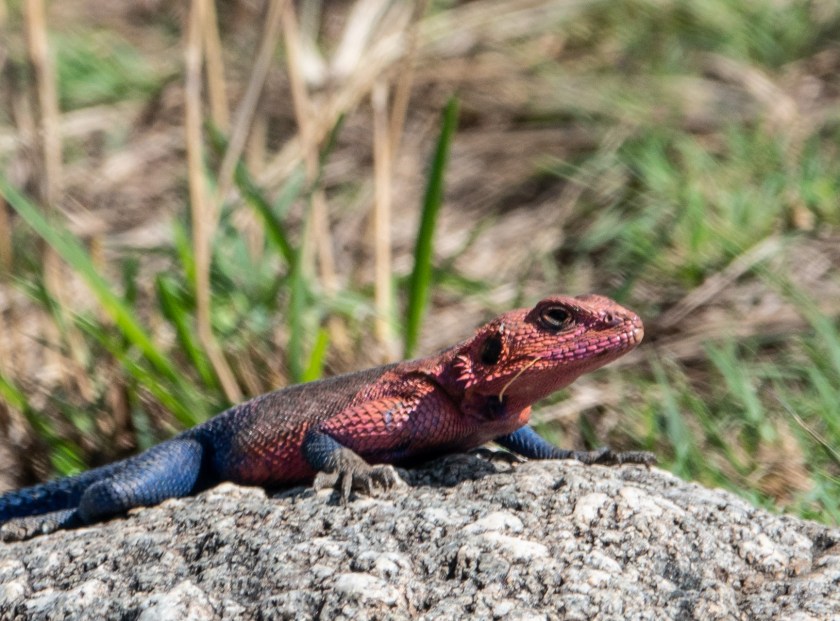
Agamas, or dragon lizards, are a family of lizard species widespread in sub-Saharan Africa. Some have spectacular coloring. The Mwanza Flat-Headed Rock Lizard, Agama mwanzae, has acquired the nickname of the Spider-Man Lizard: one look at this male, and you will see why:
For purposes of comparison his namesake can be seen here:
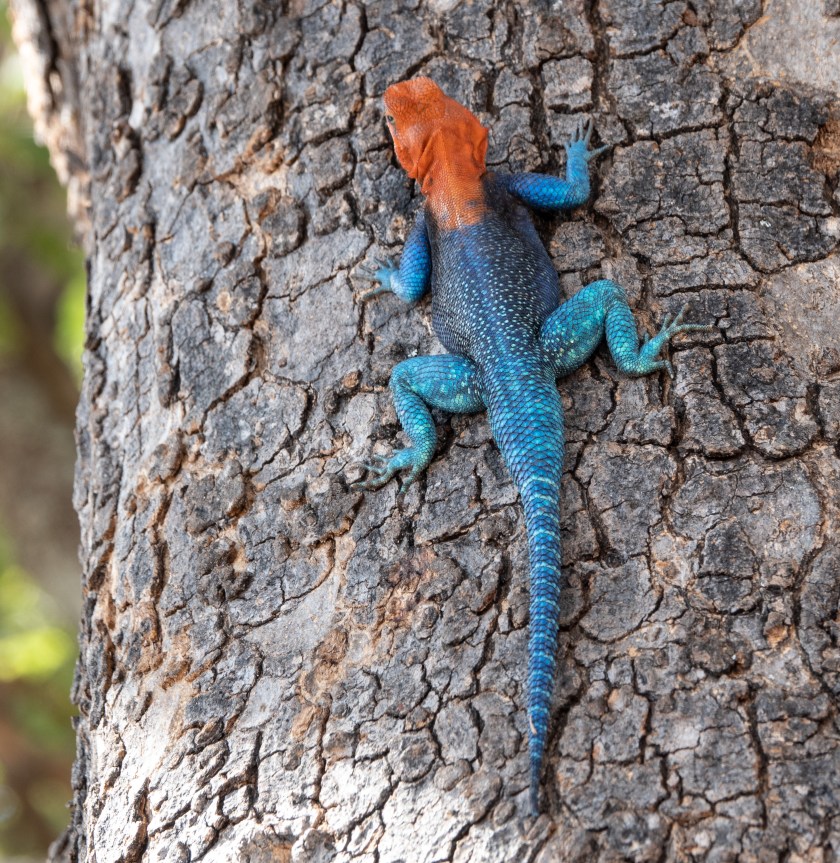
Agamas are insectivorous, and the male is usually the flamboyant one. Here is a male of a different but related species, the Red-headed Rock Agama, Agama agama, who seems to have mistaken this tree for a tall thin rock:
And this is a male blue-headed Southern Rock Agama (Agama atra) , which I saw in Uganda a few years ago. This is their breeding coloration.
In all of these species, the females are rather dull!
The closest relatives of agamas are chameleons, famous for their ability to change color.
[This Thanksgiving, count your blessings: at least you are not a wildebeest.]
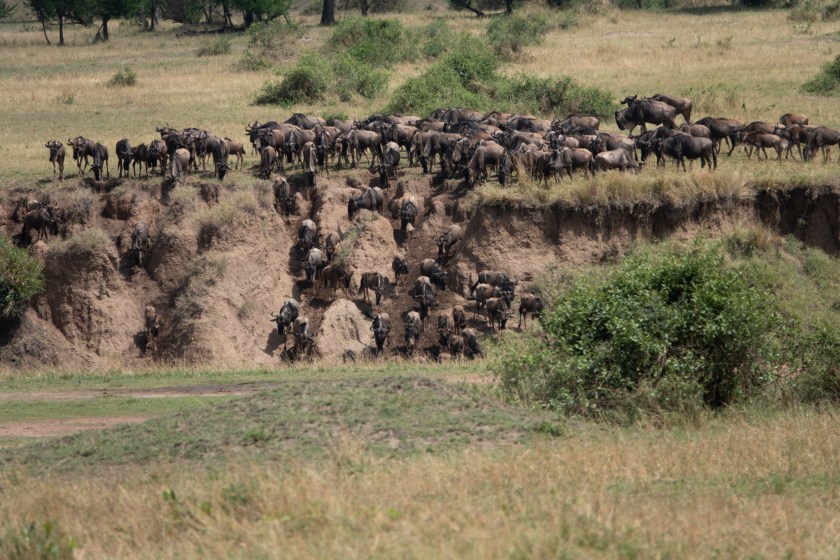
When the herd gets close to the bank, their momentum stalls. They mill around, grazing and pondering, waiting for an alpha female, or the wisdom of crowds, to take matters in hand and lead the way. This can take hours or even days, and sometimes they think better of it and retrace their steps for a day or so.
Eventually, the bravest sets off down the steep bank:
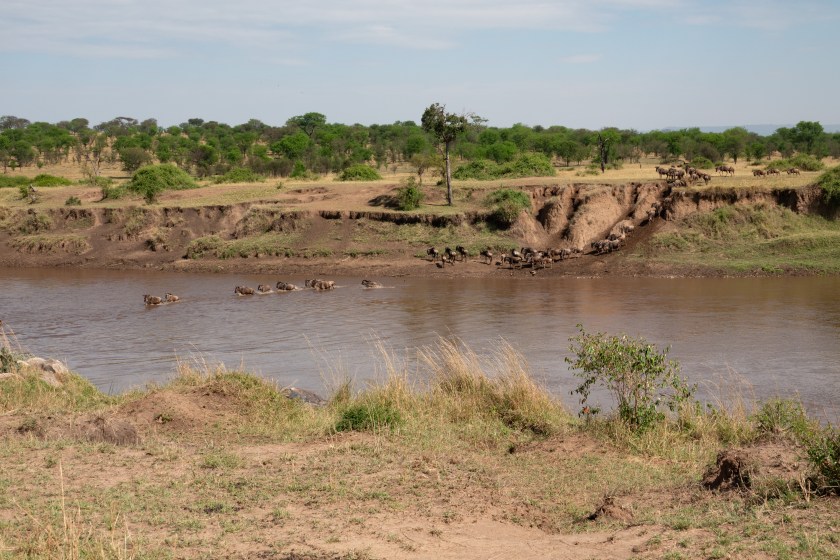
and begins to cross:
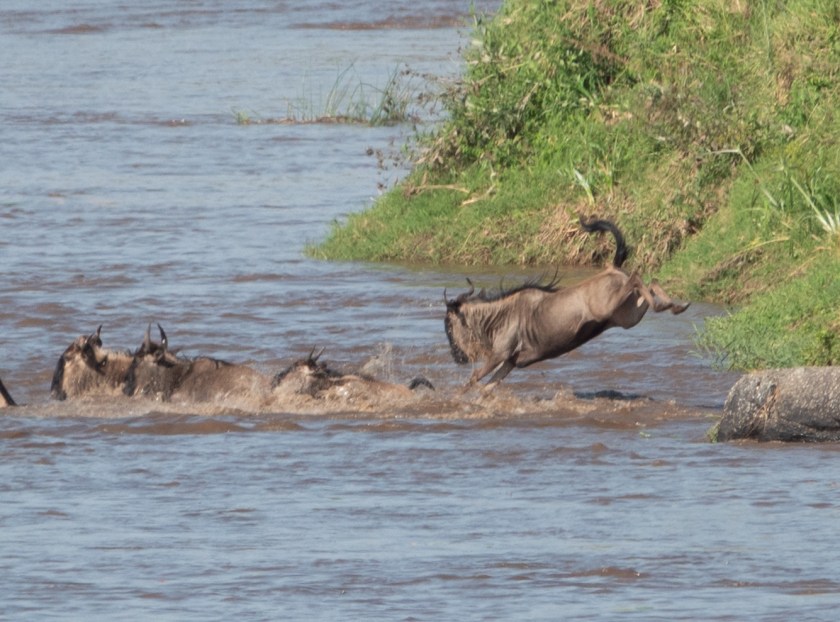
Speed is of the essence, so they launch themselves into the water with panache:
Until there is a milling, splashing traffic jam heading to the farther shore:
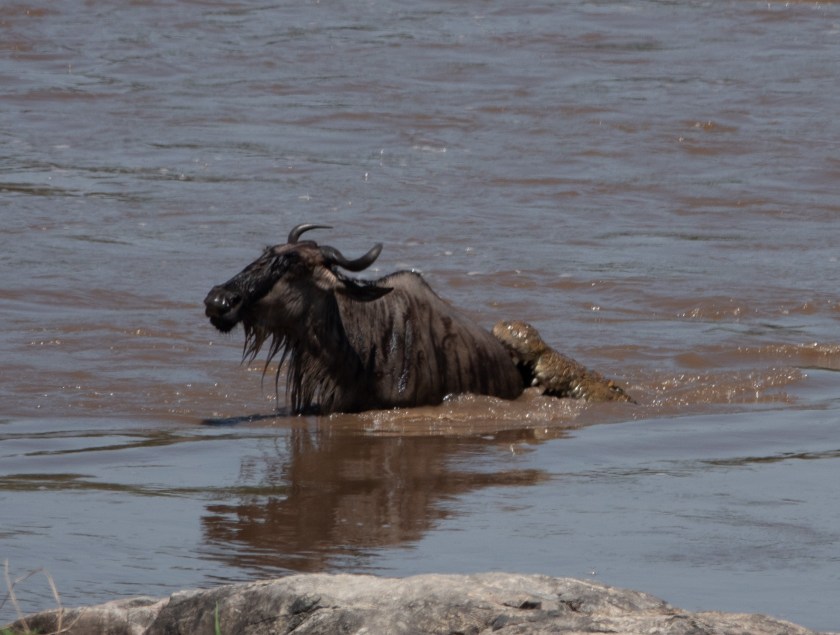
But the sense of urgency has a cause:
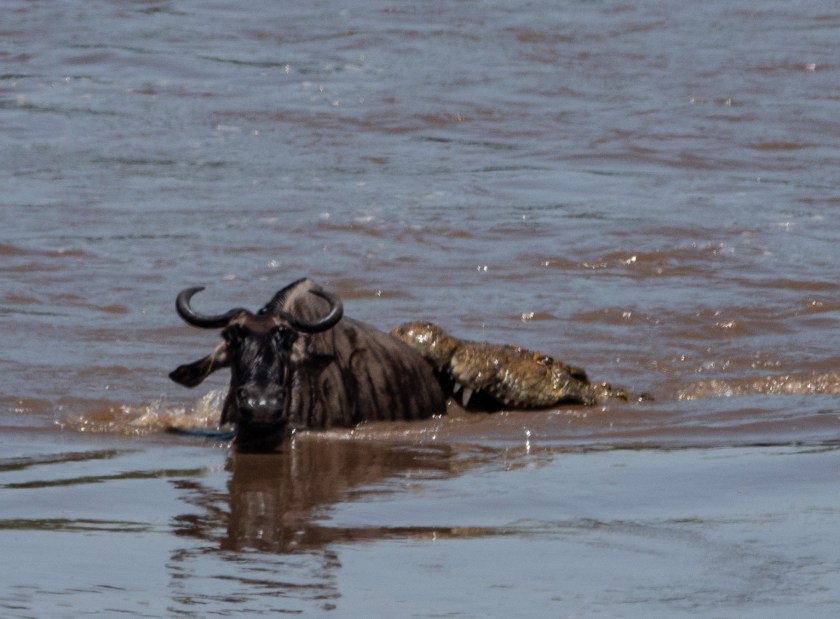
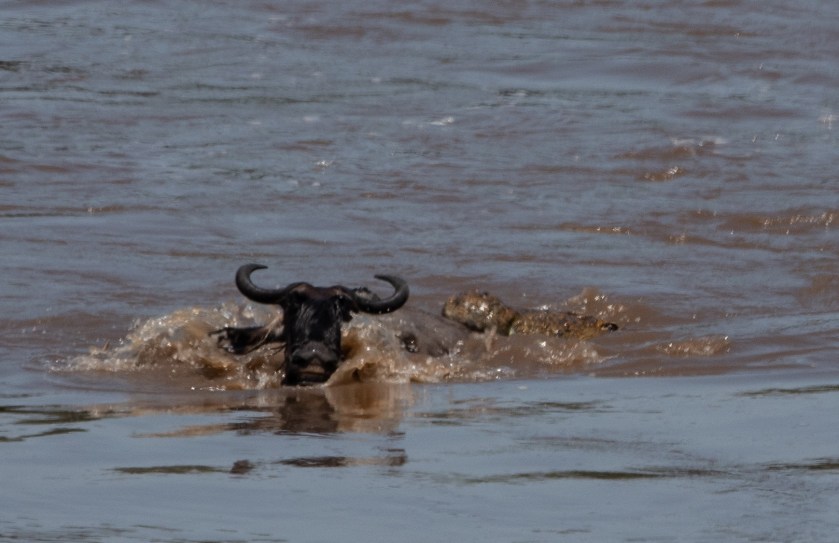
Some find this out the hard way. These three sequential photos show a female being slowly dragged down , while her calf watched from the safety of the destination bank:
Difficult to watch though this is, orphaned calves are usually adopted by the herd, so the calf will probably survive.
The heart-wrenching drama of a wildebeest mother lost to a crocodile is the tip of the iceberg: for every one of these, about fifty simply drown. At the peak of the migration the herds can be so large that they cannot get up the far bank before the next wave pushes in behind them, and mass drownings of 100 or more wildebeest happen several times a year. Click on this interesting article, which explains that even this tragedy has a silver lining: the carcasses both feed scavengers and enrich the waters:
P.S. In September and October, there is good grazing on both sides of the Mara River, and the wildebeest may criss-cross in both directions multiple times. Hard to believe it is worth it.
The Great Migration is one of the Seven Wonders of the Natural World. 1.5 million wildebeest, 500,000 Thompson’s and Grant’s gazelles and 250,000 zebra follow the seasonal rains and fresh grass in a huge circle through Tanzania and Kenya. This map shows where they are month-by-month (though there is huge variation in timing from year to year); we went to the Northern Serengeti in September and October, for reasons that will become clear!
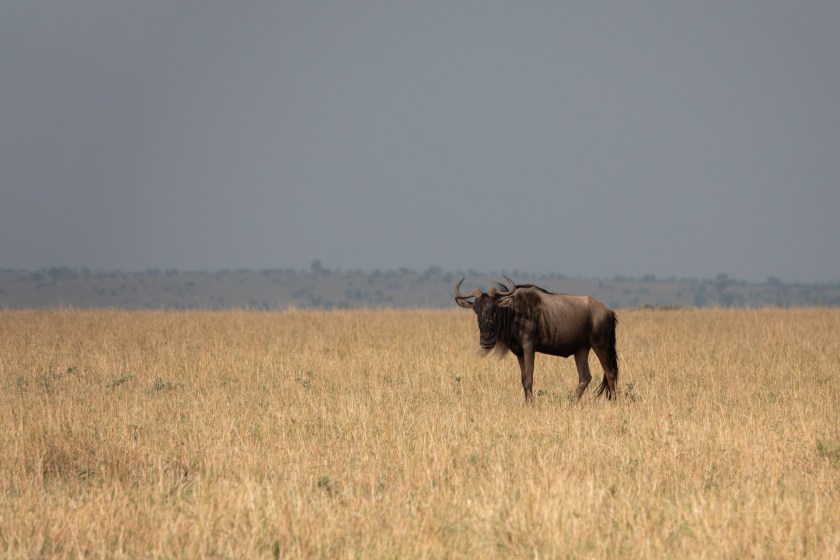
In an earlier post I showed you a herd composed largely of zebra, but the real spectacle are the Blue Wildebeest, Connochaetes taurinus, the largest antelope. At this time of year the herds are composed of adults, with the males weighing as much as 640lbs, with horns up to 33″ long:
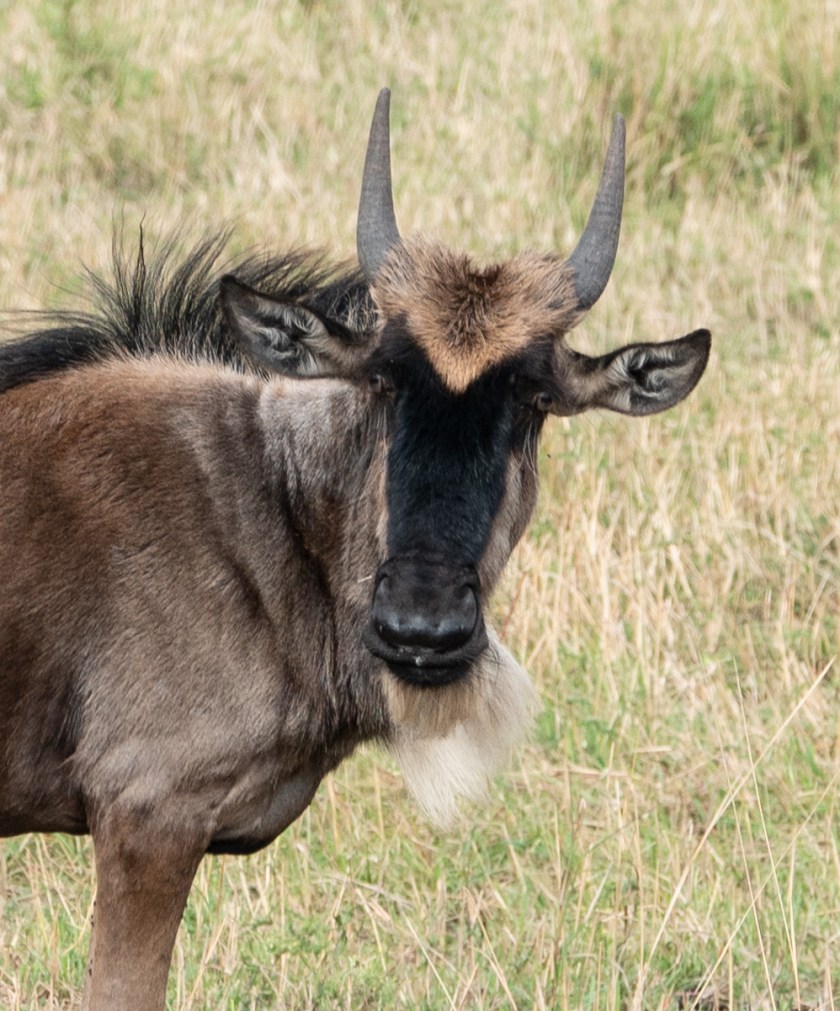
This sub-species is also called the White-bearded Wildebeest, C. t. albojubatus, for obvious reasons: the one below is young, its horns have not yet grown their swooping curves, but its hipster-ish white beard is already present.
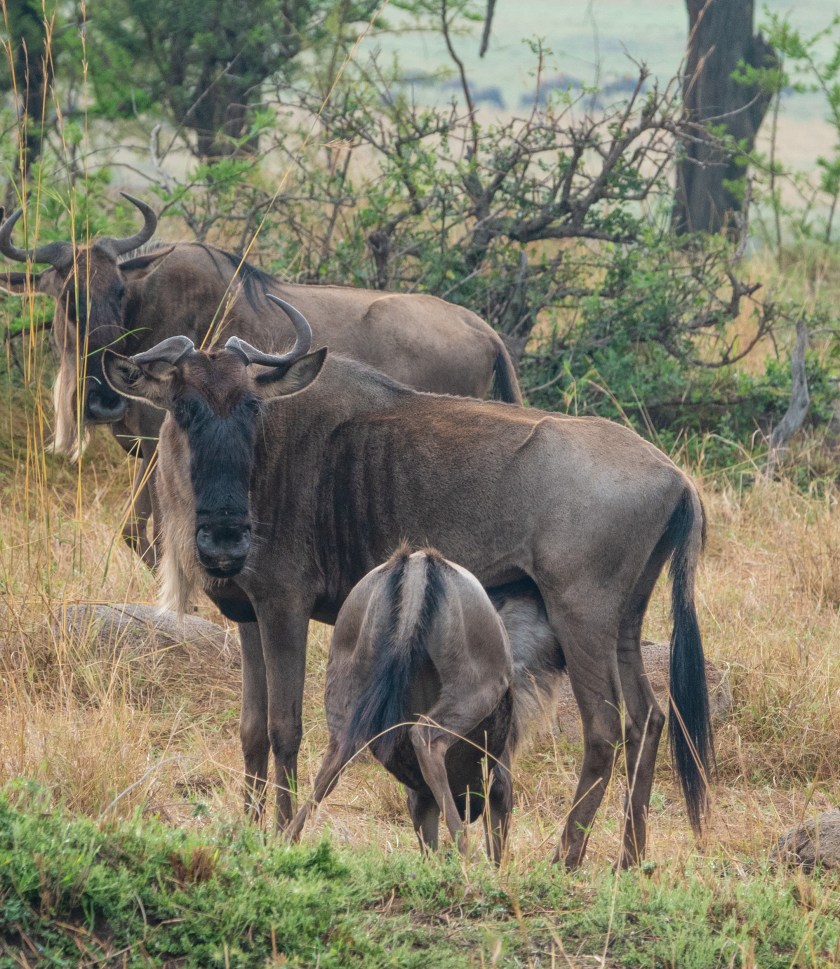
But the herds also include teenagers, some still nursing. They won’t be weaned for 6-9 months.
They pause to graze, searching for phosphorus-rich grasses:
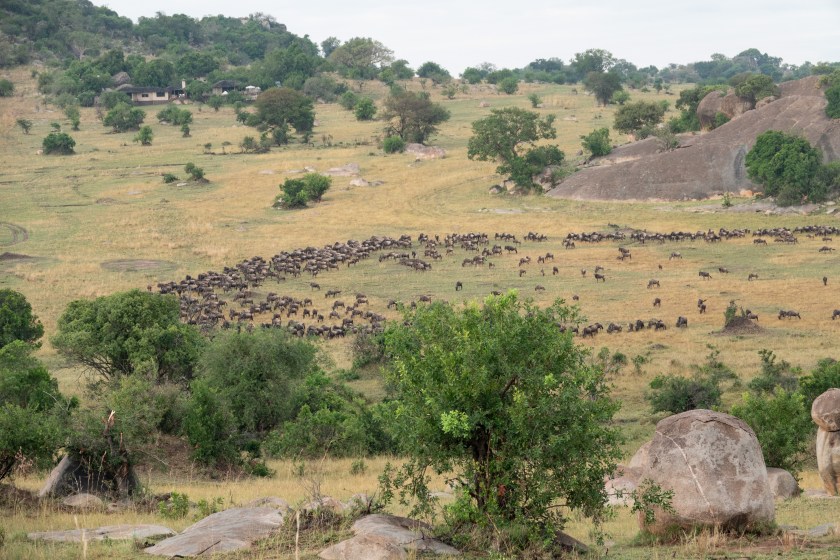
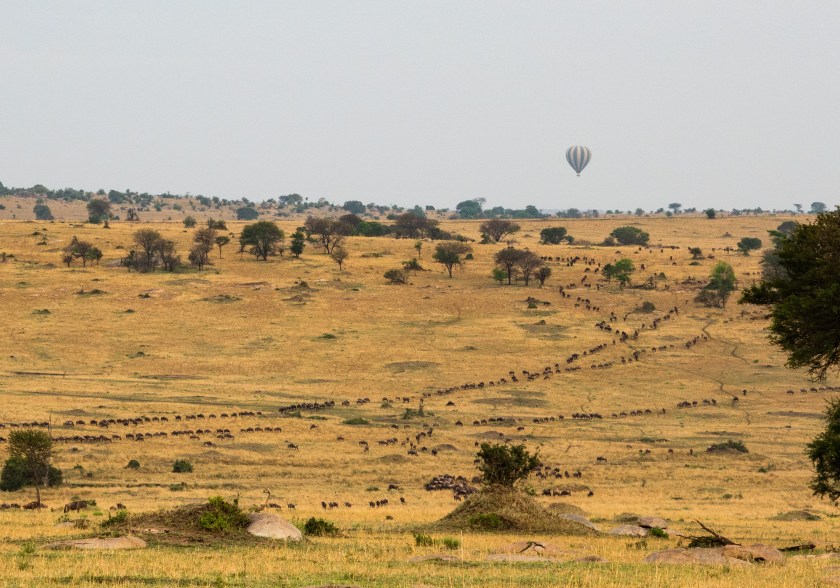
Then they move on, threads of them crossing the landscape like ants:*
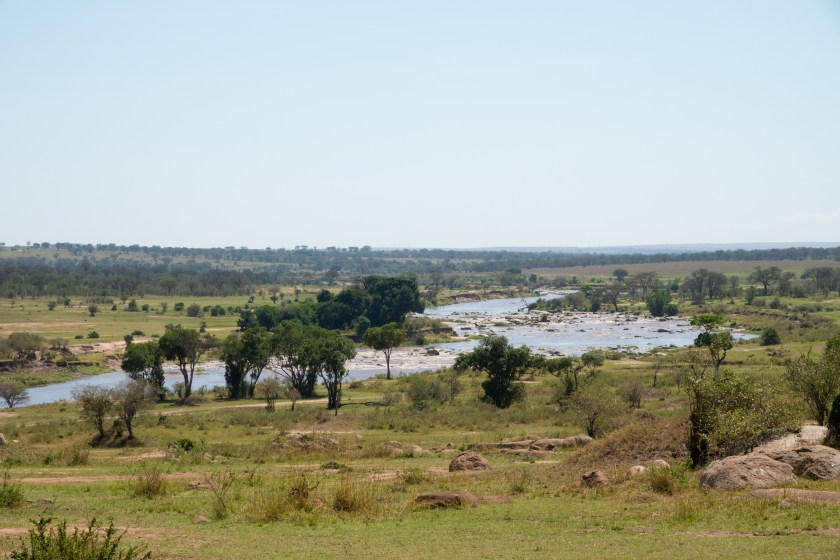
But sometimes their onward surge is blocked by a natural barrier, most famously the Mara River, a deceptively benign looking stretch of water:
Next time, we shall see the challenge that it poses …
* The balloon in the photo looks tempting, but they are controversial because they often violate park regulations by flying too low, so that the noise of their hot air burners disturbs the animals. We passed.
[I’ve decided to let my diary of the Great Migration dribble out in installments, interspersed with other tales. Just to keep the suspense building! So you will have to be patient.]
As you walk through the Serengeti grasslands, you are warned to beware of Safari Ants, Dorylus sp.. called ‘Siafu’ in Swahili. You see a thick strand, like a beaded necklace, stretching across the trail:
On no account should you tread on or near this procession. It is composed of worker ants, of two or more widely different sizes, a phenomenon known as polymorphism. In the center are the small driver ants, and on the edges are the soldier ants, much larger, with fearsome mandible jaws.
They face outwards, on the watch for predators. Their bite is ferociously painful, and they never let go, even if they are torn in half. The Maasai use them as emergency sutures to hold wounds together: give me surgical glue any day! (And how on earth do you apply them to a wound, making sure one half of the jaw is on each side of the incision before they close. Maybe it is a folktale?) A large group of them can immobilize and kill small mammals like rats. And the groups can be unimaginably large, up to 12 million in one colony.
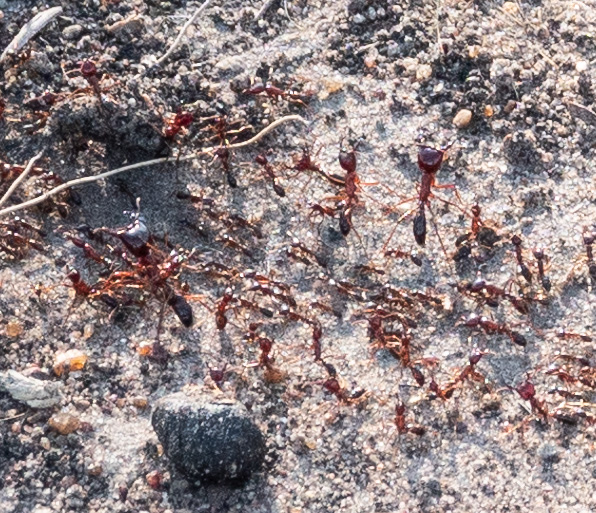
But who do they fear? I watched two Rüppell’s Starlings, Lamprotornis purpuroptera, brave enough to feed on these ants. They stood well back from the formidable myrmidon army, checking out the soldier ants which you can just see in this photo rearing up aggressively:
and then the starling lunged, keeping its feet nervously out of reach:
They were successfully catching ants:
or perhaps their grubs:
But it is hard to get a clear shot of an antsy bird, especially if you don’t want to get too close to those ants …..
P.S. Famously, chimps in West Africa eat army ants by using a long stick to avoid getting bitten. In many cases they do this hanging from a branch above the ants, so their feet never touch the ground!
P.P.S. Everything is scared of safari ants, read this:
The fear is not unfounded. The venom of these ants has a protein component and an alkaloid component. The protein component causes anaphylaxis (an acute allergic reaction), and the alkaloid component causes pain. Systemic (including anaphylaxis) symptoms are more common after multiple bites, and can be fatal (from Chianura and Pozzi 2010, which has a grisly photo of a victim who was attacked while in a drunken stupor).
We were in the Serengeti towards the end of the Great Migration (of which more later), and we drove east towards the Sand River, and the Kenyan border. This charming map was made by Ainslie at Serian Kagatende Camp, where we stayed, and it shows the Sand River on the right.
We reached the river, a serene rivulet, and enjoyed the unpopulated view:
But it was not as empty as it seemed. Can you spot the animal on the far bank, just emerging from the trees? People don’t believe that zebra are well camouflaged, but they are, just look at this next picture if you don’t believe me:
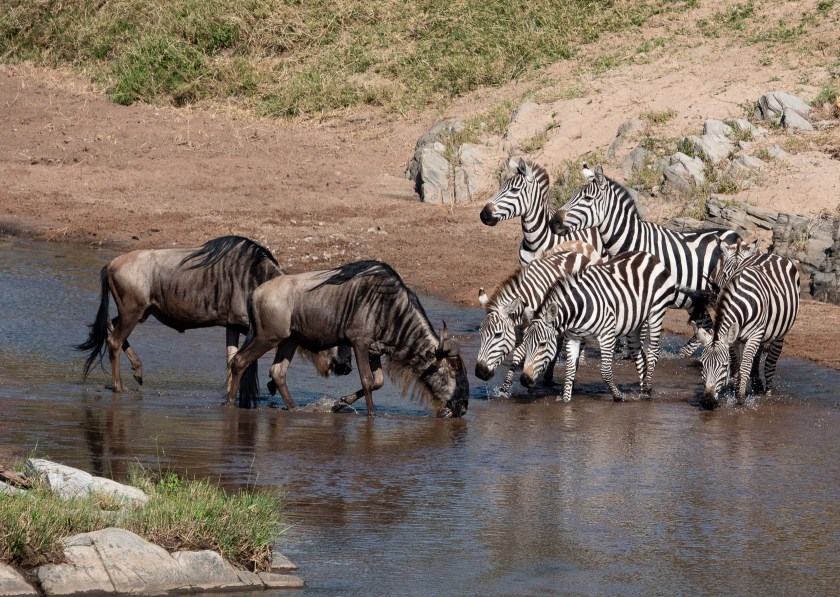
Returning to the Sand River, five minutes later the whole scene was transformed by a huge herd of mixed zebra and wildebeest, crossing from right to left into Tanzania:
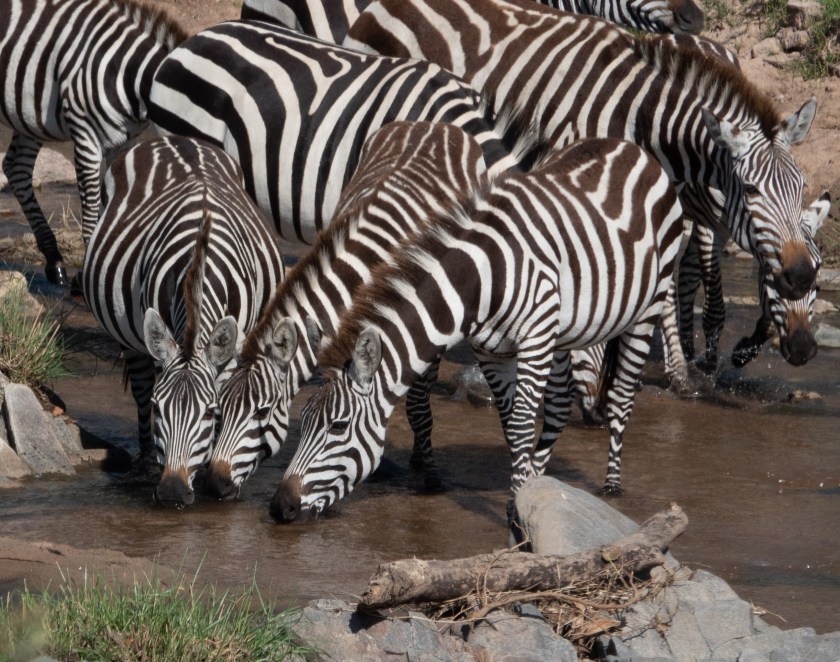
Some paused to drink:
As they crossed, they called to each other. The yelping barking sounds on this video are zebra contact calls, not at all the sounds I would have expected them to make:
The species name Equus quagga is derived from the Khoikhoi word for “zebra” and is based on the sound of its call.
I don’t know how to estimate their numbers, but the entire herd took 20 minutes to cross. The bad news is that they still have to cross the notorious Mara River if they want to go further north. But that is the subject of another post.
* PS My husband deserves credit for the title of this post!
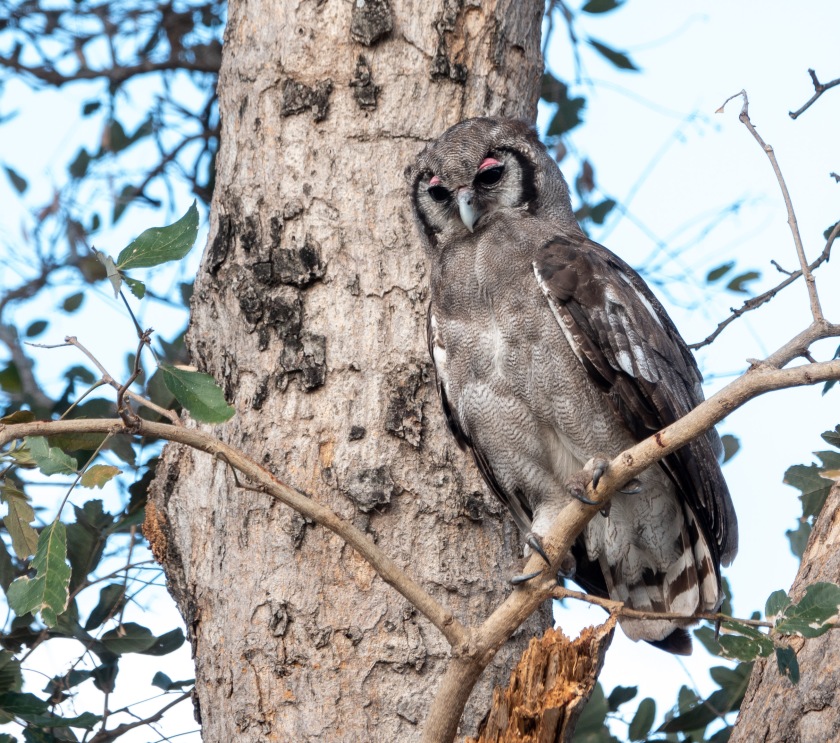
The Verreaux’s Eagle Owl, aka the Giant Eagle Owl, Bubo lacteus, is an imposing bird, measuring 26″ with a wingspan of up to five feet. It is the largest owl in Africa, and the fourth largest in the world.
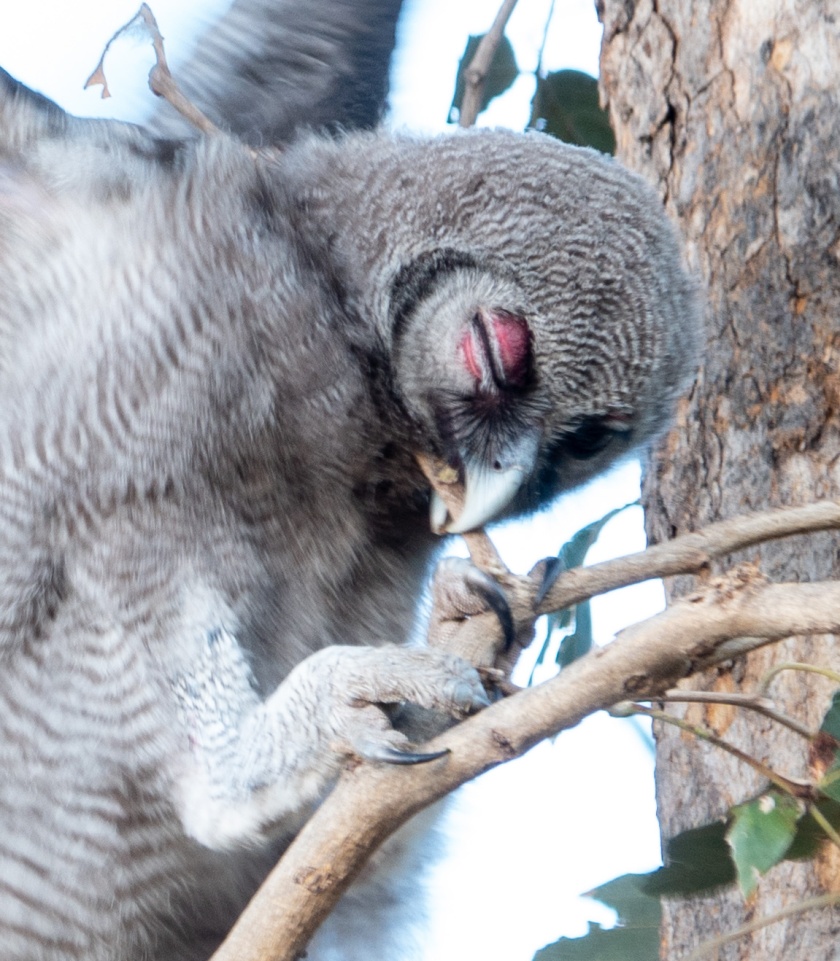
We were lucky enough to come upon two fledglings on the lower branches of a large tree in full view. Here is one of them:
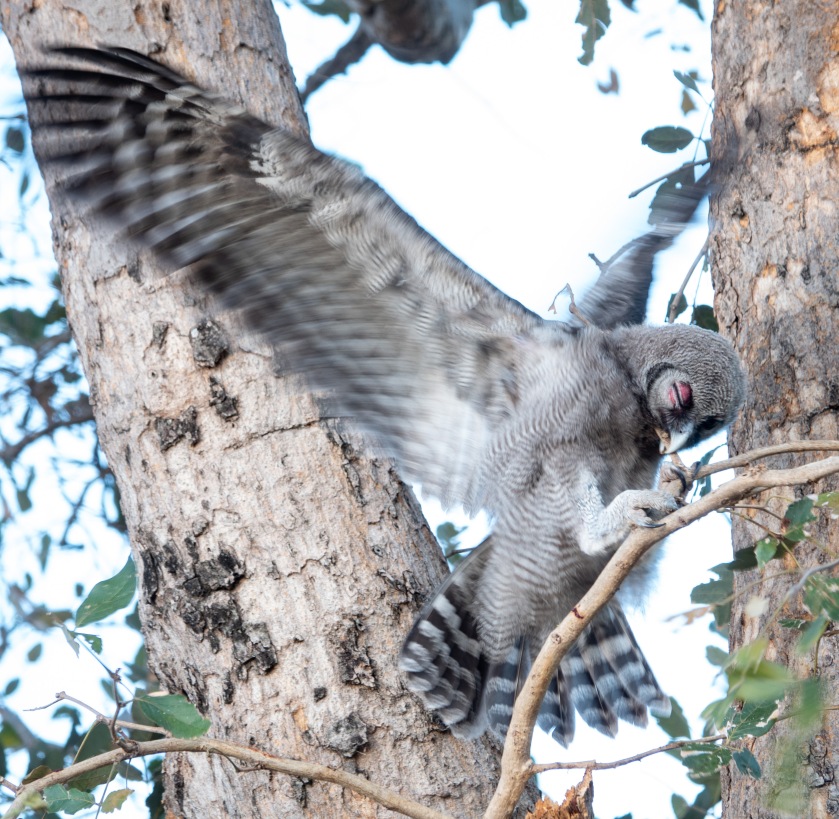
This one was practicing using its beak and its wings:
And you could clearly see the strange pink eyelids*, whose purpose is unknown, but they are brighter in males in the mating season
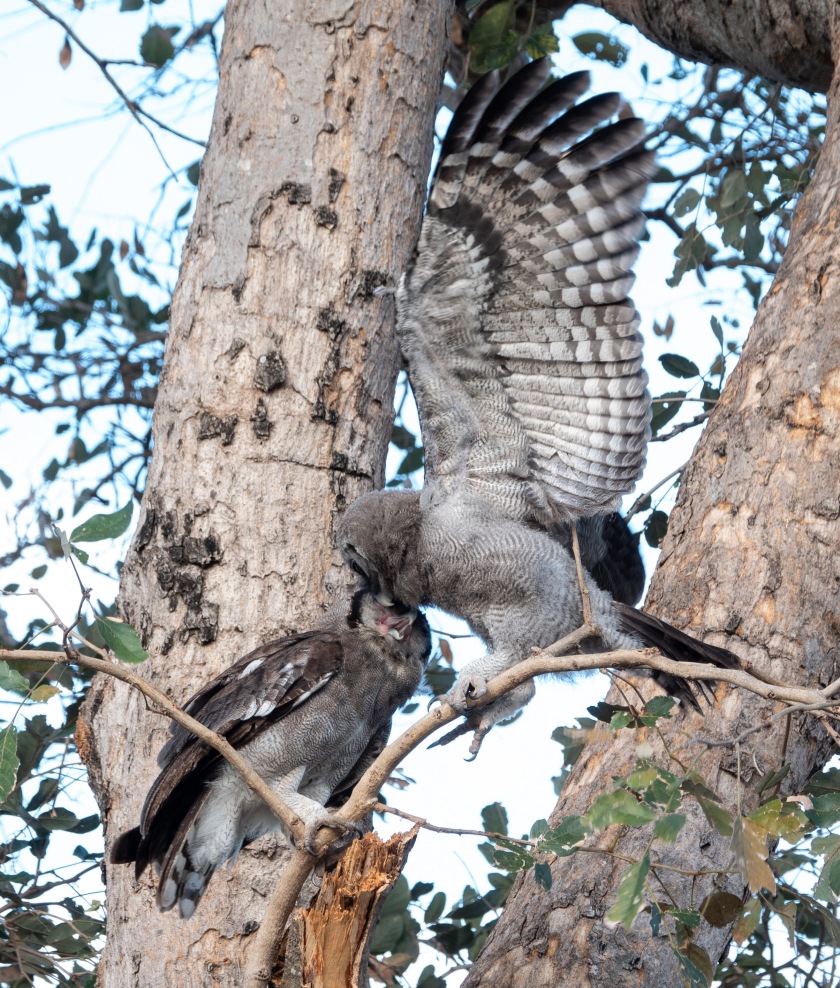
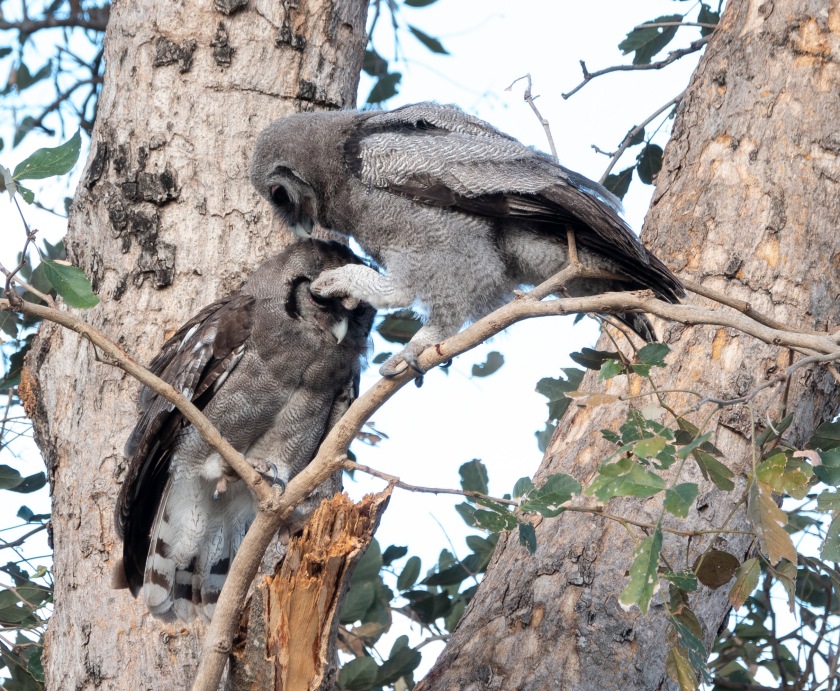
Initially they had claimed a tree each, but then one flew over to join its sibling, and all hell broke loose. It appears that sibling rivalry is alive and well in the Ruaha:
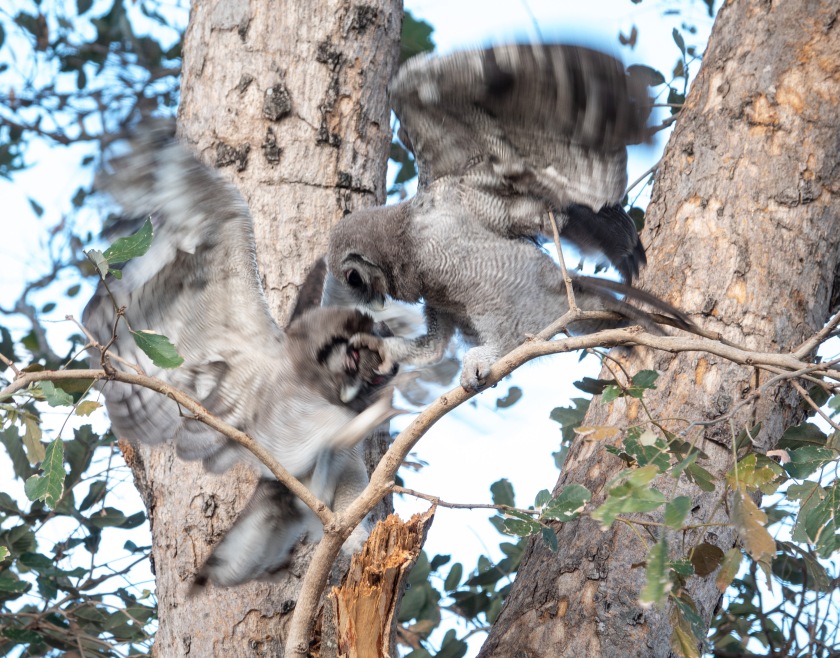
The slightly smaller one on the right, whose wing feathers are still covered by more down than those of the older one on the left, was the aggressor, clawing at the eyes of its sib:
After a ding-dong set-to, the older one gave up and returned to its original tree:
It is quite common for one sibling to kill the other, a phenomenon known as siblicide or (hence my title) Cainism. But usually the older larger chick is the aggressor. Here it seems to be the reverse. The aggression can continue at least till all the adult plumage has grown in.
Verreaux’s Eagle Owls leave the nest at about 7 weeks old, and take another 2 – 4 weeks to learn to fly, so these were probably around 10 weeks old. The mother was in a third tree nearby. They do not start to hunt for themselves till around five months, but as adults they are apex predators, eating a huge variety of mammals, birds and reptiles. One favourite is the hedgehog, and they are the only predator that routinely tackles this prickly delicacy. They swoop in, with their talons going for the spineless face. Watch this one dining like the Romans:
The eagle owl has an extraordinary call, the deepest of any owl species. This is a male, (recorded by Frank Bruneliere, in Namibia, courtesy of Xenocanto):
The call can carry up to 3 miles, and you might easily confuse it with a leopard.
—————————–
* Rihanna may be channelling her inner eagle owl with these pink eyelids:
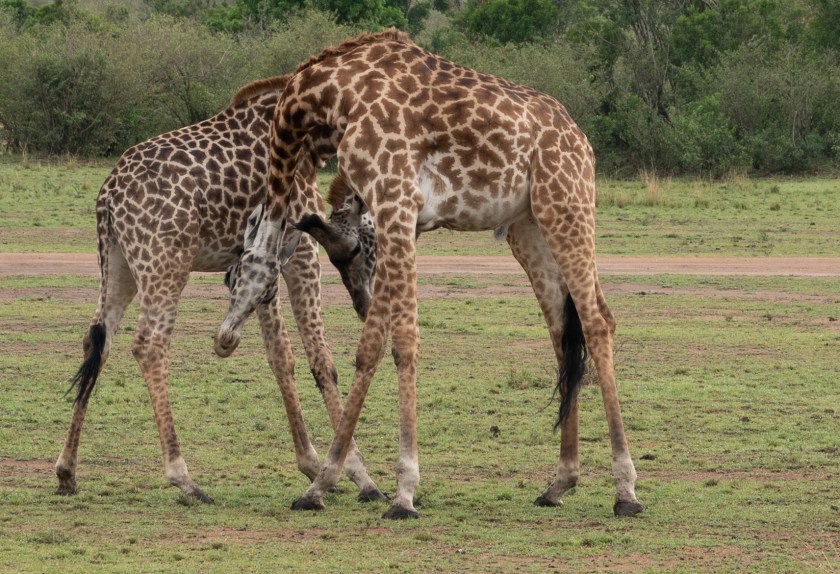
In the world of the giraffe, all is not sweetness and light. Males fight for dominance in extraordinary neck fights. I have never seen this before, and it looked more like sort of a tai ch’i slow motion dance than a fight to the death, but our guide assured us this was the real thing.
I still suspect it was two youngsters sparring to get in a little practice, and when it was over they wandered off in opposite directions none the worse for wear. Serious battles can leave the loser knocked out or even dead. This 4-minute video is well worth watching for its explanations of the physiology, as well as a couple of truly violent fights.
My two seemed pretty friendly by comparison!
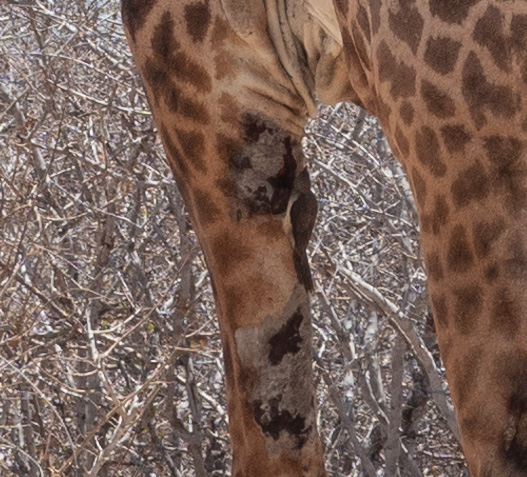
Less dramatic, but still not good for quality of life, is Giraffe Skin Disease. It causes skin lesions on the backs of the legs, but it doesn’t seem to kill the giraffes. The cause is unknown, but it is more prevalent in areas with poor soil, and less acacia, like the Ruaha.
One encouraging development for the survival of the giraffe is a reconsideration of how many species of giraffe scientists should distinguish. This matters, because conservation laws and policies often operate at the species level , and currently all giraffe are lumped together in one species , as Vulnerable, but not yet Endangered, affording them less protection.
A study by Hennessy et al in Current Biologyin 2016 proposes on the basis of DNA data that the giraffe is not a single species, but four distinct species – the northern giraffe (Giraffa camelopardalis), southern giraffe (Giraffa giraffa), reticulated giraffe (Giraffa reticulata) and Masai giraffe (Giraffa tippelskirchi). If this proposal results in a new classification, conversation efforts will be strengthened.
An African ecosystem bereft of giraffes would be a terrible thing: imagine a world in which children no longer knew what a giraffe was, and you couldn’t sing Raffi’s wonderful Joshua Giraffe to them. (There is a link to the song below, but I am not totally sure posting it is OK (though I did buy the song), or whether it violates copyright. I suspect many of you can hear it inside your heads anyway as the result of hours of long car journeys with small children in the back seat.)
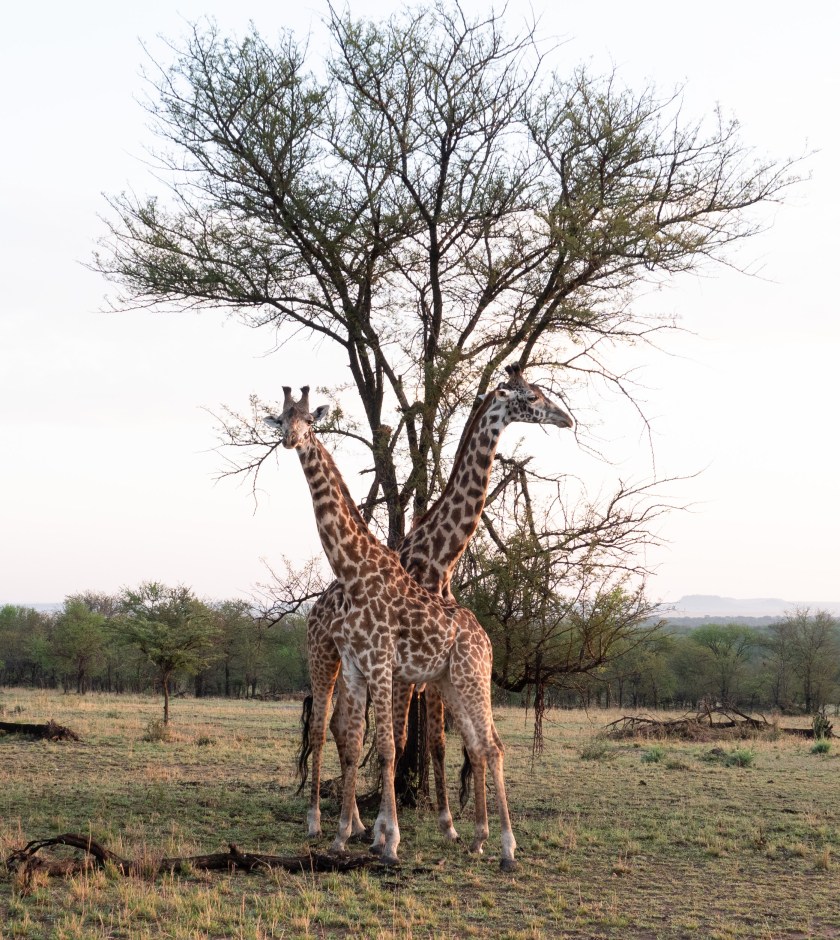
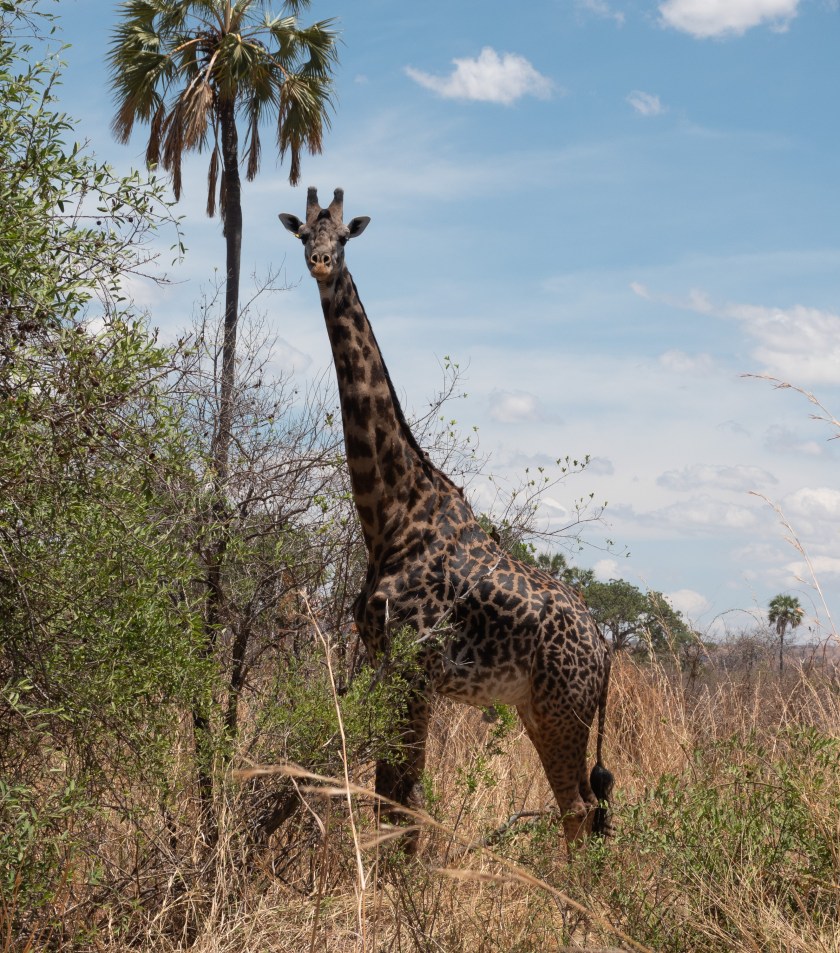
Giraffes are the endangered animal that no-one knows about. There are now fewer giraffes (70,000) than elephants (400,000) in Africa. Across all nine sub-species, giraffes are considered Vulnerable, but three sub-species are Endangered, including Tanzania’s only sub-species, the Maasai giraffe, Giraffa camelopardalis tippelskirchi. It is the largest of all giraffes, with males growing up to 19 feet tall, and weighing up to 4,275 lbs. In July this year the IUCN categorized it as endangered, because although there are 35,000 or so remaining, the population is down 50% in the last 30 years. They are poached, and land use changes have impacted their habitats.
Look at its size compared to this impala:
Its colouration is very varied, and the markings vary from individual to individual, reminding me of paper cutouts by Matisse.
giraffe
Maasai giraffe
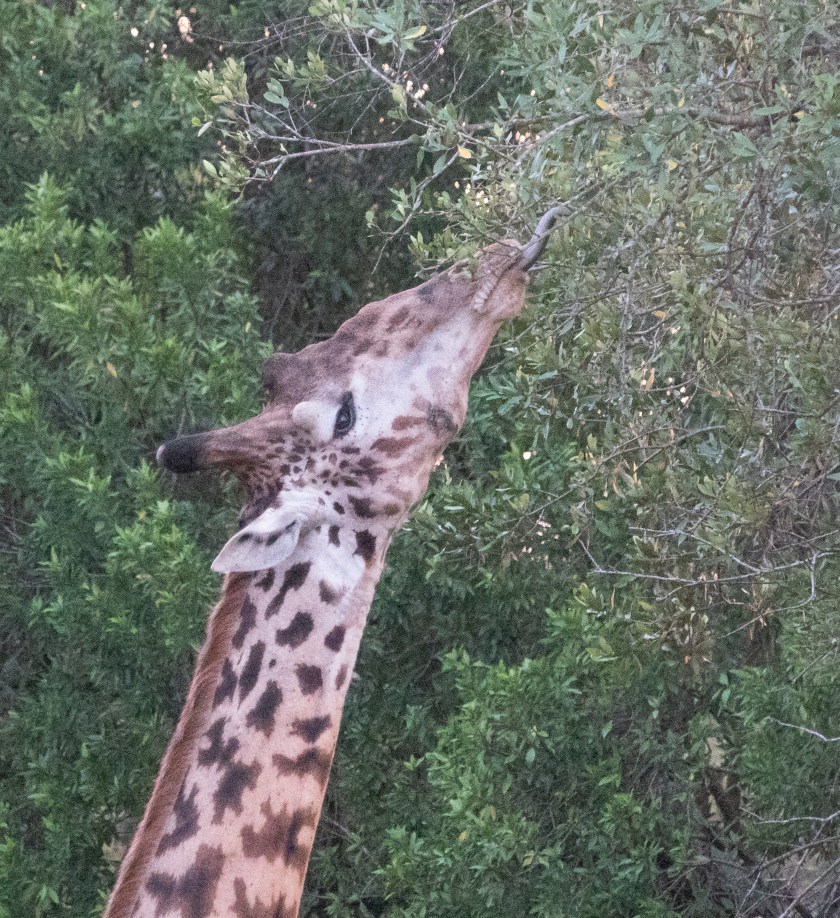
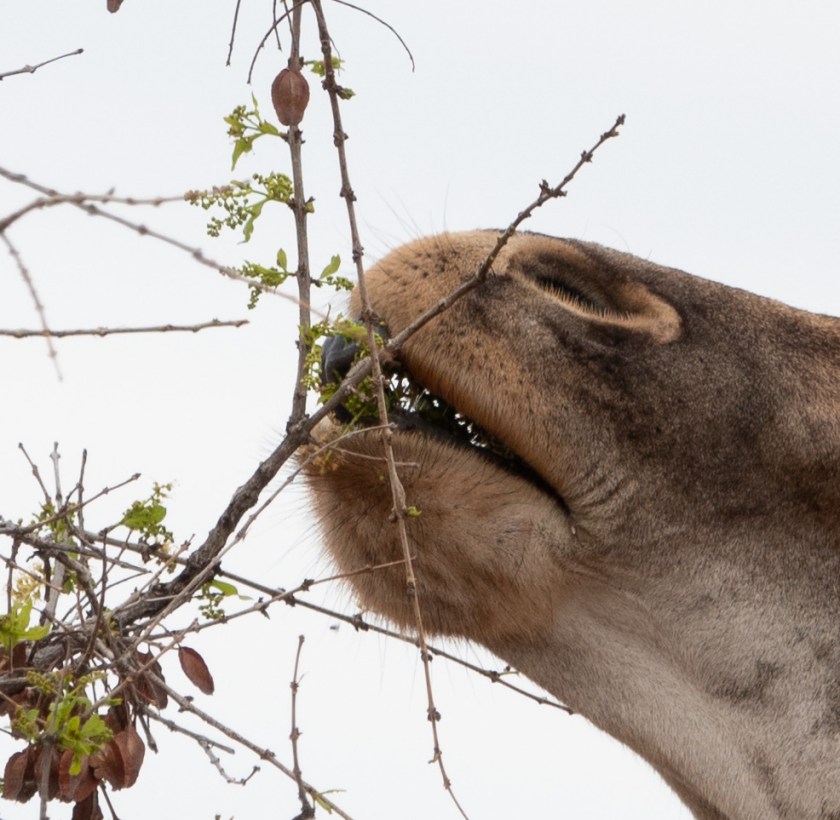
They have tongues up to 18″ long, and together with their prehensile lips they delicately deploy these to strip tiny leaves from thorny branches.
Not surprisingly, they have to eat about 16 hours a day to sustain those huge bodies.


















 Eyes on the Wild